Centre of Excellence in Biological Interactions, Department of Biological and Environmental Science, University of Jyväskylä, P.O. Box 35, FI-40014, Jyväskylä, Finland.
BMC Evol Biol. 2019 Feb 1;19(1):42. doi: 10.1186/s12862-019-1348-9.
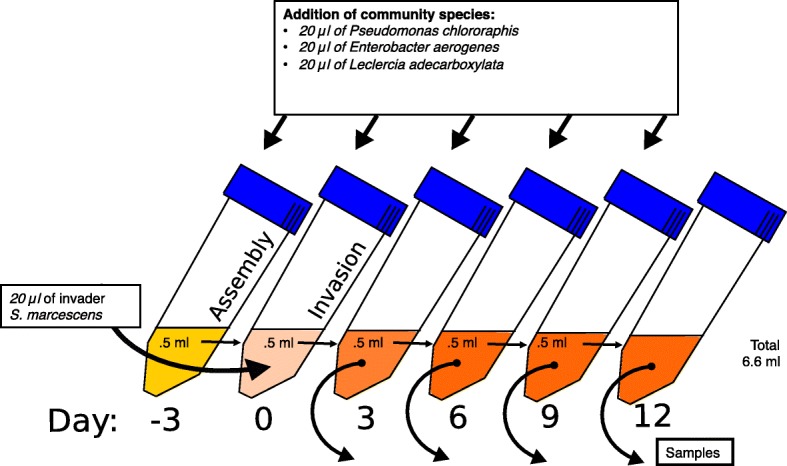
It has been suggested that climate change will lead to increased environmental fluctuations, which will undoubtedly have evolutionary consequences for all biota. For instance, fluctuations can directly increase the risk of invasions of alien species into new areas, as these species have repeatedly been proposed to benefit from disturbances. At the same time increased environmental fluctuations may also select for better invaders. However, selection by fluctuations may also influence the resistance of communities to invasions, which has rarely been tested. We tested eco-evolutionary dynamics of invasion with bacterial clones, evolved either in constant or fluctuating temperatures, and conducted experimental invasions in both conditions.
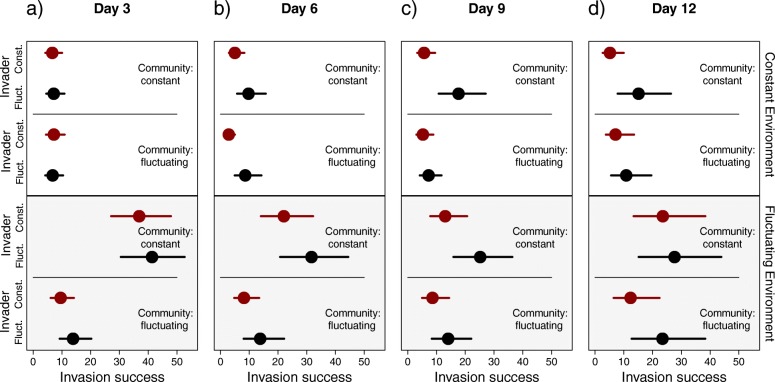
We found clear evidence that ecological fluctuations, as well as adaptation to fluctuations by both the invader and community, all affected invasions, but played different roles at different stages of invasion. Ecological fluctuations clearly promoted invasions, especially into fluctuation mal-adapted communities. The evolutionary background of the invader played a smaller role.
Our results indicate that climate change associated disturbances can directly increase the risk of invasions by altering ecological conditions during invasions, as well as via the evolution of both the invader and communities. Our experiment provides novel information on the complex consequences of climate change on invasions in general, and also charts risk factors associated with the spread of environmentally growing opportunistic pathogens.
有人认为气候变化将导致环境波动增加,这无疑将对所有生物群产生进化后果。例如,波动可以直接增加外来物种入侵新地区的风险,因为这些物种一再被认为受益于干扰。同时,环境波动的增加也可能选择更好的入侵者。然而,波动的选择也可能影响群落对入侵的抵抗力,这很少被测试过。我们用细菌克隆进行了生态进化动力学的入侵测试,这些克隆在恒定或波动的温度下进化,并在这两种条件下进行了实验性入侵。
我们清楚地发现,生态波动,以及入侵者和群落对波动的适应,都影响了入侵,但在入侵的不同阶段起着不同的作用。生态波动明显促进了入侵,特别是在波动不适应的群落中。入侵者的进化背景作用较小。
我们的研究结果表明,与气候变化相关的干扰可以通过改变入侵期间的生态条件,以及通过入侵者和群落的进化,直接增加入侵的风险。我们的实验提供了关于气候变化对入侵的复杂影响的新信息,也为与环境相关的机会性病原体的传播有关的风险因素提供了线索。