Department of Internal Medicine and Medical Specialties, Sapienza University of Rome, 00161, Rome, Italy.
Department of Pediatrics, Sapienza University of Rome, 00161, Rome, Italy.
Pediatr Res. 2019 Apr;85(5):671-677. doi: 10.1038/s41390-019-0303-1. Epub 2019 Jan 23.
To comprehensively explore metabolic and genetic contributors to liver fat accumulation in overweight/obese children.
Two hundred thirty Italian children with obesity were investigated for metabolic parameters and genotyped for PNPLA3, TM6SF2, GCKR, and MBOAT7 gene variants. Percentage hepatic fat content (HFF%) was measured by nuclear magnetic resonance.
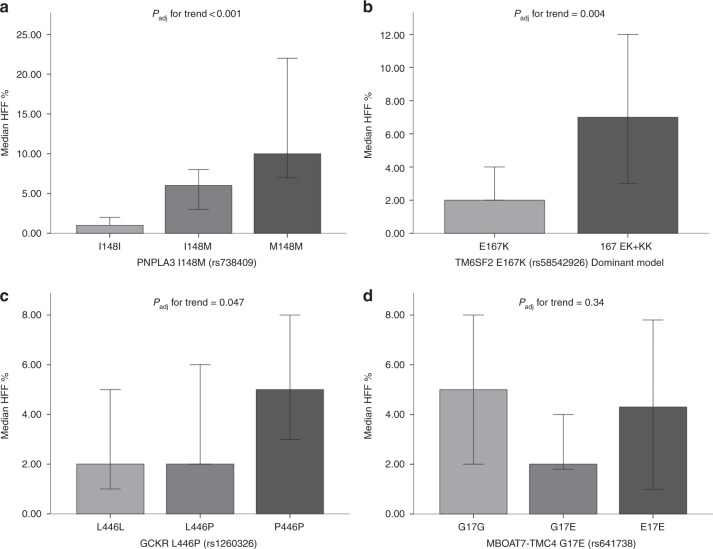
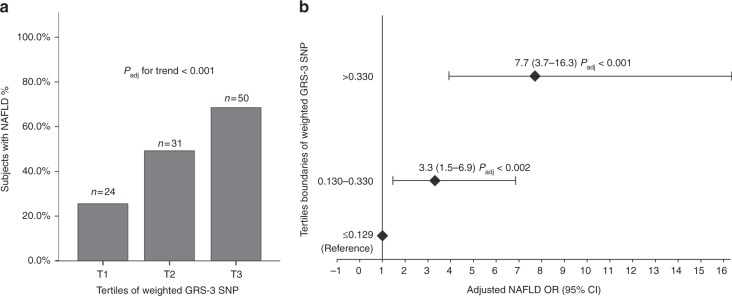
HFF% was positively related with BMI, HOMA, metabolic syndrome, ALT, AST, γGT, and albumin. Carriers of [G] allele in PNPLA3, [T] allele in GCKR and [T] allele in TM6SF2 genes had significantly higher hepatic fat content than wild-type carriers. HFF% was explained for 8.7% by metabolic and for 16.1% by genetic factors and, a model including age, gender, BMI, HOMA, PNPLA3, GCKR, and TM6SF2 variants was the best predictor of HFF%, explaining 24.8% of its variation (P < 0.001). A weighted-genetic risk score combining PNPLA3, GCKR, and TM6SF2 risk alleles was associated with almost eightfold higher risk of NAFLD.
Our data highlighted the predominant role of genetic factors in determining the amount of liver fat content in children with obesity.
全面探讨超重/肥胖儿童肝脂肪堆积的代谢和遗传因素。
对 230 名意大利肥胖儿童进行代谢参数调查,并对 PNPLA3、TM6SF2、GCKR 和 MBOAT7 基因变异进行基因分型。采用磁共振技术测量肝脂肪含量百分比(HFF%)。
HFF%与 BMI、HOMA、代谢综合征、ALT、AST、γGT 和白蛋白呈正相关。PNPLA3 基因的[G]等位基因、GCKR 基因的[T]等位基因和 TM6SF2 基因的[T]等位基因携带者的肝脂肪含量明显高于野生型携带者。代谢因素可解释 HFF%的 8.7%,遗传因素可解释 16.1%,包括年龄、性别、BMI、HOMA、PNPLA3、GCKR 和 TM6SF2 变异在内的模型是 HFF%的最佳预测因子,可解释其变异的 24.8%(P<0.001)。结合 PNPLA3、GCKR 和 TM6SF2 风险等位基因的加权遗传风险评分与非酒精性脂肪性肝病的风险增加近 8 倍相关。
我们的数据强调了遗传因素在决定肥胖儿童肝脂肪含量方面的主要作用。