Lin Yu-Cheng, Wu Chi-Chien, Ni Yen-Hsuan
Department of Pediatrics, Far Eastern Memorial Hospital, New Taipei City, Taiwan.
Department of Healthcare Administration, Oriental Institute of Technology, New Taipei City, Taiwan.
Front Pediatr. 2020 Dec 9;8:603654. doi: 10.3389/fped.2020.603654. eCollection 2020.
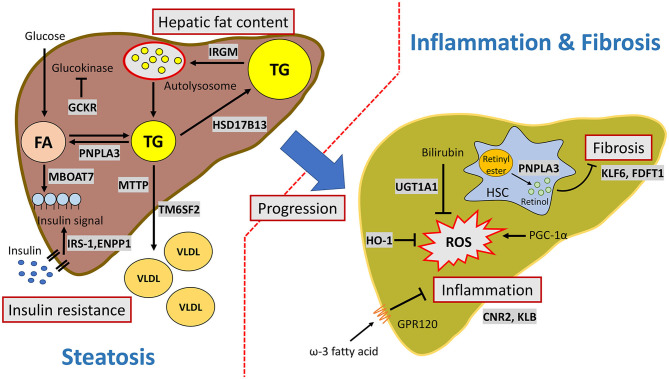
Non-alcoholic or recently re-defined metabolic associated fatty liver disease (MAFLD), a spectrum of progressive hepatic disease, has become a public health issue in obese children and adolescents. MAFLD is a complex metabolic disease strongly associated with obesity and insulin resistance. It is not known why not every obese subject will develop MAFLD. Different ethnic/racial groups display differences in MAFLD prevalence, indicating genetic factor plays a role. In the past two decades, sequence variations in genetic loci, including , etc. have been shown to confer susceptibility to MAFLD in children and adults. This review article provides an updated viewpoint of genetic predictors related to pediatric MAFLD. We discuss whether these susceptible genes can be clinically used for risk stratification and personalized care. Understanding human genetics and molecular mechanisms can give important information not only for prediction of risk but also on how to design drugs. In view of current epidemic of MAFLD worldwide, it is necessary to identify which children with MAFLD progress rapidly and need earlier intervention. In the future, a comprehensive analysis of individualized genetic and environmental factors may help assess the risk of children with MAFLD and personalize their treatment.
非酒精性或最近重新定义的代谢相关脂肪性肝病(MAFLD)是一种进行性肝病谱,已成为肥胖儿童和青少年中的一个公共卫生问题。MAFLD是一种与肥胖和胰岛素抵抗密切相关的复杂代谢性疾病。尚不清楚为何并非每个肥胖个体都会发展为MAFLD。不同种族/民族群体在MAFLD患病率上存在差异,这表明遗传因素起了作用。在过去二十年中,包括……等在内的基因座序列变异已被证明会使儿童和成人易患MAFLD。这篇综述文章提供了与儿童MAFLD相关的遗传预测因子的最新观点。我们讨论了这些易感基因是否可在临床上用于风险分层和个性化护理。了解人类遗传学和分子机制不仅可以为风险预测提供重要信息,还能为药物设计提供信息。鉴于目前MAFLD在全球范围内的流行情况,有必要确定哪些患有MAFLD的儿童进展迅速并需要更早的干预。未来,对个体遗传和环境因素的综合分析可能有助于评估患有MAFLD的儿童的风险并使其治疗个性化。