Quek Sabrina Xin Zi, Tan Eunice Xiang-Xuan, Ren Yi Ping, Muthiah Mark, Loo Evelyn Xiu Ling, Tham Elizabeth Huiwen, Siah Kewin Tien Ho
Division of Gastroenterology and Hepatology, Department of Medicine, National University Hospital, Singapore 119228, Singapore.
Department of Medicine, National University Hospital, Singapore 119228, Singapore.
World J Hepatol. 2022 Jun 27;14(6):1235-1247. doi: 10.4254/wjh.v14.i6.1235.
The rise in prevalence of non-alcoholic fatty liver disease (NAFLD) mirrors the obesity epidemic. NAFLD is insidious but may gradually progress from simple steatosis to steatohepatitis, fibrosis and cirrhosis and/or hepatocellular carcinoma. Intervention strategies to ameliorate developmental programming of NAFLD may be more efficacious during critical windows of developmental plasticity.
To review the early developmental factors associated with NAFLD.
Databases MEDLINE PubMed, and EMBASE and Reference Citation Analysis were searched and relevant publications up to April 30, 2021 were assessed. Original research studies that included risk factors associated with early development of NAFLD in human subjects were included. These factors include: Maternal factors, intrauterine and prenatal factors, post-natal factors, genetic and ethnic predisposition, childhood and adolescence environmental factors. Studies were excluded if they were review articles or animal studies, case reports or conference abstracts, or if NAFLD was not clearly defined and assessed radiologically.
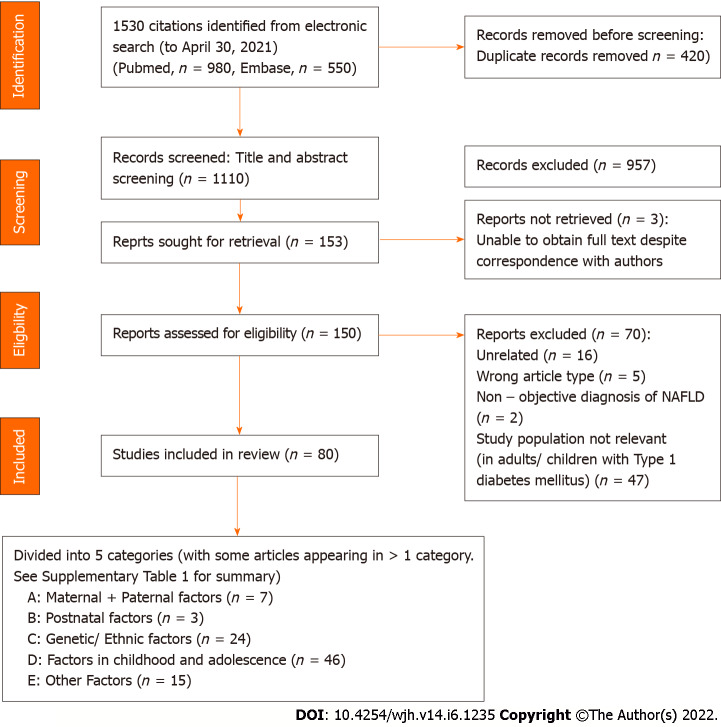
Of 1530 citations identified by electronic search, 420 duplicates were removed. Of the 1110 citations screened from title and abstract, 80 articles were included in the final analysis. Genetic polymorphisms such as patatin-like phospholipase domain-containing protein 3 (PNPLA3) and membrane-bound O-acyltransferase domain-containing protein 7 (MBOAT7) were associated with increased risk of NAFLD. Familial factors such as maternal obesogenic environment and parental history of hepatic steatosis was associated with offspring NAFLD. Longer duration of exclusive breastfeeding in infancy was associated with a lower risk of developing NAFLD later in life while metabolic dysfunction and/or obesity in adolescence was associated with increased risk of NAFLD. Studies relating to socioeconomic factors and its association with NAFLD reported confounding results.
Maternal metabolic dysfunction during pregnancy, being exclusively breastfed for a longer time postnatally, diet and physical activity in childhood and adolescence are potential areas of intervention to decrease risk of NAFLD.
非酒精性脂肪性肝病(NAFLD)患病率的上升与肥胖流行情况相似。NAFLD具有隐匿性,但可能会从单纯性脂肪变性逐渐发展为脂肪性肝炎、纤维化、肝硬化和/或肝细胞癌。在发育可塑性的关键窗口期,改善NAFLD发育编程的干预策略可能更有效。
综述与NAFLD相关的早期发育因素。
检索MEDLINE、PubMed和EMBASE数据库以及参考文献引用分析,并评估截至2021年4月30日的相关出版物。纳入了包括人类受试者中与NAFLD早期发展相关危险因素的原创性研究。这些因素包括:母亲因素、宫内和产前因素、产后因素、遗传和种族易感性、儿童和青少年环境因素。如果是综述文章、动物研究、病例报告或会议摘要,或者NAFLD未明确界定且未通过放射学评估,则排除这些研究。
通过电子检索识别出1530条引文,去除了420条重复项。从标题和摘要中筛选出的1110条引文中,80篇文章纳入最终分析。遗传多态性,如含帕他汀样磷脂酶结构域蛋白3(PNPLA3)和含膜结合O-酰基转移酶结构域蛋白7(MBOAT7)与NAFLD风险增加相关。家族因素,如母亲的致肥胖环境和父母的肝脂肪变性病史与后代NAFLD相关。婴儿期纯母乳喂养时间较长与日后患NAFLD的风险较低相关,而青少年期的代谢功能障碍和/或肥胖与NAFLD风险增加相关。关于社会经济因素及其与NAFLD关联的研究报告了相互矛盾的结果。
孕期母亲的代谢功能障碍、出生后较长时间的纯母乳喂养、儿童和青少年期的饮食及身体活动是降低NAFLD风险的潜在干预领域。