Azemfac Kareen, Christie S Ariane, Carvalho Melissa M, Nana Theophile, Fonje Ahmed N, Halle-Ekane Gregory, Dicker Rochelle, Chichom-Mefire Alain, Juillard Catherine
Faculty of Health Sciences, University of Buea, Buea, Cameroon.
Center for Global Surgical Studies, Department of Surgery, University of California, San Francisco, San Francisco, CA, USA.
J Cancer Epidemiol. 2019 Jan 1;2019:2928901. doi: 10.1155/2019/2928901. eCollection 2019.
Despite the rising trend in breast cancer incidence and mortality across Sub-Saharan Africa, there remains a critical knowledge gap about the burden and patterns of breast disease and breast cancer screening practices at the population level. This study aimed to identify socioeconomic factors associated with knowledge and practice of breast self-examination (BSE) as well as assess the prevalence of breast disease symptoms among a mixed urban-rural population of women in the Southwest region of Cameroon.
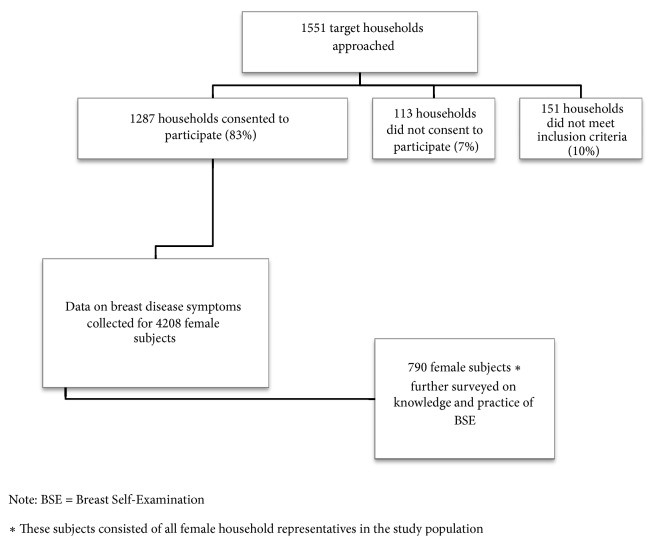
We conducted a household-level community-based study in Southwest Cameroon between January and March 2017, using a three-stage cluster sampling framework. We surveyed 1287 households and collected self-reported data on 4208 female subjects, 790 of whom were household representatives. Each household representative provided information on behalf of all female household members about any ongoing breast disease symptoms. Moreover, female household representatives were questioned about their own knowledge and practice of BSE.
Women demonstrated low frequency of knowledge of BSE, as 25% (n=201) of household representatives reported any knowledge of BSE; and among these only 15% (n=30) practiced BSE on a monthly basis. Age (aOR: 1.04), usage of Liquid Petroleum Gas fuel, a marker of higher socioeconomic status (aOR: 1.86), and speaking English as a primary language in the household (aOR: 1.59) were significant predictors of knowledge of BSE. Eleven women reported ongoing breast disease symptoms resulting in an overall prevalence of 2.3 cases of breast disease symptoms per 1000 women.
Socioeconomic disparities in access to health education may be a determinant of knowledge of BSE. Community-based strategies are needed to improve dissemination of breast cancer screening methods, particularly for women who face barriers to accessing care.
尽管撒哈拉以南非洲地区乳腺癌的发病率和死亡率呈上升趋势,但在人群层面,关于乳腺疾病负担和模式以及乳腺癌筛查实践仍存在重大知识差距。本研究旨在确定与乳房自我检查(BSE)知识和实践相关的社会经济因素,并评估喀麦隆西南部城乡混合女性人群中乳腺疾病症状的患病率。
2017年1月至3月,我们在喀麦隆西南部开展了一项基于家庭层面的社区研究,采用三阶段整群抽样框架。我们调查了1287户家庭,收集了4208名女性受试者的自我报告数据,其中790名是家庭代表。每位家庭代表代表所有女性家庭成员提供有关任何正在出现的乳腺疾病症状的信息。此外,还询问了女性家庭代表关于她们自己的BSE知识和实践情况。
女性对BSE的知晓率较低,25%(n = 201)的家庭代表报告知晓任何关于BSE的知识;在这些人中,只有15%(n = 30)每月进行BSE。年龄(调整后比值比:1.04)、使用液化石油气燃料(较高社会经济地位的一个标志,调整后比值比:1.86)以及在家中以英语作为主要语言(调整后比值比:1.59)是BSE知识的重要预测因素。11名女性报告有持续的乳腺疾病症状,导致每1000名女性中乳腺疾病症状的总体患病率为2.3例。
获得健康教育方面的社会经济差异可能是BSE知识的一个决定因素。需要采取基于社区的策略来改善乳腺癌筛查方法的传播,特别是对于那些在获得医疗服务方面面临障碍的女性。