Graether Steffen P
Department of Molecular and Cellular Biology, University of Guelph, Guelph, ON, Canada.
Front Mol Biosci. 2019 Jan 18;5:118. doi: 10.3389/fmolb.2018.00118. eCollection 2018.
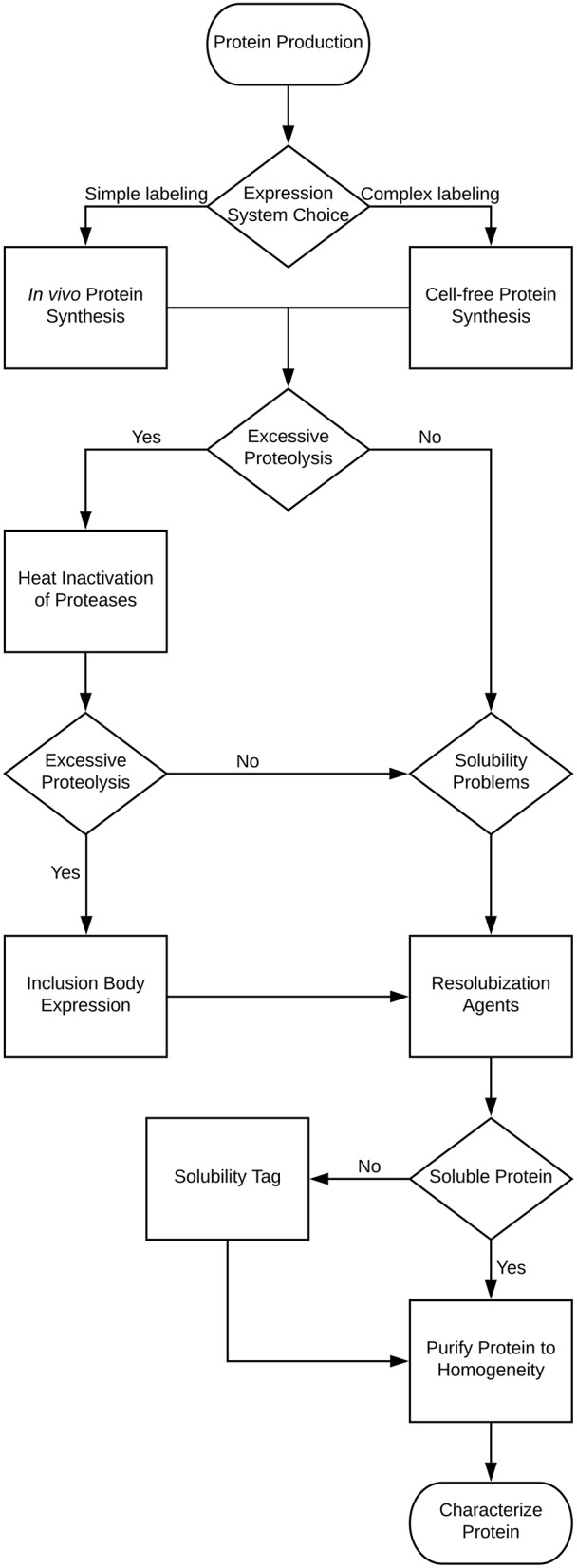
Intrinsically disordered proteins (IDPs) represent a structural class of proteins that do not have a well-defined, 3D fold in solution, and often have little secondary structure. To characterize their function and molecular mechanism, it is helpful to examine their structure using nuclear magnetic resonance (NMR), which can report on properties, such as residual structure (at both the secondary and tertiary levels), ligand binding affinity, and the effect of ligand binding on IDP structure, all on a per residue basis. This brief review reports on the common problems and decisions that are involved when preparing a disordered protein for NMR studies. The paper covers gene design, expression host choice, protein purification, and the initial NMR experiments that are performed. While many of these steps are essentially identical to those for ordered proteins, a few key differences are highlighted, including the extreme sensitivity of IDPs to proteolytic cleavage, the ability to use denaturing conditions without having to refold the protein, the optimal chromatographic system choice, and the challenges of quantifying an IDP. After successful purification, characterization by NMR can be done using the standard N-heteronuclear single quantum coherence (N-HSQC) experiment, or the newer CON series of experiments that are superior for disordered proteins.
内在无序蛋白(IDP)是一类在溶液中没有明确三维折叠结构且通常几乎没有二级结构的蛋白质。为了表征它们的功能和分子机制,利用核磁共振(NMR)来研究其结构很有帮助,NMR能够逐个残基地报告诸如残余结构(二级和三级水平)、配体结合亲和力以及配体结合对IDP结构的影响等性质。这篇简短的综述报告了在为NMR研究准备无序蛋白时所涉及的常见问题和决策。本文涵盖了基因设计、表达宿主选择、蛋白质纯化以及所进行的初始NMR实验。虽然其中许多步骤与处理有序蛋白的步骤基本相同,但也突出了一些关键差异,包括IDP对蛋白水解切割的极端敏感性、能够在无需对蛋白质进行重折叠的情况下使用变性条件、最佳色谱系统的选择以及对IDP进行定量的挑战。成功纯化后,可以使用标准的N - 异核单量子相干(N - HSQC)实验或对无序蛋白更具优势的更新的CON系列实验通过NMR进行表征。