Department of Medicine and Surgery, University of Insubria, Varese, Italy.
Private Practice, Pavia, Italy.
Prog Orthod. 2019 Feb 4;20(1):5. doi: 10.1186/s40510-018-0256-7.
Even though periodontal health was suggested to be not related to the traction technique, some other variables might influence the esthetic outcome of palatally displaced canines (PDC) when aligned, such as the initial position and impaction rate of the canine before treatment. The purpose of the present study was therefore to evaluate the existing correlations between periodontal health outcome of PDC after their exposure and alignment and their initial position identified according to the different rates of impaction severity.
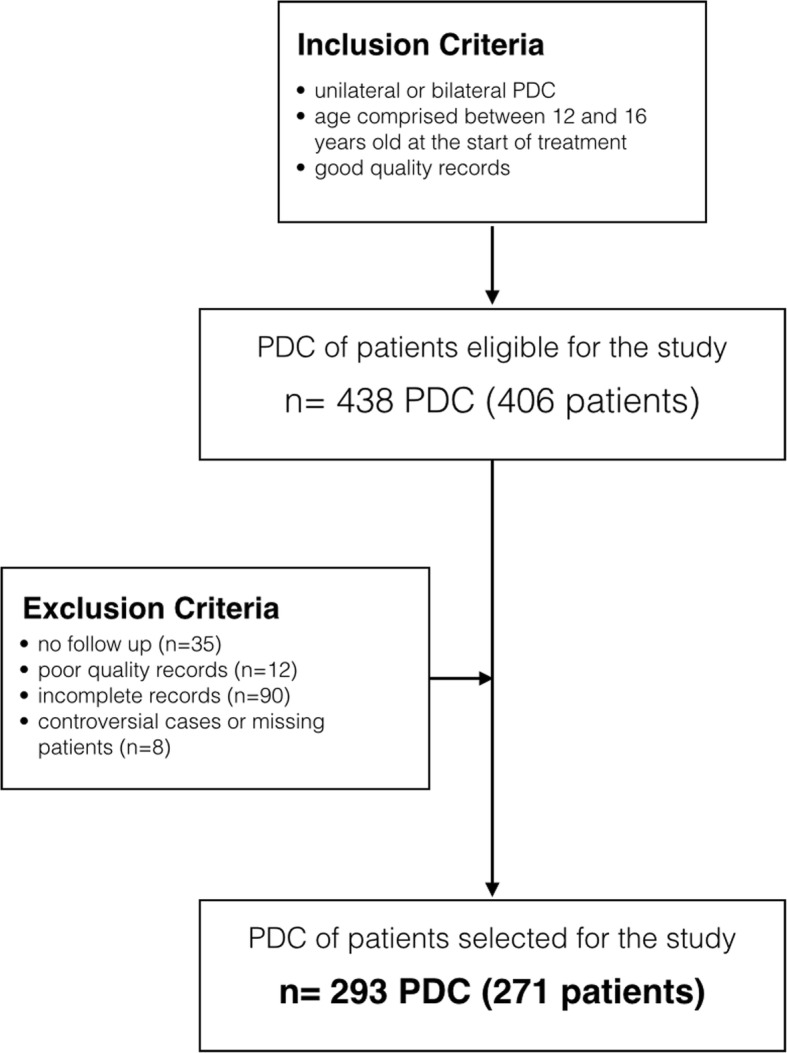
The final sample enrolled 293 PDC which satisfied inclusion and exclusion criteria. All the canines were exposed using CT by the same oral surgeon and orthodontic traction was applied using the easy cuspid device followed by fixed appliance treatment. Image analysis and periodontal status evaluation were performed for all PDCs.
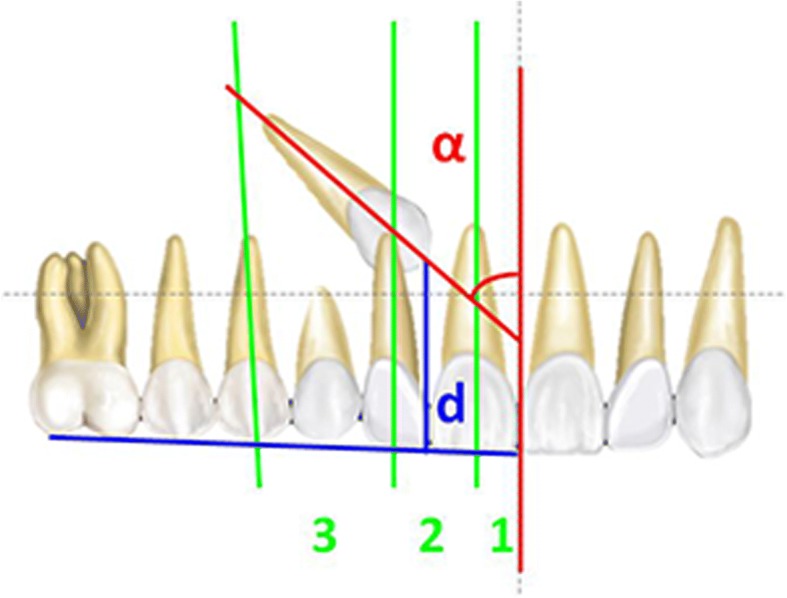
α-Angle and d-distance showed no significant differences in the periodontal outcome of PDCs after treatment. The only tested variable showing significant differences was S, since canines with CEJ visible at the end of the treatment presented sectors with a mean score of 1.67, which was significantly different (P < 0.05) when compared to the S-sector for the canines that showed PD < 2 mm at the end of the treatment.
Radiographic variables as α-Angle and d-distance seem to not influence the periodontal outcome of the treated impacted canine regardless of the amount of gravity. On the contrary, S-sector might play a significant role when higher rates of gravity are present suggesting the possibility in few cases for periodontal damage at the end of treatment.
尽管牙周健康与牵引技术无关,但其他一些变量可能会影响腭侧错位尖牙(PDC)在排齐时的美观效果,例如治疗前尖牙的初始位置和阻生率。因此,本研究的目的是评估 PDC 暴露和排齐后牙周健康状况与根据不同程度阻生率确定的初始位置之间的现有相关性。
最终纳入了 293 颗符合纳入和排除标准的 PDC。所有的尖牙均由同一位口腔外科医生使用 CT 暴露,并使用易尖牙装置进行正畸牵引,然后进行固定矫治器治疗。对所有 PDC 进行图像分析和牙周状况评估。
α角和 d 距离在 PDC 治疗后的牙周状况中没有显著差异。唯一测试的变量 S 有显著差异,因为在治疗结束时可见 CEJ 的尖牙呈现出平均得分为 1.67 的 S 区,与治疗结束时 PD < 2mm 的尖牙的 S 区相比有显著差异(P < 0.05)。
放射学变量如α角和 d 距离似乎不会影响受重力影响的治疗性阻生尖牙的牙周状况,无论重力的大小如何。相反,当存在较高的重力时,S 区可能会发挥重要作用,这表明在少数情况下治疗结束时可能会发生牙周损伤。