Martin-Loeches Ignacio, Guia Maria Consuelo, Vallecoccia Maria Sole, Suarez David, Ibarz Mercedes, Irazabal Marian, Ferrer Ricard, Artigas Antonio
Multidisciplinary Intensive Care Research Organization (MICRO), St James's Hospital/Trinity College Dublin TCD, James's St, Ushers, Dublin, D03 VX82, Ireland.
Pulmonary Intensive Care Unit, Respiratory Institute, Hospital Clinic of Barcelona, IDIBAPS, Barcelona, Spain.
Ann Intensive Care. 2019 Feb 4;9(1):26. doi: 10.1186/s13613-019-0495-x.
Age has been traditionally considered a risk factor for mortality in elderly patients admitted to intensive care units. The aim of this prospective, observational, multicenter cohort study is to determine the risk factors for mortality in elderly and very elderly critically ill patients with sepsis.
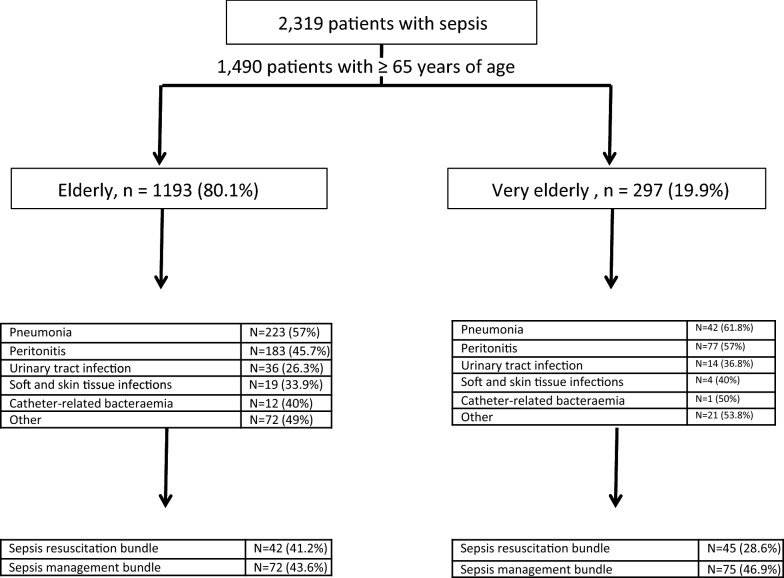
A total of 1490 patients with ≥ 65 years of age were included in the study; most of them 1231 (82.6%) had a cardiovascular failure. The mean age (± SD) was 74.5 (± 5.6) years, and 876 (58.8%) were male. The patients were divided into two cohorts: (1) elderly: 65-79 years and (2) very elderly: ≥ 80 years. The overall hospital mortality was 48.8% (n = 727) and was significantly higher in very elderly compared to elderly patients (54.2% vs. 47.4%; p = 0.02). Factors independently associated with mortality were APACHE II score of the disease, patient location at sepsis diagnosis, development of acute kidney injury, and thrombocytopenia in the group of elderly patients. On the other hand, in the group of very elderly patients, predictors of hospital mortality were age, APACHE II score, and prompt adherence of the resuscitation bundle.
This prospective multicenter study found that patients aged 80 or over had higher hospital mortality compared to patients between 65 and 79 years. Age was found to be an independent risk factor only in the very elderly group, and prompt therapy provided within the first 6 h of resuscitation was associated with a reduction in hospital mortality in the very elderly patients.
传统上,年龄被视为入住重症监护病房的老年患者死亡的风险因素。这项前瞻性、观察性、多中心队列研究的目的是确定老年和高龄重症脓毒症患者的死亡风险因素。
共有1490名年龄≥65岁的患者纳入研究;其中大多数1231名(82.6%)患有心血管衰竭。平均年龄(±标准差)为74.5(±5.6)岁,876名(58.8%)为男性。患者被分为两个队列:(1)老年组:65 - 79岁;(2)高龄组:≥80岁。总体医院死亡率为48.8%(n = 727),高龄组的死亡率显著高于老年组(54.2%对47.4%;p = 0.02)。老年患者中与死亡率独立相关的因素为疾病的急性生理与慢性健康状况评分系统(APACHE II)得分、脓毒症诊断时患者的位置、急性肾损伤的发生以及血小板减少。另一方面,在高龄患者组中,医院死亡率的预测因素为年龄、APACHE II得分以及复苏集束方案的及时依从性。
这项前瞻性多中心研究发现,80岁及以上患者的医院死亡率高于65至79岁的患者。年龄仅在高龄组中被发现是一个独立的风险因素,并且在复苏的前6小时内提供及时治疗与高龄患者医院死亡率的降低相关。