Department of Epidemiology, Mailman School of Public Health, Columbia University, New York, New York, United States.
Beijing Center for Disease Control and Prevention, Beijing, China.
PLoS Comput Biol. 2019 Feb 4;15(2):e1006806. doi: 10.1371/journal.pcbi.1006806. eCollection 2019 Feb.
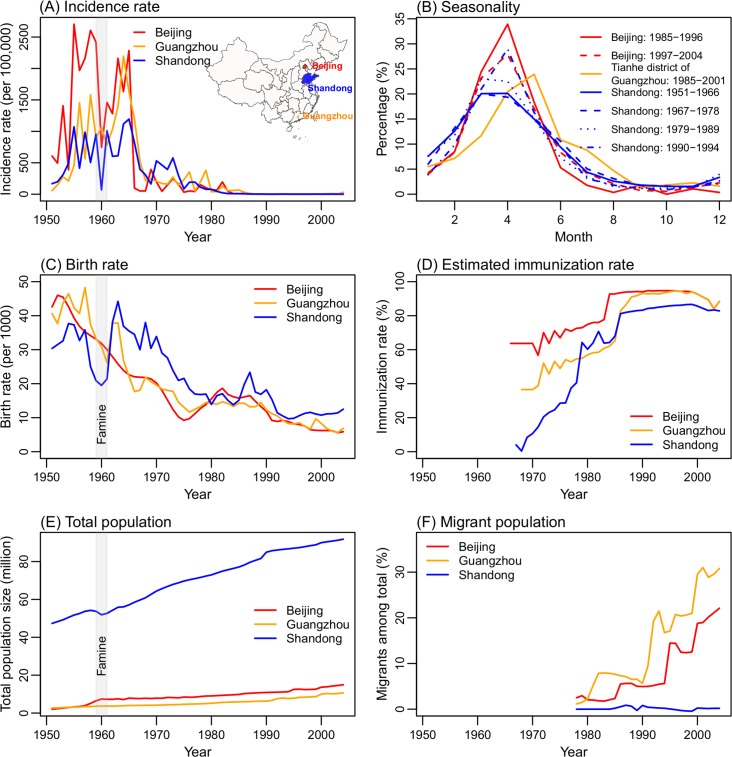
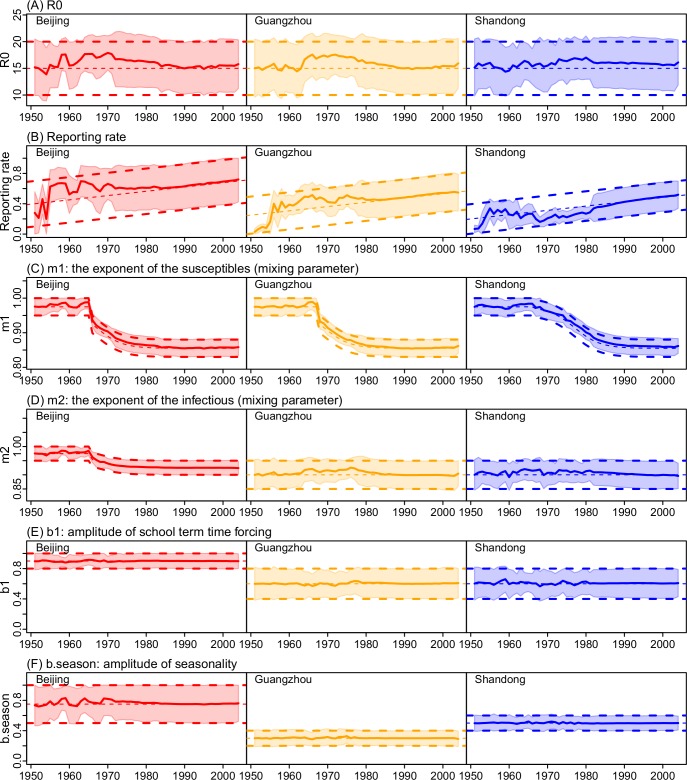
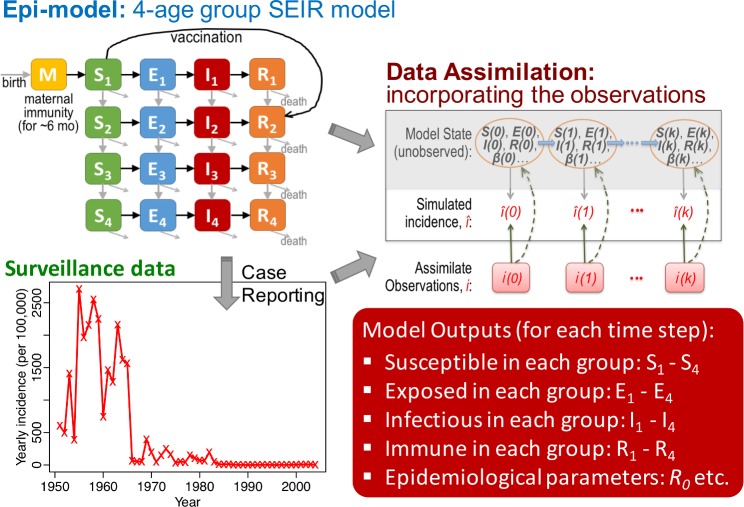
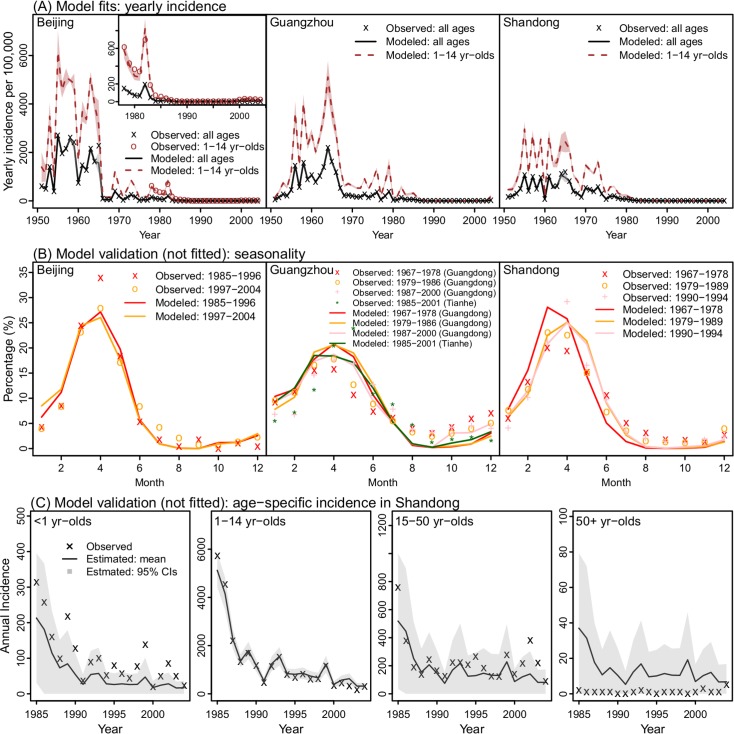
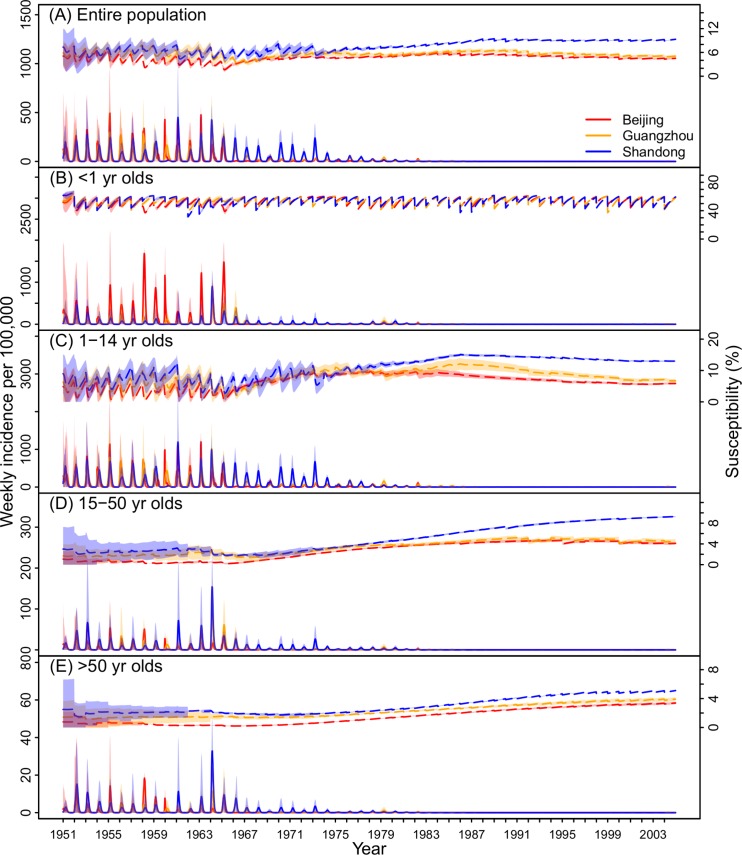
Measles is a highly infectious, severe viral disease. The disease is targeted for global eradication; however, this result has proven challenging. In China, where countrywide vaccination coverage for the last decade has been above 95% (the threshold for measles elimination), measles continues to cause large epidemics. To diagnose factors contributing to the persistency of measles, here we develop a model-inference system to infer measles transmission dynamics in China. The model-inference system uses demographic and vaccination data for each year as model inputs to directly account for changing population dynamics (including births, deaths, migrations, and vaccination). In addition, it simultaneously estimates unobserved model variables and parameters based on incidence data. When fitted to yearly incidence data for the entire population, it is able to accurately estimate independent, out-of-sample age-specific incidence. Using this validated model-inference system, we are thus able to estimate epidemiological and demographical characteristics key to measles transmission during 1951-2004 for three key locations in China, including its capital Beijing. These characteristics include age-specific population susceptibility and incidence rates, the basic reproductive number (R0), reporting rate, population mixing intensity, and amplitude of seasonality. Key differences among the three sites reveal population and epidemiological characteristics crucial for understanding the current persistence of measles epidemics in China. We also discuss the implications our findings have for future elimination strategies.
麻疹是一种高度传染性的严重病毒性疾病。该疾病是全球消灭的目标,但这一结果证明具有挑战性。在中国,过去十年的全国疫苗接种覆盖率一直高于 95%(消除麻疹的阈值),麻疹仍在持续引发大规模疫情。为了确定导致麻疹持续存在的因素,我们在这里开发了一个模型推断系统,以推断中国的麻疹传播动态。该模型推断系统将每年的人口统计和疫苗接种数据作为模型输入,直接考虑不断变化的人口动态(包括出生、死亡、迁移和疫苗接种)。此外,它还根据发病率数据同时估计未观察到的模型变量和参数。当将其拟合到整个人口的年度发病率数据时,它能够准确估计独立的、样本外的年龄特异性发病率。使用这个经过验证的模型推断系统,我们能够估计中国三个关键地区(包括首都北京)1951-2004 年麻疹传播的流行病学和人口统计学特征。这些特征包括特定年龄人群的易感性和发病率、基本繁殖数 (R0)、报告率、人口混合强度和季节性幅度。三个地点之间的关键差异揭示了对理解中国当前麻疹疫情持续存在至关重要的人口和流行病学特征。我们还讨论了我们的发现对未来消除策略的影响。