Morio Yuji, Izawa Kazuhiro P, Omori Yoshitsugu, Katata Hironobu, Ishiyama Daisuke, Koyama Shingo, Yamano Yoshihisa
Department of Rehabilitation, Faculty of Medical Sciences, Shonan University of Medical Sciences, Yokohama 244-0806, Japan.
Cardiovascular stroke Renal Project (CRP), Kobe 654-0142, Japan.
Diseases. 2019 Feb 2;7(1):17. doi: 10.3390/diseases7010017.
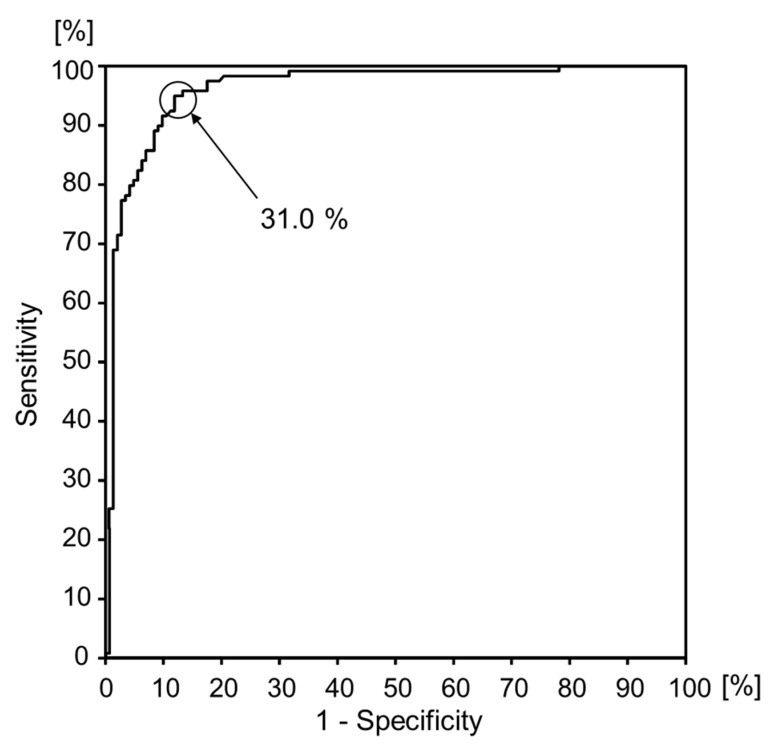
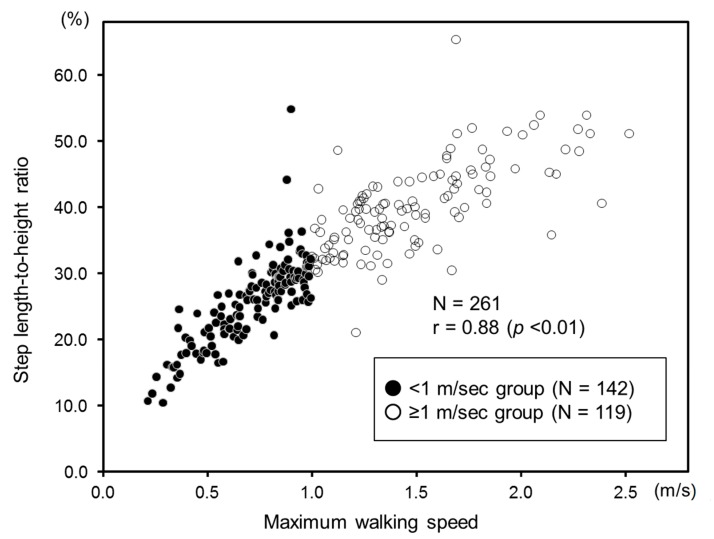
Compared with elderly people who have not experienced falls, those who have were reported to have a shortened step length, large fluctuations in their pace, and a slow walking speed. The purpose of this study was to elucidate the step length required to maintain a walking speed of 1.0 m/s in patients aged 75 years or older. We measured the 10 m maximum walking speed in patients aged 75 years or older and divided them into the following two groups: Those who could walk 1.0 m/s or faster (fast group) and those who could not (slow group). Step length was determined from the number of steps taken during the 10 m-maximum walking speed test, and the step length-to-height ratio was calculated. Isometric knee extension muscle force (kgf), modified functional reach (cm), and one-leg standing time (s) were also measured. We included 261 patients (average age: 82.1 years, 50.6% men) in this study. The fast group included 119 participants, and the slow group included 142 participants. In a regression logistic analysis, knee extension muscle force ( = 0.03) and step length-to-height ratio ( < 0.01) were determined as factors significantly related to the fast group. As a result of ROC curve analysis, a step length-to-height ratio of 31.0% could discriminate between the two walking speed groups. The results suggest that the step length-to-height ratio required to maintain a walking speed of 1.0 m/s is 31.0% in patients aged 75 years or older.
与未经历过跌倒的老年人相比,经历过跌倒的老年人步长缩短、步幅波动大且步行速度慢。本研究的目的是阐明75岁及以上患者维持1.0米/秒步行速度所需的步长。我们测量了75岁及以上患者的10米最大步行速度,并将他们分为以下两组:能够以1.0米/秒或更快速度行走的患者(快组)和不能达到该速度的患者(慢组)。通过10米最大步行速度测试中的步数确定步长,并计算步长与身高的比值。还测量了等长伸膝肌力(千克力)、改良功能性伸展(厘米)和单腿站立时间(秒)。本研究纳入了261名患者(平均年龄:82.1岁,男性占50.6%)。快组包括119名参与者,慢组包括142名参与者。在回归逻辑分析中,伸膝肌力(=0.03)和步长与身高的比值(<0.01)被确定为与快组显著相关的因素。ROC曲线分析结果显示,步长与身高的比值为31.0%时可区分两个步行速度组。结果表明,75岁及以上患者维持1.0米/秒步行速度所需的步长与身高的比值为31.0%。