Institute of Earth Sciences, China University of Geosciences (Beijing), Beijing 100083, China.
Int J Environ Res Public Health. 2019 Feb 2;16(3):440. doi: 10.3390/ijerph16030440.
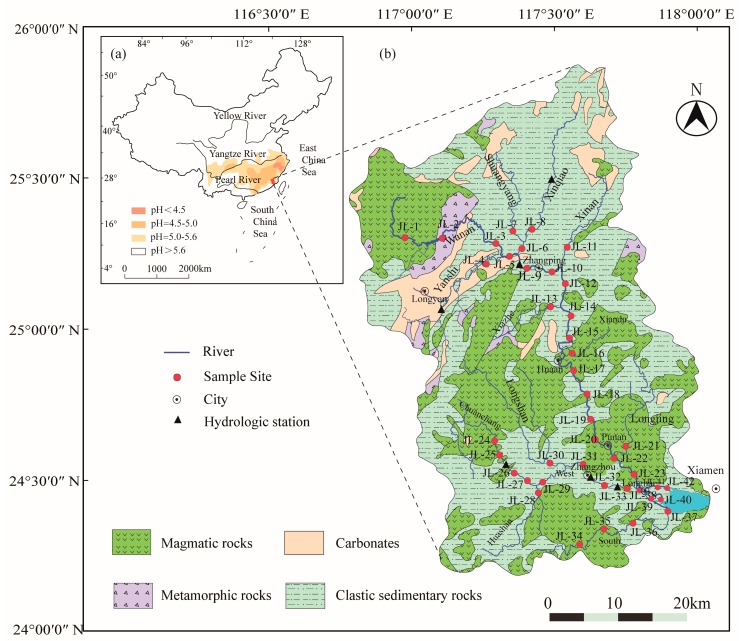
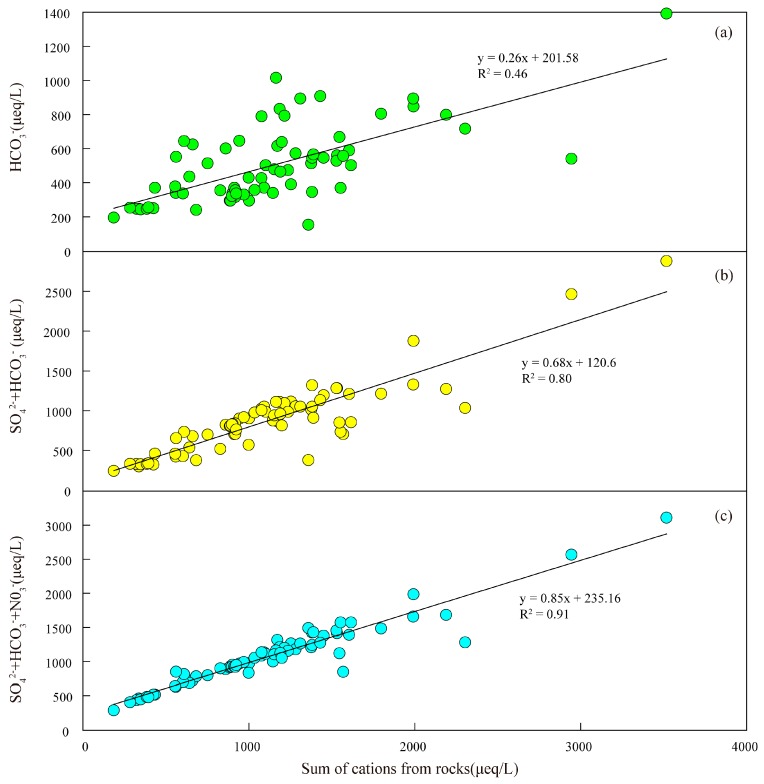
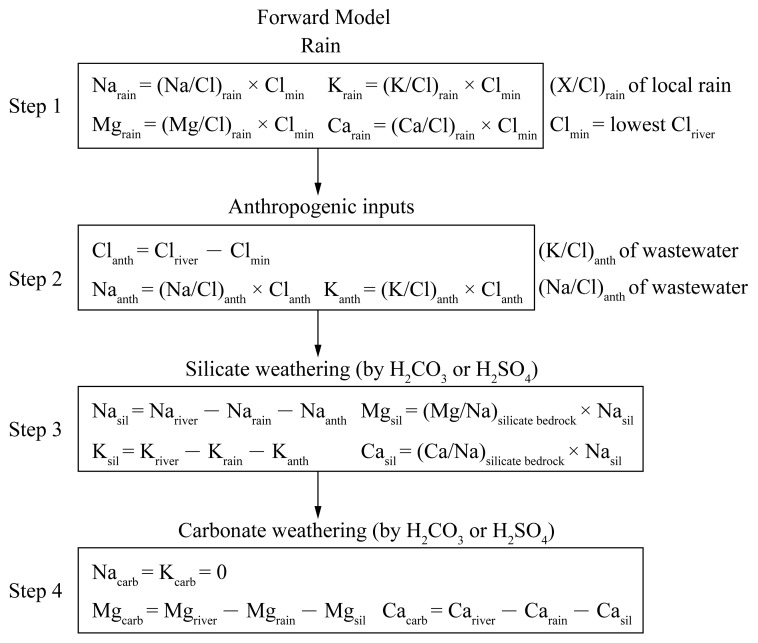
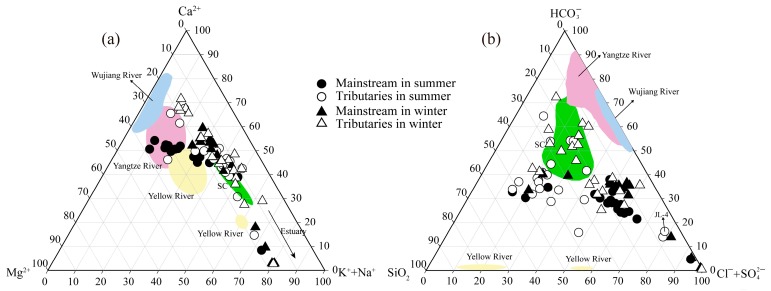
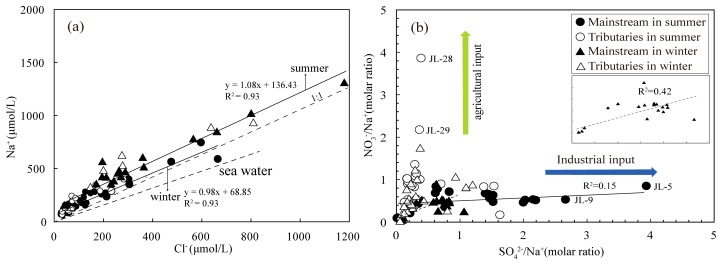
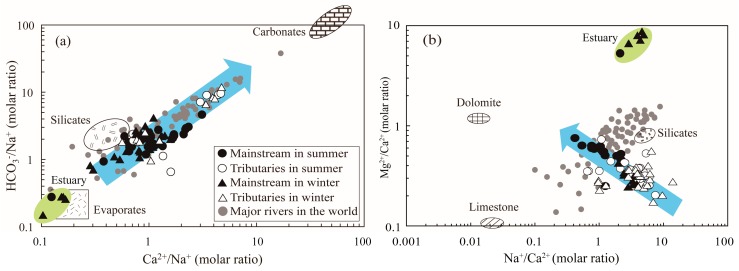
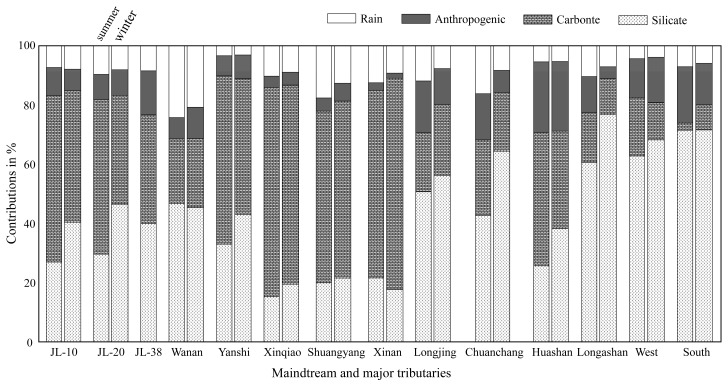
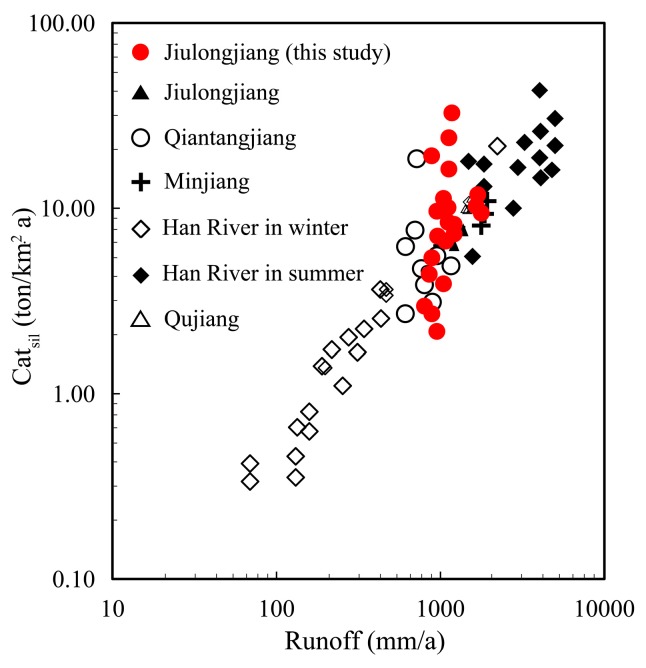
This study focuses on the chemical weathering process under the influence of human activities in the Jiulongjiang River basin, which is the most developed and heavily polluted area in southeast China. The average total dissolved solid (TDS) of the river water is 116.6 mg/L and total cation concentration ( TZ + ) is 1.5 meq/L. Calcium and HCO 3 - followed by Na + and SO 4 2 - constitute the main species in river waters. A mass balance based on cations calculation indicated that the silicate weathering (43.3%), carbonate weathering (30.7%), atmospheric (15.6%) and anthropogenic inputs (10.4%) are four reservoirs contributing to the dissolved load. Silicates (SCW) and carbonates (CCW) chemical weathering rates are calculated to be approximately 53.2 ton/km²/a and 15.0 ton/km²/a, respectively. When sulfuric and nitric acid from rainfall affected by human activities are involved in the weathering process, the actual atmospheric CO 2 consumption rates are estimated at 3.7 × 10⁵ mol/km²/a for silicate weathering and 2.2 × 10⁵ mol/km²/a for carbonate weathering. An overestimated carbon sink (17.4 Gg C / a ) is about 27.0% of the CO 2 consumption flux via silicate weathering in the Jiulongjiang River basin, this result shows the strong effects of anthropogenic factors on atmospheric CO 2 level and current and future climate change of earth.
本研究关注人类活动影响下的九龙江流域的化学风化过程,该流域是中国东南部最发达和污染最严重的地区。河水的平均总溶解固体(TDS)为 116.6mg/L,总阳离子浓度(TZ+)为 1.5meq/L。钙和 HCO3-,其次是 Na+和 SO42-,构成河水的主要物质。基于阳离子计算的质量平衡表明,硅酸盐风化(43.3%)、碳酸盐风化(30.7%)、大气(15.6%)和人为输入(10.4%)是溶解负荷的四个来源。硅酸盐(SCW)和碳酸盐(CCW)的化学风化速率分别计算为约 53.2 吨/平方公里/年和 15.0 吨/平方公里/年。当受人类活动影响的降雨中的硫酸和硝酸参与风化过程时,实际大气 CO2消耗速率估计为硅酸盐风化的 3.7×10⁵mol/平方公里/年和碳酸盐风化的 2.2×10⁵mol/平方公里/年。人为因素对大气 CO2水平和地球当前及未来气候变化的影响,九龙江流域的硅酸盐风化消耗通量中约有 17.4 Gg C/a 的碳汇被高估,这一结果表明了这一结果表明了人为因素的强烈影响。