Luxembourg Institute of Health (LIH), Department of Population Health, 1A rue Thomas Edison, L-1445, Strassen, Luxembourg.
Centre Hospitalier du Luxembourg (CHL), Luxembourg City, Luxembourg.
BMC Med Res Methodol. 2019 Feb 4;19(1):27. doi: 10.1186/s12874-019-0669-0.
It is challenging to manage data collection as planned and creation of opportunities to adapt during the course of enrolment may be needed. This paper aims to summarize the different sampling strategies adopted in the second wave of Observation of Cardiovascular Risk Factors (ORISCAV-LUX, 2016-17), with a focus on population coverage and sample representativeness.
Data from the first nationwide cross-sectional, population-based ORISCAV-LUX survey, 2007-08 and from the newly complementary sample recruited via different pathways, nine years later were analysed. First, we compare the socio-demographic characteristics and health profiles between baseline participants and non-participants to the second wave. Then, we describe the distribution of subjects across different strategy-specific samples and performed a comparison of the overall ORISCAV-LUX2 sample to the national population according to stratification criteria.
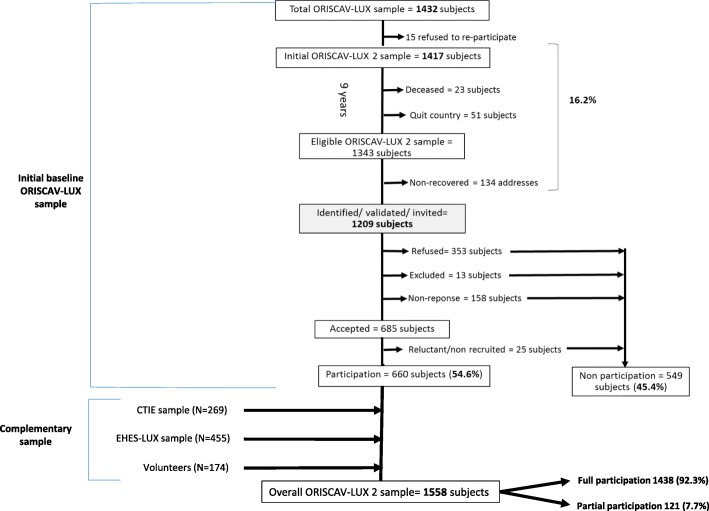
For the baseline sample (1209 subjects), the participants (660) were younger than the non-participants (549), with a significant difference in average ages (44 vs 45.8 years; P = 0.019). There was a significant difference in terms of education level (P < 0.0001), 218 (33%) participants having university qualification vs. 95 (18%) non-participants. The participants seemed having better health perception (p < 0.0001); 455 (70.3%) self-reported good or very good health perception compared to 312 (58.2%) non-participants. The prevalence of obesity (P < 0.0001), hypertension (P < 0.0001), diabetes (P = 0.007), and mean values of related biomarkers were significantly higher among the non-participants. The overall sample (1558 participants) was mainly composed of randomly selected subjects, including 660 from the baseline sample and 455 from other health examination survey sample and 269 from civil registry sample (constituting in total 88.8%), against only 174 volunteers (11.2%), with significantly different characteristics and health status. The ORISCAV-LUX2 sample was representative of national population for geographical district, but not for sex and age; the younger (25-34 years) and older (65-79 years) being underrepresented, whereas middle-aged adults being over-represented, with significant sex-specific difference (p < 0.0001).
This study represents a careful first-stage analysis of the ORISCAV-LUX2 sample, based on available information on participants and non-participants. The ORISCAV-LUX datasets represents a relevant tool for epidemiological research and a basis for health monitoring and evidence-based prevention of cardiometabolic risk in Luxembourg.
按计划管理数据收集具有挑战性,在入组过程中可能需要创造机会进行调整。本文旨在总结在心血管风险因素观察(ORISCAV-LUX,2016-17 年)第二波研究中采用的不同抽样策略,重点关注人口覆盖范围和样本代表性。
对首次全国性、基于人群的 ORISCAV-LUX 调查(2007-08 年)的基线数据和九年后通过不同途径新招募的补充样本数据进行分析。首先,我们比较了基线参与者和未参与者的社会人口统计学特征和健康状况。然后,我们描述了不同策略特定样本中的受试者分布,并根据分层标准比较了整个 ORISCAV-LUX2 样本与全国人口。
对于基线样本(1209 人),参与者(660 人)比未参与者(549 人)年轻,平均年龄差异显著(44 岁与 45.8 岁;P=0.019)。教育水平有显著差异(P<0.0001),218 名(33%)参与者具有大学学历,而 95 名(18%)未参与者具有大学学历。参与者的健康感知似乎更好(P<0.0001);455 名(70.3%)自我报告良好或非常好的健康感知,而 312 名(58.2%)未参与者。肥胖(P<0.0001)、高血压(P<0.0001)、糖尿病(P=0.007)的患病率以及相关生物标志物的平均值在未参与者中显著更高。总体样本(1558 人)主要由随机选择的受试者组成,包括基线样本中的 660 人、其他健康检查调查样本中的 455 人和民事登记样本中的 269 人(总计 88.8%),而只有 174 名志愿者(11.2%),具有显著不同的特征和健康状况。ORISCAV-LUX2 样本在地理区域上代表全国人口,但在性别和年龄上不代表;年轻(25-34 岁)和老年(65-79 岁)人口代表性不足,而中年人口代表性过高,性别差异显著(P<0.0001)。
本研究代表了对 ORISCAV-LUX2 样本的首次仔细的分析,基于参与者和未参与者的可用信息。ORISCAV-LUX 数据集是流行病学研究的重要工具,也是卢森堡心脏代谢风险监测和循证预防的基础。