Department of Dairy Technology, University of Veterinary and Animal Sciences, Lahore, Punjab, Pakistan.
Institute of Home and Food Sciences, Faculty of Life Sciences, Government College University, Faisalabad, Punjab, Pakistan.
Lipids Health Dis. 2019 Feb 4;18(1):41. doi: 10.1186/s12944-019-0969-8.
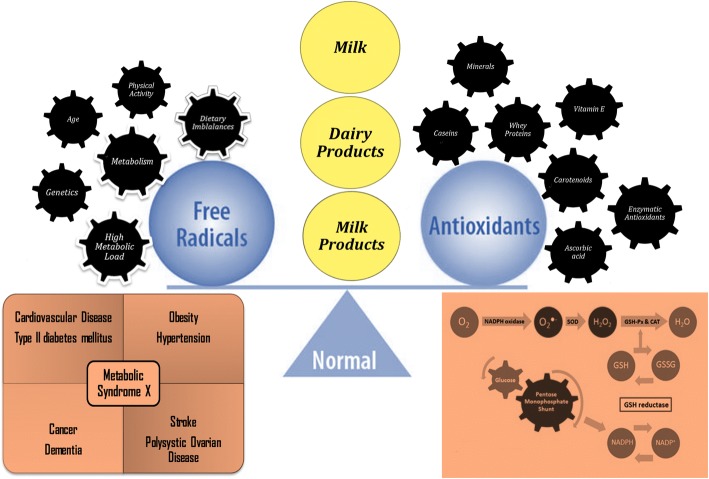
Milk and dairy products are integral part of human nutrition and they are considered as the carriers of higher biological value proteins, calcium, essential fatty acids, amino acids, fat, water soluble vitamins and several bioactive compounds that are highly significant for several biochemical and physiological functions. In recent years, foods containing natural antioxidants are becoming popular all over the world as antioxidants can neutralize and scavenge the free radicals and their harmful effects, which are continuously produced in the biological body. Uncontrolled free radicals activity can lead to oxidative stresses, which have been implicated in breakdown of vital biochemical compounds such as lipids, protein, DNA which may lead to diabetes, accelerated ageing, carcinogenesis and cardiovascular diseases. Antioxidant capacity of milk and milk products is mainly due to sulfur containing amino acids, such as cysteine, phosphate, vitamins A, E, carotenoids, zinc, selenium, enzyme systems, superoxide dismutase, catalase, glutathione peroxidase, milk oligosaccharides and peptides that are produced during fermentation and cheese ripening. Antioxidant activity of milk and dairy products can be enhanced by phytochemicals supplementation while fermented dairy products have been reported contained higher antioxidant capacity as compared to the non-fermented dairy products. Literature review has shown that milk and dairy products have antioxidant capacity, however, information regarding the antioxidant capacity of milk and dairy products has not been previously compiled. This review briefly describes the nutritional and antioxidant capacity of milk and dairy products.
牛奶和乳制品是人类营养的重要组成部分,它们被认为是更高生物价值蛋白质、钙、必需脂肪酸、氨基酸、脂肪、水溶性维生素和多种生物活性化合物的载体,这些物质对多种生化和生理功能具有重要意义。近年来,含有天然抗氧化剂的食品在全球范围内越来越受欢迎,因为抗氧化剂可以中和和清除自由基及其有害影响,自由基在生物体内不断产生。自由基活动不受控制会导致氧化应激,这与脂质、蛋白质、DNA 等重要生化化合物的破坏有关,可能导致糖尿病、加速衰老、致癌和心血管疾病。牛奶和乳制品的抗氧化能力主要归因于含硫氨基酸,如半胱氨酸、磷酸盐、维生素 A、E、类胡萝卜素、锌、硒、酶系统、超氧化物歧化酶、过氧化氢酶、谷胱甘肽过氧化物酶、牛奶低聚糖和肽,这些物质在发酵和奶酪成熟过程中产生。通过添加植物化学物质可以增强牛奶和乳制品的抗氧化活性,而发酵乳制品的抗氧化能力高于非发酵乳制品。文献综述表明,牛奶和乳制品具有抗氧化能力,但是,关于牛奶和乳制品抗氧化能力的信息尚未被汇总。本文简要描述了牛奶和乳制品的营养价值和抗氧化能力。