Synthetic and Functional Biomolecules Center, Beijing National Laboratory for Molecular Sciences, Key Laboratory of Bioorganic Chemistry and Molecular Engineering of Ministry of Education, College of Chemistry and Molecular Engineering, Peking University, Beijing 100871, China.
Department of Pharmacology and Chemical Biology, Shanghai Jiao Tong University School of Medicine, Shanghai 200025, China.
Proc Natl Acad Sci U S A. 2019 Feb 19;116(8):2919-2924. doi: 10.1073/pnas.1820574116. Epub 2019 Feb 4.
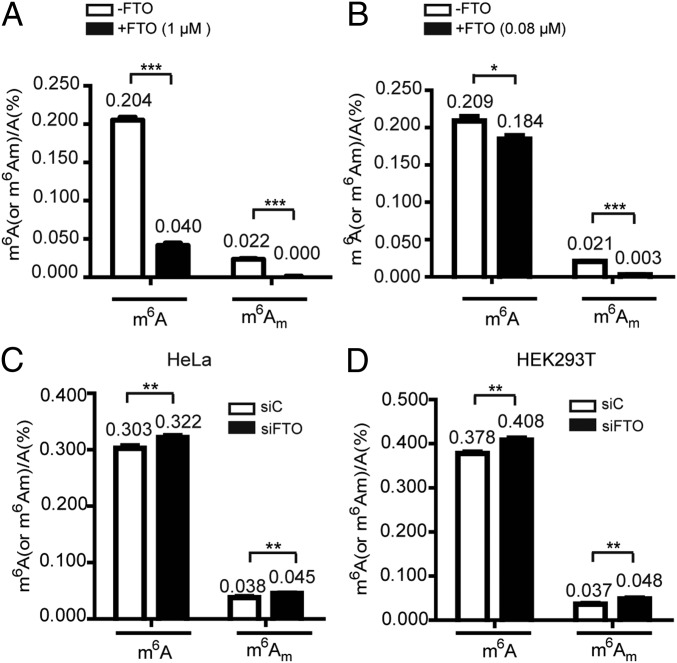
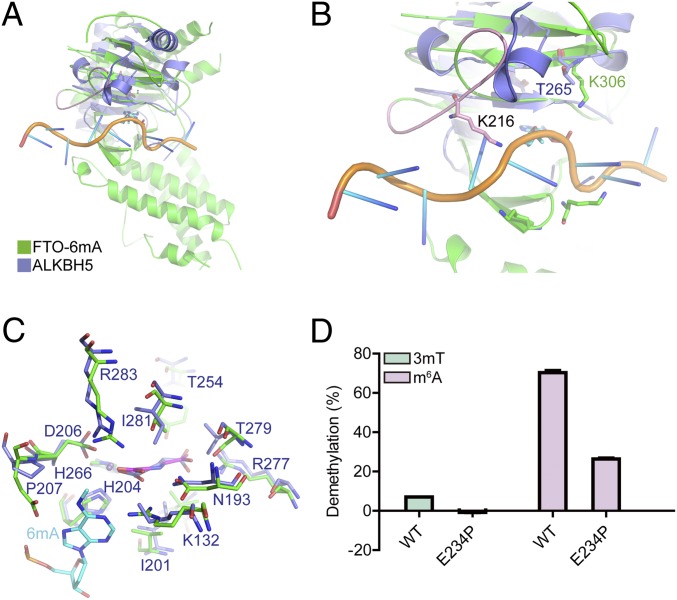
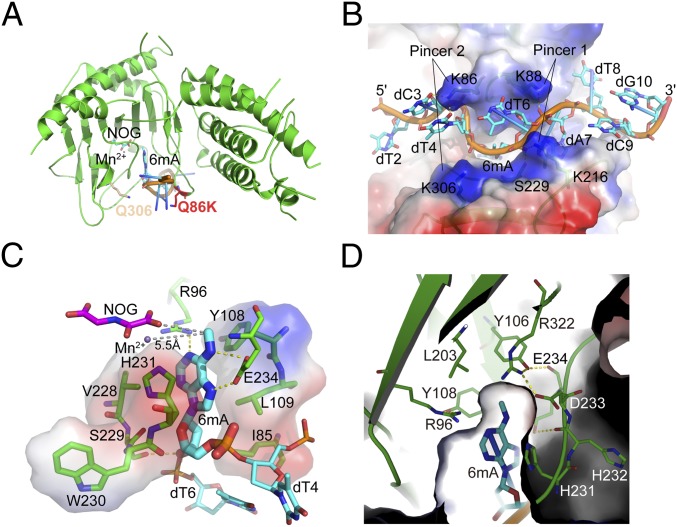
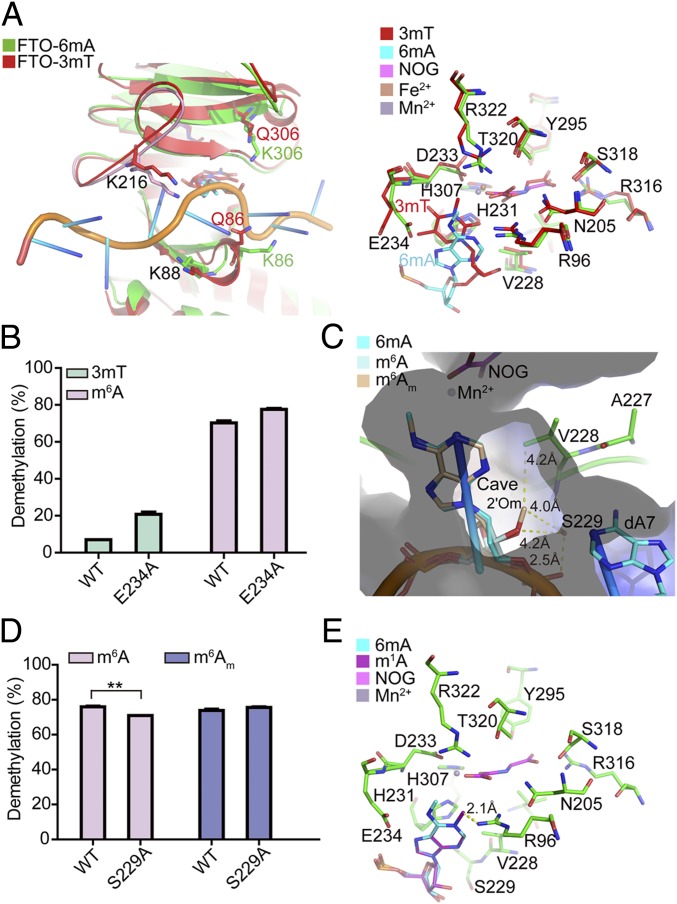
FTO demethylates internal -methyladenosine (mA) and ,2'--dimethyladenosine (mA; at the cap +1 position) in mRNA, mA and mA in snRNA, and -methyladenosine (mA) in tRNA in vivo, and in vitro evidence supports that it can also demethylate -methyldeoxyadenosine (6mA), 3-methylthymine (3mT), and 3-methyluracil (mU). However, it remains unclear how FTO variously recognizes and catalyzes these diverse substrates. Here we demonstrate-in vitro and in vivo-that FTO has extensive demethylation enzymatic activity on both internal mA and cap mA Considering that 6mA, mA, and mA all share the same nucleobase, we present a crystal structure of human FTO bound to 6mA-modified ssDNA, revealing the molecular basis of the catalytic demethylation of FTO toward multiple RNA substrates. We discovered that () -methyladenine is the most favorable nucleobase substrate of FTO, () FTO displays the same demethylation activity toward internal mA and mA in the same RNA sequence, suggesting that the substrate specificity of FTO primarily results from the interaction of residues in the catalytic pocket with the nucleobase (rather than the ribose ring), and () the sequence and the tertiary structure of RNA can affect the catalytic activity of FTO. Our findings provide a structural basis for understanding the catalytic mechanism through which FTO demethylates its multiple substrates and pave the way forward for the structure-guided design of selective chemicals for functional studies and potential therapeutic applications.
FTO 可使 mRNA 中的内部 -甲基腺苷(mA)和 2',-二甲基腺苷(mA;在帽 +1 位)、snRNA 中的 mA 和 mA 以及 tRNA 中的 -甲基腺苷(mA)去甲基化,体外证据表明它还可以使 -甲基脱氧腺苷(6mA)、3-甲基胸腺嘧啶(3mT)和 3-甲基尿嘧啶(mU)去甲基化。然而,目前尚不清楚 FTO 如何识别和催化这些不同的底物。在这里,我们证明了——在体外和体内——FTO 对内部 mA 和帽 mA 都具有广泛的去甲基化酶活性。鉴于 6mA、mA 和 mA 都具有相同的碱基,我们提出了人 FTO 与 6mA 修饰的 ssDNA 结合的晶体结构,揭示了 FTO 对多种 RNA 底物进行催化去甲基化的分子基础。我们发现,()-甲基腺嘌呤是 FTO 最理想的碱基底物,()FTO 对同一 RNA 序列中的内部 mA 和 mA 显示出相同的去甲基化活性,这表明 FTO 的底物特异性主要源于催化口袋中的残基与碱基(而不是核糖环)的相互作用,以及()RNA 的序列和三级结构可以影响 FTO 的催化活性。我们的研究结果为理解 FTO 去甲基化其多种底物的催化机制提供了结构基础,并为选择性化学物质的结构导向设计铺平了道路,这些化学物质可用于功能研究和潜在的治疗应用。