
慢性疼痛研究中影响生态瞬时评估完成情况的因素有哪些?一项个体患者数据荟萃分析。
What Affects the Completion of Ecological Momentary Assessments in Chronic Pain Research? An Individual Patient Data Meta-Analysis.
作者信息
Ono Masakatsu, Schneider Stefan, Junghaenel Doerte U, Stone Arthur A
机构信息
Center for Self-Report Science, Center for Economic and Social Research, University of Southern California, Los Angeles, CA, United States.
Department of Psychology, University of Southern California, Los Angeles, CA, United States.
出版信息
J Med Internet Res. 2019 Feb 5;21(2):e11398. doi: 10.2196/11398.
BACKGROUND
Ecological momentary assessment (EMA) involves repeated sampling of people's current experiences in real time in their natural environments, which offers a granular perspective on patients' experience of pain and other symptoms. However, EMA can be burdensome to patients, and its benefits depend upon patients' engagement in the assessments.
OBJECTIVE
The goal of this study was to investigate factors affecting EMA-completion rates among patients with chronic pain.
METHODS
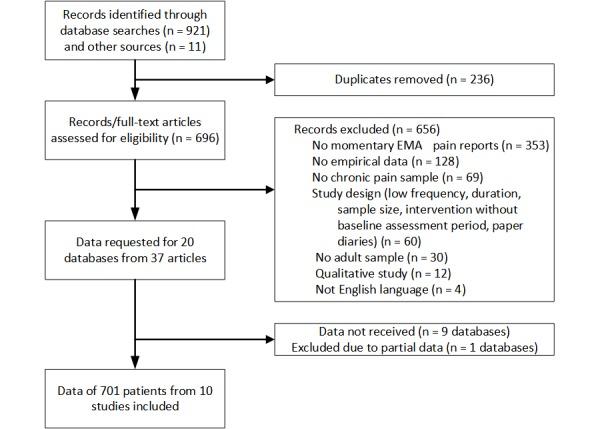
This individual patient data meta-analysis was based on 12 EMA datasets that examined patients with chronic noncancer-related pain (n=701). The EMA-completion rates were calculated on a daily basis for each patient. Multilevel models were used to test the following predictors of completion rates at different levels: within-patient factors (days into the study and daily pain level), between-patient factors (age, sex, pain diagnosis, and average pain level per person), and between-study EMA design factors (study duration, sampling density, and survey length).
RESULTS
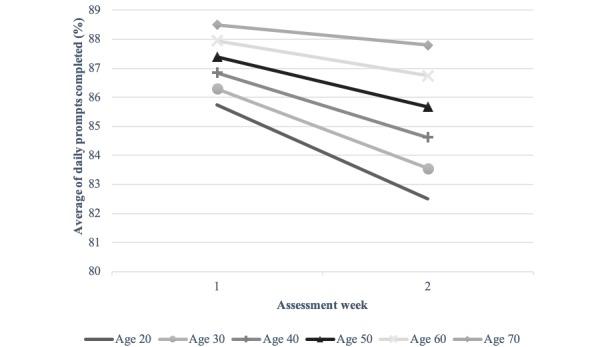
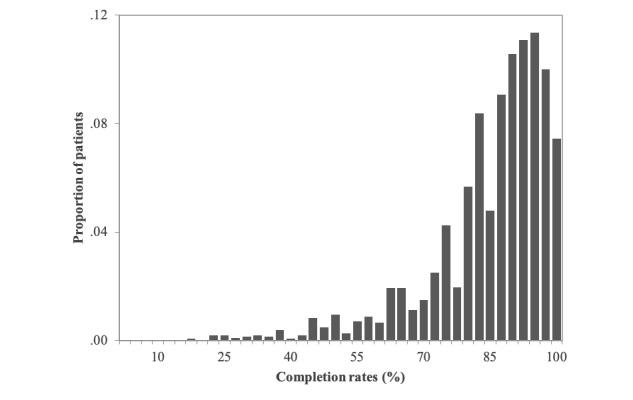
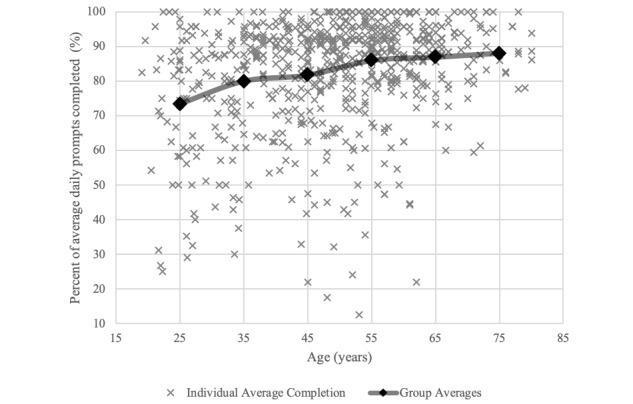
Across datasets, an EMA-completion rate of 85% was observed. The strongest results were found for the between-patient factor age: Younger respondents reported lower completion rates than older respondents (P=.002). One within-patient factor, study day, was associated with completion rates (P<.001): over the course of the studies, the completion rates declined. The two abovementioned factors interacted with each other (P=.02) in that younger participants showed a more rapid decline in EMA completion over time. In addition, none of the other hypothesized factors including gender, chronic pain diagnoses, pain intensity levels, or measures of study burden showed any significant effects.
CONCLUSION
Many factors thought to influence the EMA-completion rates in chronic pain studies were not confirmed. However, future EMA research in chronic pain should note that study length and young age can impact the quality of the momentary data and devise strategies to maximize completion rates across different age groups and study days.
背景
生态瞬时评估(EMA)涉及在自然环境中对人们当前经历进行实时重复抽样,这为患者的疼痛及其他症状体验提供了细致入微的视角。然而,EMA对患者而言可能负担较重,其益处取决于患者参与评估的程度。
目的
本研究的目的是调查影响慢性疼痛患者EMA完成率的因素。
方法
这项个体患者数据荟萃分析基于12个EMA数据集,这些数据集研究了慢性非癌性疼痛患者(n = 701)。每天计算每位患者的EMA完成率。使用多层次模型来检验不同层面上完成率的以下预测因素:患者内部因素(研究天数和每日疼痛程度)、患者间因素(年龄、性别、疼痛诊断以及每人的平均疼痛程度)以及研究间EMA设计因素(研究持续时间、抽样密度和调查长度)。
结果
在各个数据集中,观察到的EMA完成率为85%。在患者间因素年龄方面发现了最显著的结果:年轻受访者的完成率低于年长受访者(P = 0.002)。一个患者内部因素,即研究天数,与完成率相关(P < 0.001):在研究过程中,完成率下降。上述两个因素相互作用(P = 0.02),即年轻参与者的EMA完成率随时间下降得更快。此外,其他假设因素,包括性别、慢性疼痛诊断、疼痛强度水平或研究负担指标,均未显示出任何显著影响。
结论
许多被认为会影响慢性疼痛研究中EMA完成率的因素未得到证实。然而,未来慢性疼痛的EMA研究应注意,研究时长和年轻年龄可能会影响瞬时数据的质量,并应制定策略以在不同年龄组和研究天数中最大化完成率。
 Zotero 插件