Cancer Research UK Cambridge Institute, University of Cambridge, Cambridge, United Kingdom.
Centre for Computational Biology, Institute of Cancer and Genomic Sciences, University of Birmingham, Birmingham, United Kingdom.
Int J Cancer. 2019 Aug 15;145(4):1125-1137. doi: 10.1002/ijc.32186. Epub 2019 Mar 18.
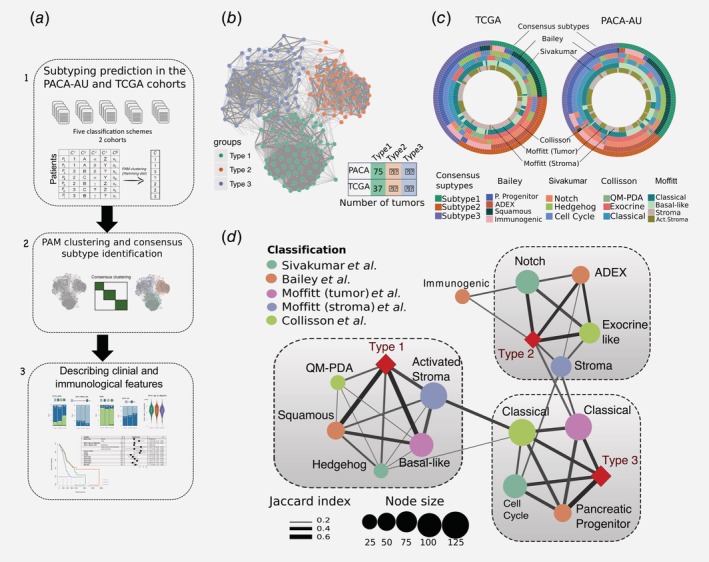
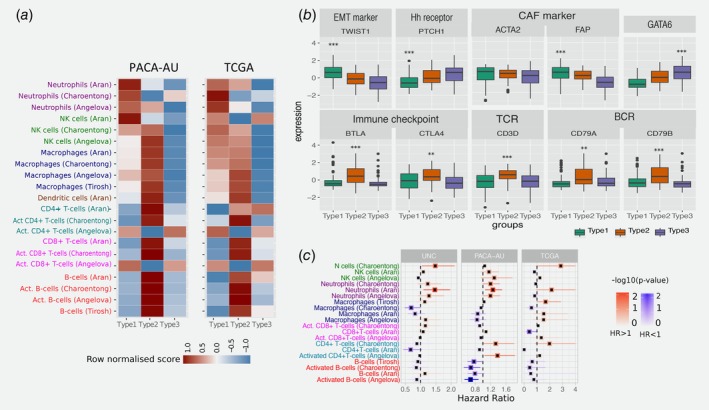
Pancreatic ductal adenocarcinoma (PDAC) is the most common malignancy of the pancreas and has one of the highest mortality rates of any cancer type with a 5-year survival rate of <5%. Recent studies of PDAC have provided several transcriptomic classifications based on separate analyses of individual patient cohorts. There is a need to provide a unified transcriptomic PDAC classification driven by therapeutically relevant biologic rationale to inform future treatment strategies. Here, we used an integrative meta-analysis of 353 patients from four different studies to derive a PDAC classification based on immunologic parameters. This consensus clustering approach indicated transcriptomic signatures based on immune infiltrate classified as adaptive, innate and immune-exclusion subtypes. This reveals the existence of microenvironmental interpatient heterogeneity within PDAC and could serve to drive novel therapeutic strategies in PDAC including immune modulation approaches to treating this disease.
胰腺导管腺癌 (PDAC) 是胰腺最常见的恶性肿瘤,其死亡率在所有癌症类型中最高,5 年生存率<5%。最近对 PDAC 的研究根据对单个患者队列的单独分析提供了几种基于转录组的分类。需要提供一种基于治疗相关生物学原理的统一的转录组 PDAC 分类,以告知未来的治疗策略。在这里,我们使用来自四项不同研究的 353 名患者的综合荟萃分析,基于免疫参数得出 PDAC 分类。这种共识聚类方法表明,基于免疫浸润的转录组特征可分为适应性、固有和免疫排斥亚型。这揭示了 PDAC 内存在微环境的个体间异质性,可用于推动 PDAC 的新治疗策略,包括免疫调节方法来治疗这种疾病。