Vie Tina Løkke, Hufthammer Karl Ove, Meland Eivind, Breidablik Hans Johan
Helse Førde HF/Førde Health Trust, postboks 1000, 6807 Førde, Norway.
Centre for Clinical Research, Haukeland University Hospital, Norway.
SSM Popul Health. 2019 Jan 23;7:100364. doi: 10.1016/j.ssmph.2019.100364. eCollection 2019 Apr.
Self-rated health (SRH), which is frequently used in epidemiological research, has consistently been shown to be a strong predictor of morbidity and mortality, even after controlling for demographic, social and medical risk factors. However, less is known about the relationship between SRH and all-cause and cause-specific mortality in young adulthood.
To investigate SRH in young people (13-35 years-old) as a predictor of all-cause mortality in young adulthood (deaths before age 54) and examine the associated causes of death.
We used data from two large population-based cohort studies (N = 23,679): Young-HUNT1 (1995-1997, persons 13 to 20 years old, participation rate = 90%) and HUNT2 (1995-1997, persons 20 to 35 years old, participation rate = 70%). These data were linked to the Norwegian Cause of Death Registry up to 2014, and 247 deaths were identified. Other predictors we examined included age, gender, baseline smoking, physical activity and physical and mental disability.
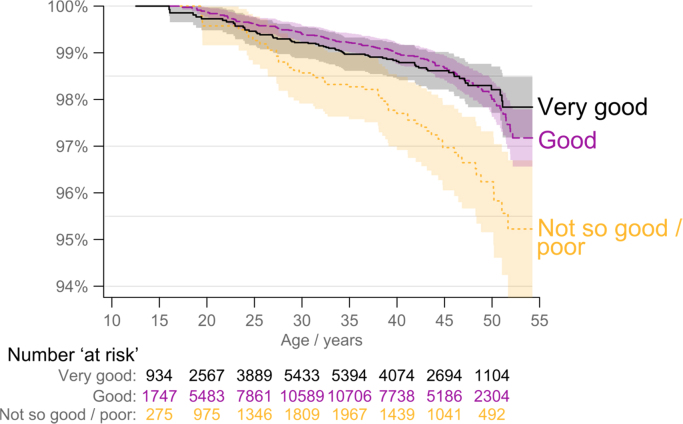
Participants reporting 'not so good'/'poor' SRH had approximately twice the risk of death compared to those reporting 'good' or 'very good' SRH at baseline. The association between low SRH and risk of death was attenuated when the models were adjusted for other predictors, but remained statistically significant. The causes of death differed somewhat between SRH levels. Most of the deaths for people reporting 'very good' SRH at baseline were mostly due to (34%) and (30%). The causes of death were more varied for people reporting 'not so good'/'poor' SRH, with (23%), (21%) and (17%) being the most frequent causes.
SRH predicts all-cause mortality in young adulthood, with poor SRH being associated with death in young adulthood. The findings also indicate different causes of death for different SRH. This knowledge is important for identifying groups at risk for later disease, which can potentially be used to prevent morbidity in the adult population.
自我评估健康状况(SRH)常用于流行病学研究,即便在控制了人口统计学、社会和医学风险因素之后,它一直被证明是发病率和死亡率的有力预测指标。然而,关于SRH与青年期全因死亡率及特定病因死亡率之间的关系,我们了解得较少。
调查年轻人(13至35岁)的SRH作为青年期全因死亡率(54岁之前死亡)的预测指标,并研究相关的死亡原因。
我们使用了两项基于人群的大型队列研究的数据(N = 23,679):Young-HUNT1(1995 - 1997年,13至20岁人群,参与率 = 90%)和HUNT2(1995 - 1997年,20至35岁人群,参与率 = 70%)。这些数据与挪威死亡原因登记处的数据关联至2014年,共识别出247例死亡病例。我们研究的其他预测因素包括年龄、性别、基线吸烟情况、身体活动以及身体和精神残疾情况。
与在基线时报告“良好”或“非常良好”SRH的参与者相比,报告“不太好”/“差”SRH的参与者死亡风险约为其两倍。当模型针对其他预测因素进行调整时,低SRH与死亡风险之间的关联减弱,但仍具有统计学意义。不同SRH水平的死亡原因有所不同。在基线时报告“非常良好”SRH的人群中,大多数死亡主要归因于(34%)和(30%)。报告“不太好”/“差”SRH的人群死亡原因更为多样,(23%)、(21%)和(17%)是最常见的原因。
SRH可预测青年期全因死亡率,SRH差与青年期死亡相关。研究结果还表明不同SRH水平对应的死亡原因不同。这一知识对于识别未来疾病风险人群很重要,有可能用于预防成年人群的发病情况。