Molecular Genetics Section, Laboratory of Neurogenetics, National Institute on Aging, National Institutes of Health, Bethesda, MD.
Instituto de Investigación Biosanitaria de Granada (ibs.GRANADA), Granada, Spain.
Ann Neurol. 2019 Apr;85(4):470-481. doi: 10.1002/ana.25431. Epub 2019 Mar 13.
To identify shared polygenic risk and causal associations in amyotrophic lateral sclerosis (ALS).
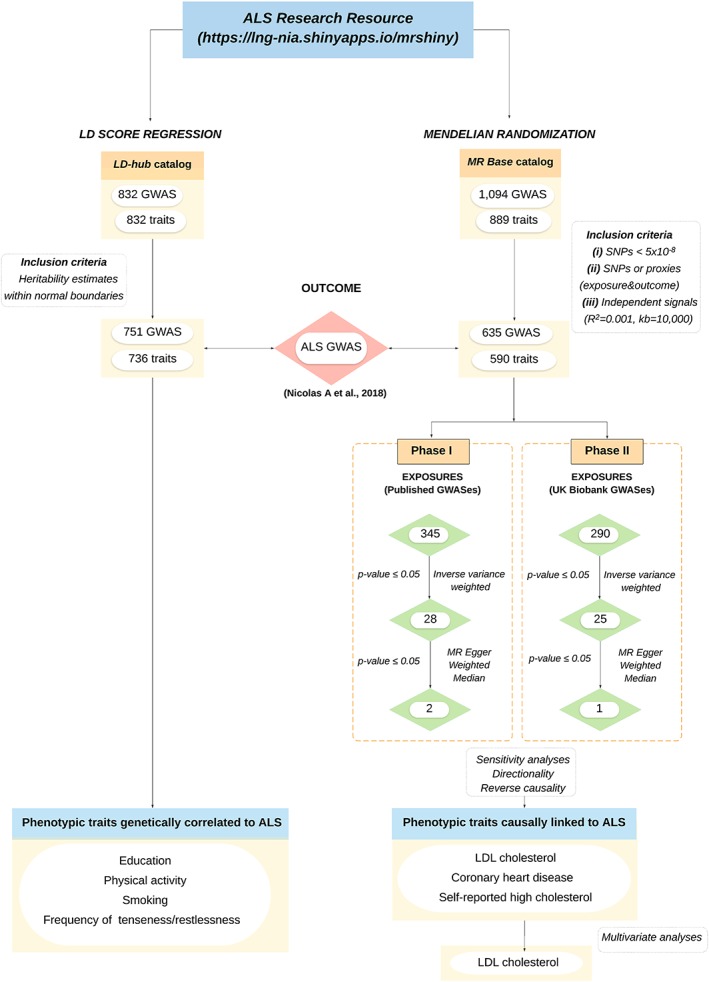
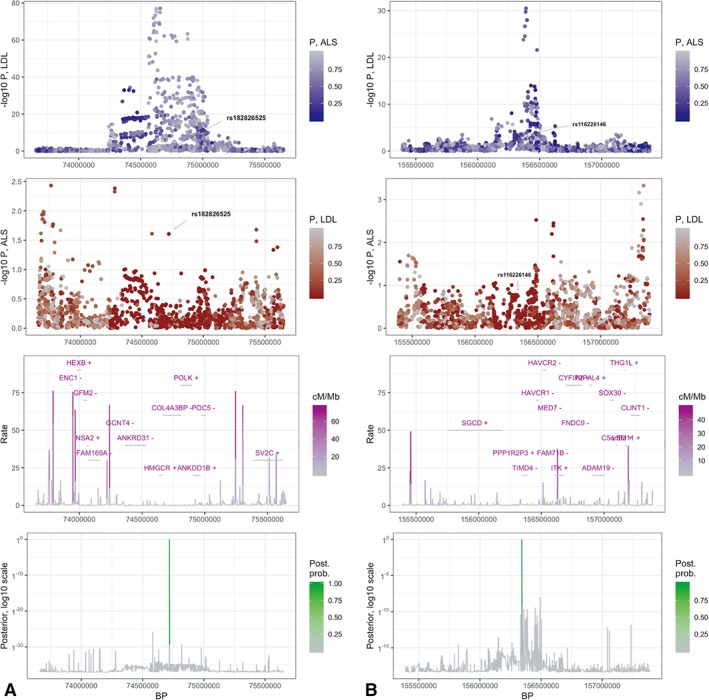
Linkage disequilibrium score regression and Mendelian randomization were applied in a large-scale, data-driven manner to explore genetic correlations and causal relationships between >700 phenotypic traits and ALS. Exposures consisted of publicly available genome-wide association studies (GWASes) summary statistics from MR Base and LD-hub. The outcome data came from the recently published ALS GWAS involving 20,806 cases and 59,804 controls. Multivariate analyses, genetic risk profiling, and Bayesian colocalization analyses were also performed.
We have shown, by linkage disequilibrium score regression, that ALS shares polygenic risk genetic factors with a number of traits and conditions, including positive correlations with smoking status and moderate levels of physical activity, and negative correlations with higher cognitive performance, higher educational attainment, and light levels of physical activity. Using Mendelian randomization, we found evidence that hyperlipidemia is a causal risk factor for ALS and localized putative functional signals within loci of interest.
Here, we have developed a public resource (https://lng-nia.shinyapps.io/mrshiny) which we hope will become a valuable tool for the ALS community, and that will be expanded and updated as new data become available. Shared polygenic risk exists between ALS and educational attainment, physical activity, smoking, and tenseness/restlessness. We also found evidence that elevated low-desnity lipoprotein cholesterol is a causal risk factor for ALS. Future randomized controlled trials should be considered as a proof of causality. Ann Neurol 2019;85:470-481.
确定肌萎缩侧索硬化症(ALS)中共同的多基因风险和因果关联。
采用连锁不平衡评分回归和孟德尔随机化方法,以大规模、数据驱动的方式探讨 700 多种表型特征与 ALS 之间的遗传相关性和因果关系。暴露因素包括来自 MR Base 和 LD-hub 的公开全基因组关联研究(GWAS)汇总统计数据。结果数据来自最近发表的一项涉及 20806 例病例和 59804 例对照的 ALS GWAS。还进行了多变量分析、遗传风险分析和贝叶斯共定位分析。
通过连锁不平衡评分回归,我们表明 ALS 与多种特征和疾病存在共同的多基因风险遗传因素,包括与吸烟状况和适度体力活动呈正相关,与较高的认知表现、较高的教育程度和较低水平的体力活动呈负相关。通过孟德尔随机化,我们发现高血脂是 ALS 的一个因果风险因素,并在感兴趣的基因座内定位到了潜在的功能信号。
在这里,我们开发了一个公共资源(https://lng-nia.shinyapps.io/mrshiny),我们希望它将成为 ALS 社区的一个有价值的工具,并将随着新数据的出现而扩展和更新。ALS 与教育程度、体力活动、吸烟和紧张/不安之间存在共同的多基因风险。我们还发现证据表明,升高的低密度脂蛋白胆固醇是 ALS 的一个因果风险因素。未来的随机对照试验应被视为因果关系的证据。Ann Neurol 2019;85:470-481.