Department of Biomedical Engineering, University of Florida, Gainesville, FL, United States.
Department of Epidemiology, University of Florida, Gainesville, FL, United States.
JMIR Mhealth Uhealth. 2019 Feb 6;7(2):e11270. doi: 10.2196/11270.
Wearable accelerometers have greatly improved measurement of physical activity, and the increasing popularity of smartwatches with inherent acceleration data collection suggest their potential use in the physical activity research domain; however, their use needs to be validated.
This study aimed to assess the validity of accelerometer data collected from a Samsung Gear S smartwatch (SGS) compared with an ActiGraph GT3X+ (GT3X+) activity monitor. The study aims were to (1) assess SGS validity using a mechanical shaker; (2) assess SGS validity using a treadmill running test; and (3) compare individual activity recognition, location of major body movement detection, activity intensity detection, locomotion recognition, and metabolic equivalent scores (METs) estimation between the SGS and GT3X+.
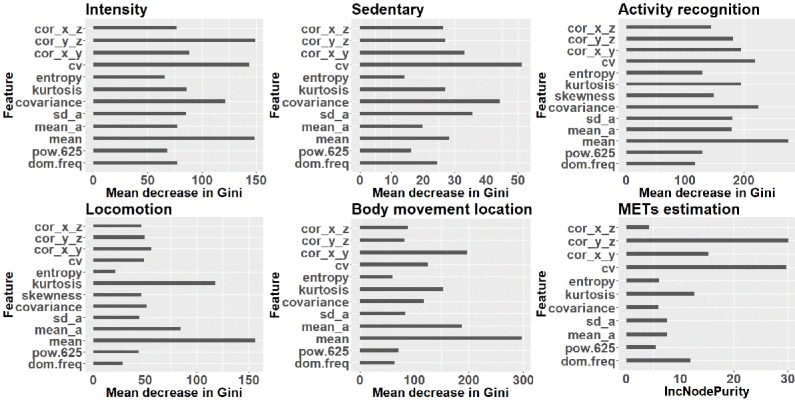
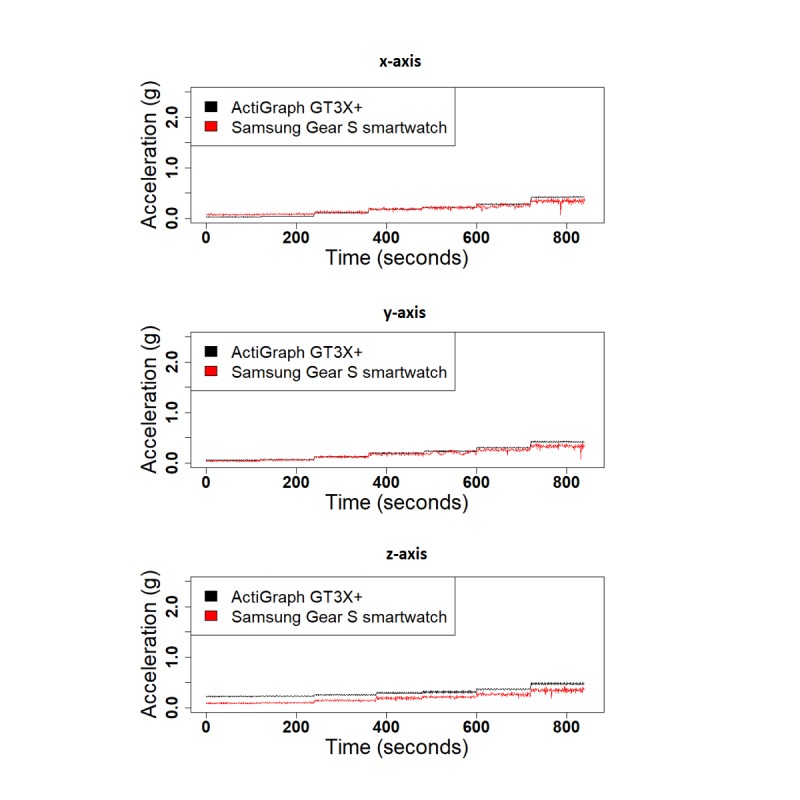
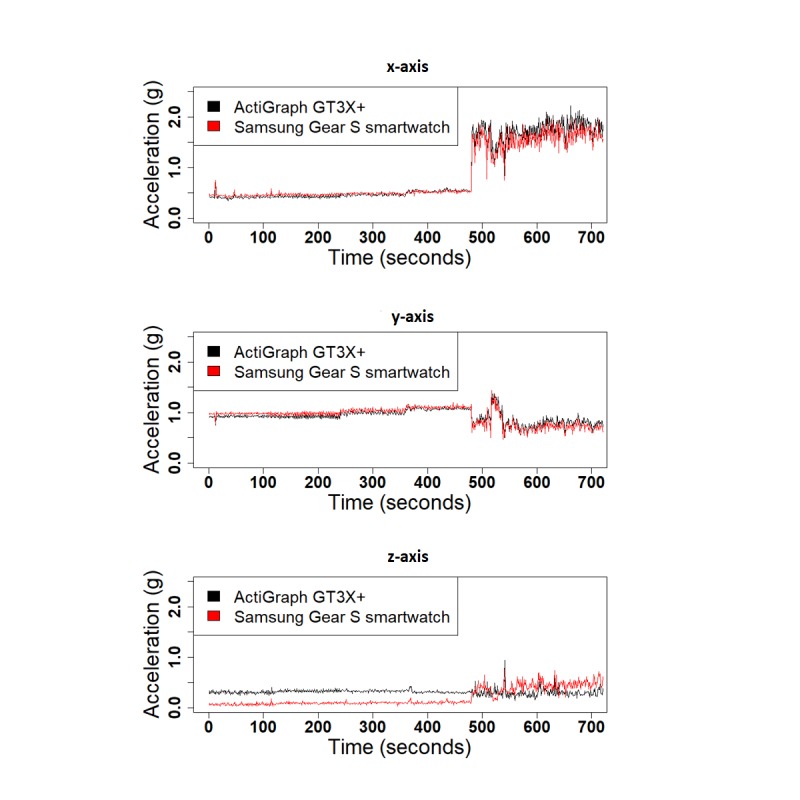
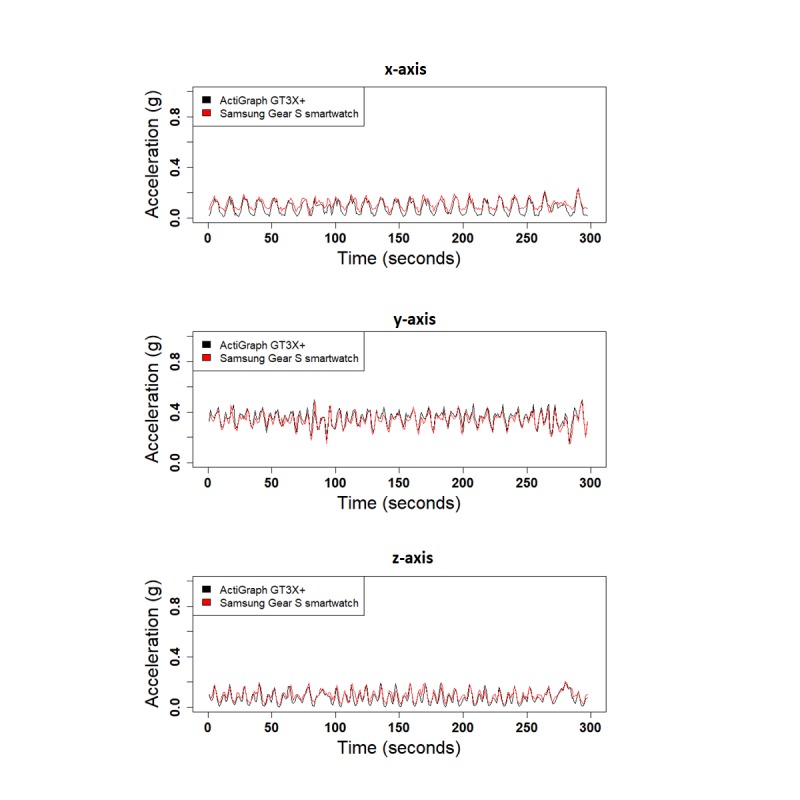
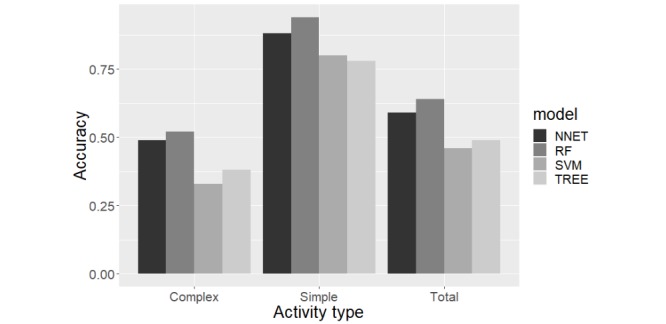
To validate and compare the SGS accelerometer data with GT3X+ data, we collected data simultaneously from both devices during highly controlled, mechanically simulated, and less-controlled natural wear conditions. First, SGS and GT3X+ data were simultaneously collected from a mechanical shaker and an individual ambulating on a treadmill. Pearson correlation was calculated for mechanical shaker and treadmill experiments. Finally, SGS and GT3X+ data were simultaneously collected during 15 common daily activities performed by 40 participants (n=12 males, mean age 55.15 [SD 17.8] years). A total of 15 frequency- and time-domain features were extracted from SGS and GT3X+ data. We used these features for training machine learning models on 6 tasks: (1) individual activity recognition, (2) activity intensity detection, (3) locomotion recognition, (4) sedentary activity detection, (5) major body movement location detection, and (6) METs estimation. The classification models included random forest, support vector machines, neural networks, and decision trees. The results were compared between devices. We evaluated the effect of different feature extraction window lengths on model accuracy as defined by the percentage of correct classifications. In addition to these classification tasks, we also used the extracted features for METs estimation.
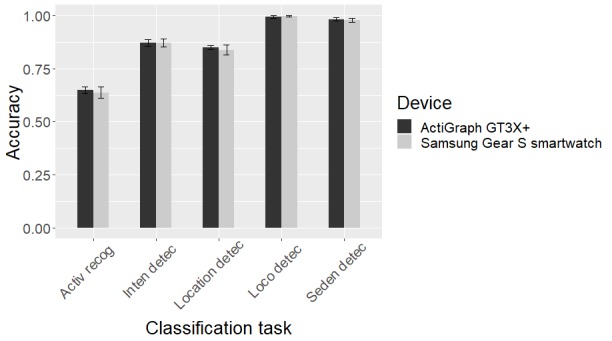
The results were compared between devices. Accelerometer data from SGS were highly correlated with the accelerometer data from GT3X+ for all 3 axes, with a correlation ≥.89 for both the shaker test and treadmill test and ≥.70 for all daily activities, except for computer work. Our results for the classification of activity intensity levels, locomotion, sedentary, major body movement location, and individual activity recognition showed overall accuracies of 0.87, 1.00, 0.98, 0.85, and 0.64, respectively. The results were not significantly different between the SGS and GT3X+. Random forest model was the best model for METs estimation (root mean squared error of .71 and r-squared value of .50).
Our results suggest that a commercial brand smartwatch can be used in lieu of validated research grade activity monitors for individual activity recognition, major body movement location detection, activity intensity detection, and locomotion detection tasks.
可穿戴加速度计极大地改善了身体活动的测量,而具有固有加速度数据采集功能的智能手表日益普及,这表明它们可能在身体活动研究领域得到应用;然而,其使用需要经过验证。
本研究旨在评估三星 Gear S 智能手表(SGS)与 ActiGraph GT3X+(GT3X+)活动监测器采集的加速度计数据的有效性。本研究的目的是:(1)使用机械振动器评估 SGS 的有效性;(2)使用跑步机跑步测试评估 SGS 的有效性;(3)比较 SGS 和 GT3X+在个体活动识别、主要身体运动检测位置、活动强度检测、运动识别和代谢当量(MET)估计方面的性能。
为了验证和比较 SGS 加速度计数据与 GT3X+数据,我们在高度受控、机械模拟和自然佩戴条件下同时从这两种设备中采集数据。首先,在机械振动器和个体在跑步机上行走时,同时从 SGS 和 GT3X+采集数据。对机械振动器和跑步机实验进行 Pearson 相关分析。最后,在 40 名参与者(n=12 名男性,平均年龄 55.15[SD 17.8]岁)进行的 15 项常见日常活动中同时采集 SGS 和 GT3X+数据。从 SGS 和 GT3X+数据中提取了 15 个频域和时域特征。我们使用这些特征在 6 项任务上训练机器学习模型:(1)个体活动识别;(2)活动强度检测;(3)运动识别;(4)久坐活动检测;(5)主要身体运动位置检测;(6)MET 估计。分类模型包括随机森林、支持向量机、神经网络和决策树。比较设备之间的结果。我们评估了不同特征提取窗口长度对模型准确性的影响,定义为正确分类的百分比。除了这些分类任务之外,我们还使用提取的特征进行 MET 估计。
对设备之间的结果进行了比较。SGS 的加速度计数据与 GT3X+的加速度计数据在所有 3 个轴上均高度相关,在振动器测试和跑步机测试中相关性均≥.89,在所有日常活动中相关性均≥.70,除了计算机工作。我们对活动强度水平、运动、久坐、主要身体运动位置和个体活动识别的分类结果的总体准确性分别为 0.87、1.00、0.98、0.85 和 0.64。SGS 和 GT3X+之间的结果没有显著差异。随机森林模型是 MET 估计的最佳模型(均方根误差为.71,r-squared 值为.50)。
我们的研究结果表明,商用品牌智能手表可用于替代经过验证的研究级活动监测器,用于个体活动识别、主要身体运动位置检测、活动强度检测和运动检测任务。