Mueller P P, Jackson B M, Miller P F, Hinnebusch A G
Unit on Molecular Genetics of Lower Eukaryotes, National Institute of Child Health and Human Development, Bethesda, Maryland 20892.
Mol Cell Biol. 1988 Dec;8(12):5439-47. doi: 10.1128/mcb.8.12.5439-5447.1988.
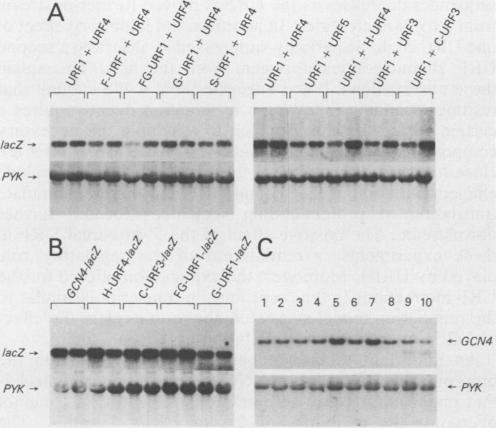
The third and fourth AUG codons in GCN4 mRNA efficiently repress translation of the GCN4-coding sequences under normal growth conditions. The first AUG codon is approximately 30-fold less inhibitory and is required under amino acid starvation conditions to override the repressing effects of AUG codons 3 and 4. lacZ fusions constructed to functional, elongated versions of the first and fourth upstream open reading frames (URFs) were used to show that AUG codons 1 and 4 function similarly as efficient translational start sites in vivo, raising the possibility that steps following initiation distinguish the regulatory properties of URFs 1 and 4. In accord with this idea, we observed different consequences of changing the length and termination site of URF1 versus changing those of URFs 3 and 4. The latter were lengthened considerably, with little or no effect on regulation. In fact, the function of URFs 3 and 4 was partially reconstituted with a completely heterologous URF. By contrast, certain mutations that lengthen URF1 impaired its positive regulatory function nearly as much as removing its AUG codon did. The same mutations also made URF1 a much more inhibitory element when it was present alone in the mRNA leader. These results strongly suggest that URFs 1 and 4 both function in regulation as translated coding sequences. To account for the phenotypes of the URF1 mutations, we suggest the most ribosomes normally translate URF1 and that the mutations reduce the number of ribosomes that are able to complete URF1 translation and resume scanning downstream. This effect would impair URF1 positive regulatory function if ribosomes must first translate URF1 in order to overcome the strong translational block at the 3'-proximal URFs. Because URF1-lacZ fusions were translated at the same rate under repressing and derepressing conditions, it appears that modulating initiation at URF1 is not the means that is used to restrict the regulatory consequences of URF1 translation to starvation conditions.
在正常生长条件下,GCN4 mRNA中的第三个和第四个AUG密码子可有效抑制GCN4编码序列的翻译。第一个AUG密码子的抑制作用约低30倍,在氨基酸饥饿条件下,它是克服第三个和第四个AUG密码子抑制作用所必需的。构建到第一个和第四个上游开放阅读框(URF)的功能性、延长版本的lacZ融合体用于表明,AUG密码子1和4在体内作为有效的翻译起始位点发挥相似的作用,这增加了起始后步骤区分URF1和4调控特性的可能性。与此观点一致,我们观察到改变URF1的长度和终止位点与改变URF3和4的长度和终止位点会产生不同的结果。后者被大幅延长,对调控几乎没有影响。事实上,用一个完全异源的URF可部分重建URF3和4的功能。相比之下,某些延长URF1的突变几乎与去除其AUG密码子一样严重损害其正调控功能。当URF1单独存在于mRNA前导序列中时,相同的突变也使它成为一个更具抑制性的元件。这些结果强烈表明,URF1和4在调控中均作为已翻译的编码序列发挥作用。为了解释URF1突变的表型,我们认为大多数核糖体通常翻译URF1,而这些突变减少了能够完成URF1翻译并继续下游扫描的核糖体数量。如果核糖体必须首先翻译URF1才能克服3'近端URF处的强翻译阻断,那么这种效应将损害URF1的正调控功能。由于URF1 - lacZ融合体在抑制和去抑制条件下以相同的速率翻译,似乎调节URF1处的起始不是用于将URF1翻译的调控后果限制在饥饿条件下的手段。