Barros Ângela Ferreira, Araújo Jeniffer Melo de, Murta-Nascimento Cristiane, Dias Adriano
Escola Superior de Ciências da Saúde. Secretaria de Estado de Saúde do Distrito Federal. Brasília, DF, Brasil.
Universidade Estadual Paulista. Faculdade de Medicina. Programa de Pós-Graduação em Saúde Coletiva. Botucatu, SP, Brasil.
Rev Saude Publica. 2019 Jan 31;53:14. doi: 10.11606/S1518-8787.2019053000406.
To identify the clinical pathways of women with breast cancer treated in public hospitals, and to analyze the factors that influence the time interval between the first appointment and the start of therapy.
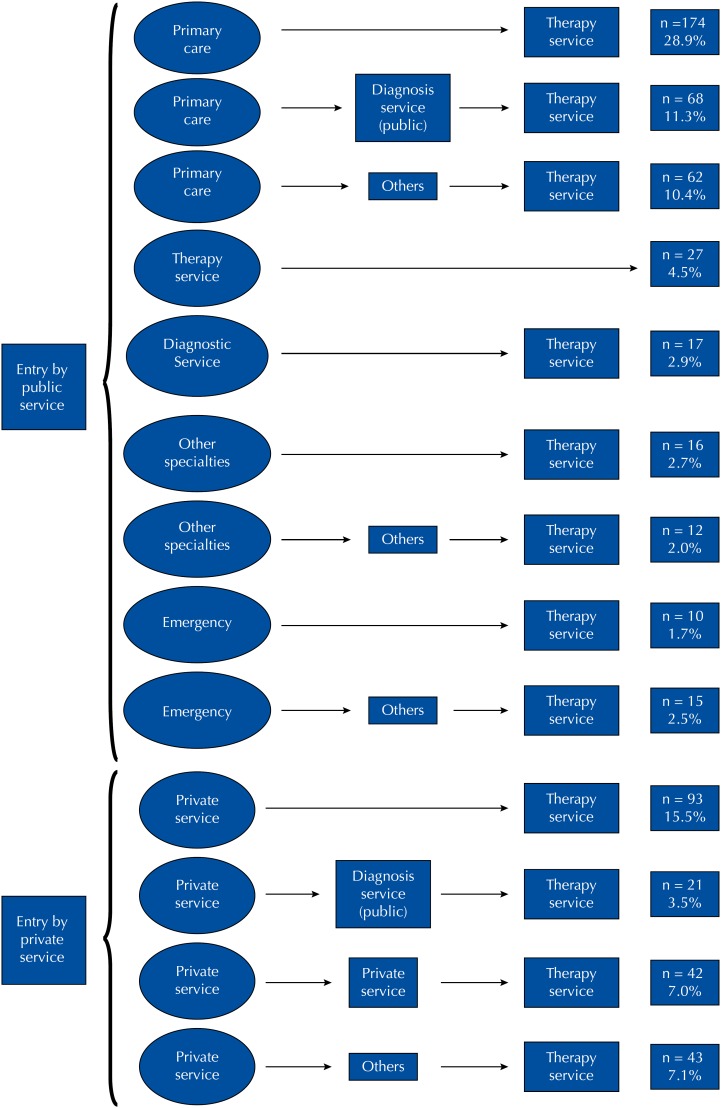
A cross-sectional study was conducted with 600 women with breast cancer treated in nine public hospitals in the Brazilian Federal District. Patients were interviewed between September 2012 and September 2014. Simple and multiple logistic regression models were adjusted to evaluate the variables associated with the time interval studied. The most frequent pathway was the one that started in primary care with following care in the therapy service (28.9%). In the multiple adjustment, factors associated to a longer time interval between the first appointment and therapy were: lower family income (OR = 1.89; 95%CI 1.32-2.68), the first appointment in public services (OR = 1.78; 95%CI 1.20-2.64), care in more than two health services in the clinical pathway (OR = 1.71; 95%CI 1.19-2.44); and obtaining the anatomopathological analysis of the biopsy in public services instead of private health services (OR = 1.87; 95%CI 1.29-2.71). Independently, the implementation of specialist appointment scheduling, with care regulation, was associated with a shorter time interval between first appointment and therapy (OR = 0.33; 95%CI 0.16-0.65).
We observed that multiple pathways were covered by women with breast cancer treated in public services of the Federal District. Socioeconomic iniquities and several aspectos of the pathways covered were associated with a longer time interval between the first appointment and the start of breast cancer therapy.
确定在公立医院接受治疗的乳腺癌女性的临床路径,并分析影响首次预约至治疗开始时间间隔的因素。
对巴西联邦区9家公立医院治疗的600例乳腺癌女性进行横断面研究。在2012年9月至2014年9月期间对患者进行访谈。调整简单和多元逻辑回归模型以评估与所研究时间间隔相关的变量。最常见的路径是从初级保健开始,随后在治疗服务机构接受治疗(28.9%)。在多元调整中,与首次预约至治疗时间间隔较长相关的因素有:家庭收入较低(OR = 1.89;95%CI 1.32 - 2.68)、在公共服务机构进行首次预约(OR = 1.78;95%CI 1.20 - 2.64)、临床路径中在两个以上医疗服务机构接受治疗(OR = 1.71;95%CI 1.19 - 2.44);以及在公共服务机构而非私立医疗服务机构获得活检的解剖病理学分析结果(OR = 1.87;95%CI 1.29 - 2.71)。独立来看,实施有护理规范的专科预约安排与首次预约至治疗的时间间隔较短相关(OR = 0.33;95%CI 0.16 - 0.65)。
我们观察到,在联邦区公共服务机构接受治疗的乳腺癌女性涵盖了多种路径。社会经济不平等以及所涵盖路径的几个方面与首次预约至乳腺癌治疗开始的时间间隔较长相关。