Ortega Eduardo, Gálvez Isabel, Martín-Cordero Leticia
Department of Physiology (Immunophysiology Research Group), Faculty of Sciences, University of Extremadura, Badajoz, Spain.
Department of Nursing (Immunophysiology Research Group), University Center of Plasencia, University of Extremadura, Plasencia, Spain.
Endocr Metab Immune Disord Drug Targets. 2019;19(8):1089-1099. doi: 10.2174/1871530319666190206124520.
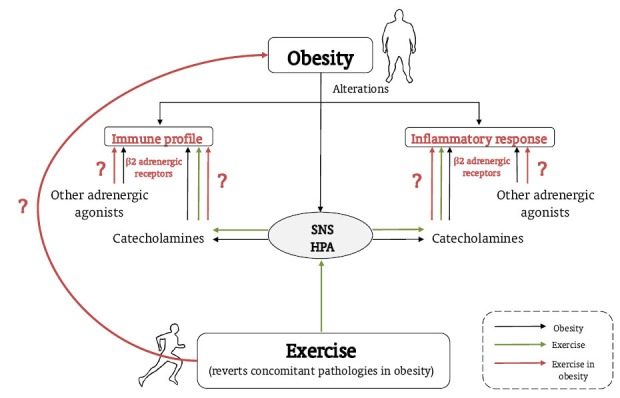
The effects of exercise on the innate/inflammatory immune responses are crucially mediated by catecholamines and adrenoreceptors; and mediations in both stimulatory and anti-inflammatory responses have been attributed to them. Obesity and metabolic syndrome are included among low-grade chronic inflammatory pathologies; particularly because patients have a dysregulation of the inflammatory and stress responses, which can lead to high levels of inflammatory cytokines that induce insulin resistance, contributing to the onset or exacerbation of type 2 diabetes. Macrophages play a crucial role in this obesity-induced inflammation. Although most of the antiinflammatory effects of catecholamines are mediated by β adrenergic receptors (particularly β2), it is not known whether in altered homeostatic conditions, such as obesity and during exercise, innate/ inflammatory responses of macrophages to β2 adrenergic stimulation are similar to those in cells of healthy organisms at baseline.
This review aims to emphasize that there could be possible different responses to β2 adrenergic stimulation in obesity, and exercise in this condition.
A revision of the literature based on the hypothesis that obesity affects β2 adrenergic regulation of macrophage-mediated innate/inflammatory responses, as well as the effect of exercise in this context.
The inflammatory responses mediated by β2 adrenoreceptors are different in obese individuals with altered inflammatory states at baseline compared to healthy individuals, and exercise can also interfere with these responses. Nevertheless, it is clearly necessary to develop more studies that contribute to widening the knowledge of the neuroimmune regulation process in obesity, particularly in this context.
运动对先天性/炎症性免疫反应的影响关键由儿茶酚胺和肾上腺素能受体介导;刺激反应和抗炎反应均归因于它们。肥胖和代谢综合征属于低度慢性炎症性疾病;特别是因为患者的炎症反应和应激反应失调,这可能导致诱导胰岛素抵抗的炎症细胞因子水平升高,从而促使2型糖尿病的发生或加重。巨噬细胞在这种肥胖诱导的炎症中起关键作用。尽管儿茶酚胺的大多数抗炎作用由β肾上腺素能受体(特别是β2)介导,但尚不清楚在肥胖和运动等内环境稳态改变的情况下,巨噬细胞对β2肾上腺素能刺激的先天性/炎症反应是否与健康生物体细胞在基线时的反应相似。
本综述旨在强调在肥胖及肥胖状态下运动时,对β2肾上腺素能刺激可能存在不同反应。
基于肥胖影响巨噬细胞介导的先天性/炎症反应的β2肾上腺素能调节这一假设以及运动在此背景下的作用对文献进行综述。
与健康个体相比,基线时炎症状态改变的肥胖个体中,由β2肾上腺素能受体介导的炎症反应不同,运动也会干扰这些反应。然而,显然有必要开展更多研究,以拓宽对肥胖中神经免疫调节过程的认识,特别是在此背景下。