Liquid biopsy and metastasis research group, GENYO, Centre for Genomics and Oncological Research, Pfizer/University of Granada/Andalusian Regional Government PTS, Granada, Avenida de la Ilustración 114, 18016, Granada, Spain.
Laboratory of Genetic Identification, Legal Medicine and Toxicology Department, Faculty of Medicine, University of Granada, Avenida de la Investigación, 11, 18071, Granada, Spain.
Breast Cancer Res. 2019 Feb 6;21(1):21. doi: 10.1186/s13058-019-1109-0.
Breast cancer patients under neoadjuvant chemotherapy includes a heterogeneous group of patients who eventually develop distal disease, not detectable by current methods. We propose the use of exosomal miRNAs and circulating tumor cells as diagnostic and predictive biomarkers in these patients.
Fifty-three breast cancer women initially diagnosed with localized breast cancer under neoadjuvant chemotherapy were prospectively enrolled in this study. However, six of them were later re-evaluated and diagnosed as metastatic breast cancer patients by PET-CT scan. Additionally, eight healthy donors were included. Circulating tumor cells and serum exosomal miRNAs were isolated from blood samples before and at the middle of neoadjuvant therapy and exosomal miRNA levels analyzed by qPCR.
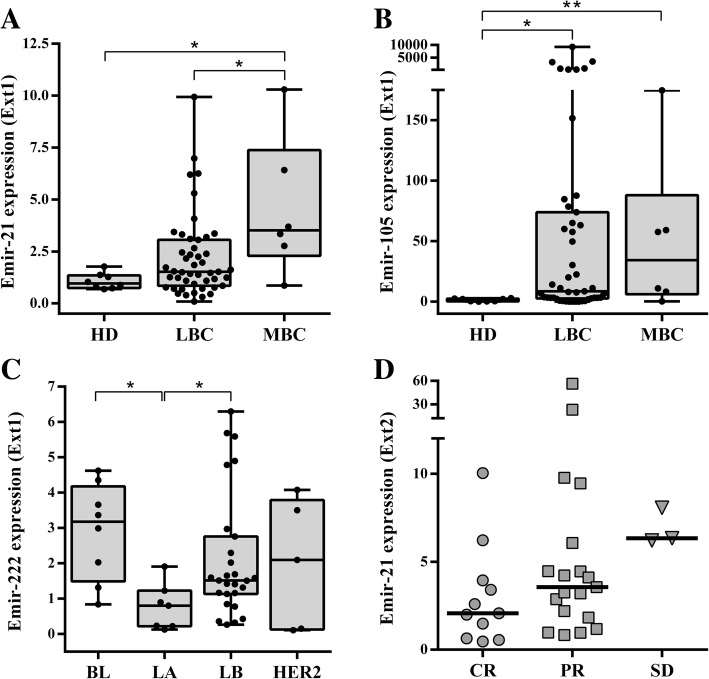
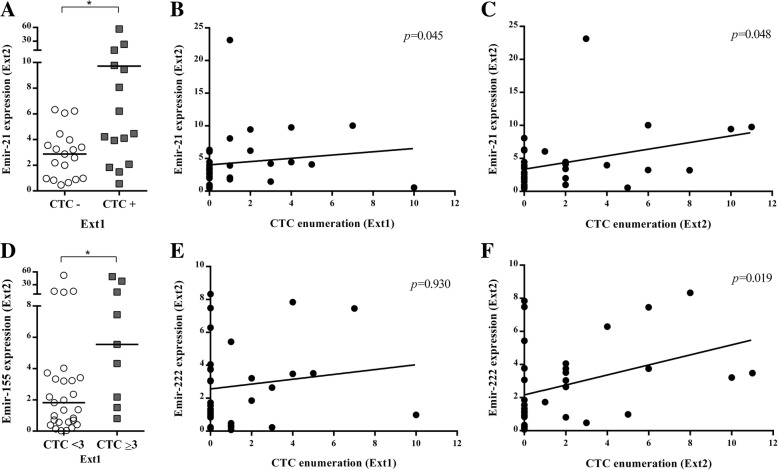
Before neoadjuvant therapy, exosomal miRNA-21 and 105 expression levels were higher in metastatic versus non-metastatic patients and healthy donors. Likewise, higher levels of miRNA-222 were observed in basal-like (p = 0.037) and in luminal B versus luminal A (p = 0.0145) tumor subtypes. Exosomal miRNA-222 levels correlated with clinical and pathological variables such as progesterone receptor status (p = 0.017) and Ki67 (p = 0.05). During neoadjuvant treatment, exosomal miRNA-21 expression levels directly correlated with tumor size (p = 0.039) and inversely with Ki67 expression (p = 0.031). Finally, higher levels of exosomal miRNA-21, miRNA-222, and miRNA-155 were significantly associated with the presence of circulating tumor cells.
Liquid biopsies based on exosomal miRNAs and circulating tumor cells can be a complementary clinical tool for improving breast cancer diagnosis and prognosis.
接受新辅助化疗的乳腺癌患者包括一组异质性患者,他们最终会发展为远处疾病,目前的方法无法检测到。我们建议在这些患者中使用外泌体 miRNA 和循环肿瘤细胞作为诊断和预测生物标志物。
本前瞻性研究纳入了 53 名最初诊断为局部乳腺癌并接受新辅助化疗的乳腺癌女性患者。然而,其中 6 名患者后来通过 PET-CT 扫描重新评估并诊断为转移性乳腺癌患者。此外,还纳入了 8 名健康供体。在新辅助治疗前和中期从血液样本中分离循环肿瘤细胞和血清外泌体 miRNA,并通过 qPCR 分析外泌体 miRNA 水平。
在新辅助治疗前,转移性患者和健康供体的外泌体 miRNA-21 和 105 表达水平高于非转移性患者。同样,在基底样(p=0.037)和 luminal B 型(p=0.0145)肿瘤亚型中观察到更高水平的 miRNA-222。外泌体 miRNA-222 水平与孕激素受体状态(p=0.017)和 Ki67(p=0.05)等临床和病理变量相关。在新辅助治疗期间,外泌体 miRNA-21 表达水平与肿瘤大小直接相关(p=0.039),与 Ki67 表达水平呈负相关(p=0.031)。最后,外泌体 miRNA-21、miRNA-222 和 miRNA-155 水平升高与循环肿瘤细胞的存在显著相关。
基于外泌体 miRNA 和循环肿瘤细胞的液体活检可以作为改善乳腺癌诊断和预后的一种补充临床工具。