Department of Nutrition and Health Sciences, Human Performance Laboratory, University of Nebraska - Lincoln, 110 Ruth Leverton Hall, Lincoln, NE, 68583-0806, USA.
J Int Soc Sports Nutr. 2019 Feb 6;16(1):3. doi: 10.1186/s12970-019-0270-2.
Shilajit is a safe, fluvic mineral complex exudate that is common to Ayurvedic medicine and is composed of fulvic acids, dibenzo-α-pyrones, proteins, and minerals. The purpose of this study was to examine the effects of 8 weeks of Shilajit supplementation at 250 mg·d (low dose) and 500 mg·d (high dose) versus placebo on maximal voluntary isometric contraction (MVIC) strength, concentric peak torque, fatigue-induced percent decline in strength, and serum hydroxyproline (HYP).
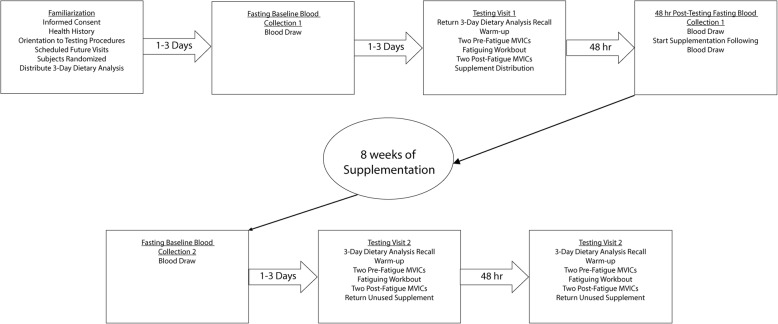
Sixty-three recreationally-active men ([Formula: see text] ± SD: 21.2 ± 2.4 yr.; 179.8 ± 6.3 cm; 83.1 ± 12.7 kg) volunteered to participate in this study. The subjects were randomly assigned to the high dose, low dose, or placebo group (each group: n = 21). During pre-supplementation testing, the subjects performed 2 pretest MVICs, 2 sets of 50 maximal, bilateral, concentric isokinetic leg extensions at 180°·s separated by 2-min of rest, and 2 posttest MVICs. Following 8 weeks of supplementation, the subjects repeated the pre-supplementation testing procedures. In addition, the groups were dichotomized at the 50th percentile based on pre-supplementation MVIC and baseline HYP. Mixed model ANOVAs and ANCOVAs were used to statistically analyze the dependent variables for the total groups (n = 21 per group) as well as dichotomized groups.
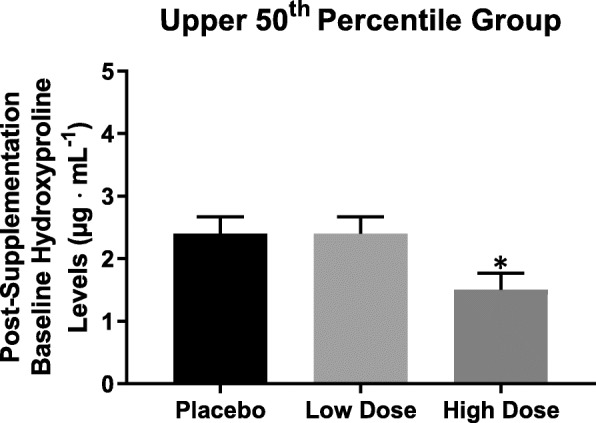
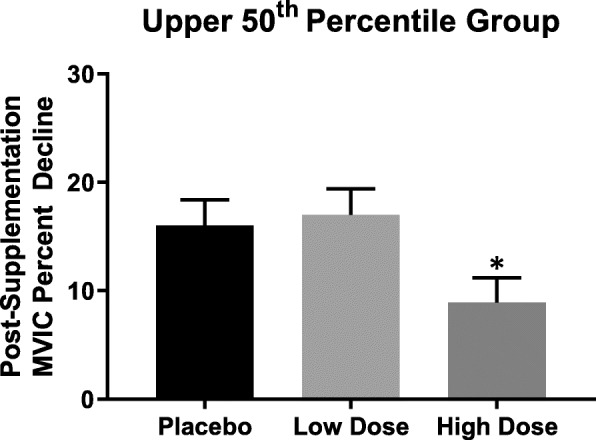
For the upper 50th percentile group, the post-supplementation adjusted mean percent decline in MVIC was significantly less for the high dose group (8.9 ± 2.3%) than the low dose (17.0 ± 2.4%; p = 0.022) and placebo (16.0 ± 2.4%; p = 0.044) groups. There was no significant (p = 0.774) difference, however, between the low dose and placebo groups. In addition, for the upper 50th percentile group, the adjusted mean post-supplementation baseline HYP for the high dose group (1.5 ± 0.3 μg·mL) was significantly less than both the low dose (2.4 ± 0.3 μg·mL; p = 0.034) and placebo (2.4 ± 0.3 μg·mL, p = 0.024) groups.
The results of the present study demonstrated that 8 weeks of PrimaVie® Shilajit supplementation at 500 mg·d promoted the retention of maximal muscular strength following the fatiguing protocol and decreased baseline HYP. Thus, PrimaVie® Shilajit supplementation at 500 mg·d elicited favorable muscle and connective tissue adaptations.
喜来芝是一种安全的、富里酸矿物复合物渗出物,常见于阿育吠陀医学,由富里酸、二苯并-α-吡喃酮、蛋白质和矿物质组成。本研究的目的是检验 8 周喜来芝补充剂(250mg·d[低剂量]和 500mg·d[高剂量])与安慰剂相比对最大自主等长收缩(MVIC)强度、向心峰值扭矩、疲劳诱导的力量下降百分比以及血清羟脯氨酸(HYP)的影响。
63 名休闲活跃的男性([公式:见文本]±SD:21.2±2.4 岁;179.8±6.3cm;83.1±12.7kg)自愿参加这项研究。受试者被随机分配到高剂量组、低剂量组或安慰剂组(每组:n=21)。在补充前测试中,受试者进行了 2 次预测试 MVIC、2 组 50 次最大、双侧、180°·s 等速腿伸,每组间隔 2 分钟休息,以及 2 次后测试 MVIC。在 8 周补充后,受试者重复了补充前的测试程序。此外,根据补充前的 MVIC 和基线 HYP,将组分为 50%的二分位数。混合模型方差分析和协方差分析用于统计分析总组(每组 n=21)以及二分位数组的因变量。
对于上 50%组,高剂量组的 MVIC 后补充调整后的平均下降百分比明显低于低剂量组(8.9%±2.3%)和安慰剂组(16.0%±2.4%;p=0.044)。然而,低剂量组和安慰剂组之间没有显著差异(p=0.774)。此外,对于上 50%组,高剂量组的补充后调整后的基线 HYP 平均值(1.5±0.3μg·mL)明显低于低剂量组(2.4±0.3μg·mL;p=0.034)和安慰剂组(2.4±0.3μg·mL,p=0.024)。
本研究结果表明,8 周 PrimaVie®喜来芝补充剂 500mg·d 可促进疲劳方案后最大肌肉力量的保留,并降低基线 HYP。因此,PrimaVie®喜来芝补充剂 500mg·d 可引起有利的肌肉和结缔组织适应性变化。