International Health Policy Program, Ministry of Public Health, Tivanond Road, Muang District, Nonthaburi 11000, Thailand.
Nutrition and Indigenous Medicine, Ministry of Health, Colombo, Sri Lanka.
Bull World Health Organ. 2019 Feb 1;97(2):129-141. doi: 10.2471/BLT.18.220483. Epub 2018 Dec 19.
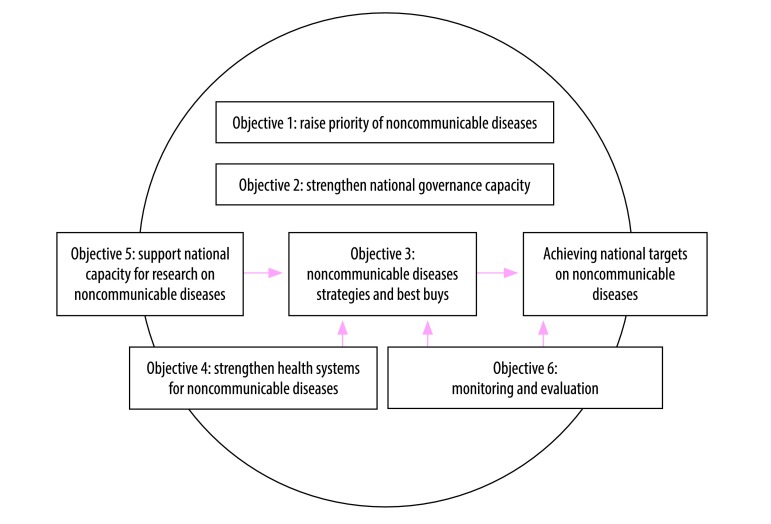
By 2016, Member States of the World Health Organization (WHO) had developed and implemented national action plans on noncommunicable diseases in line with the In 2018, we assessed the implementation status of the recommended best-buy noncommunicable diseases interventions in seven Asian countries: Bhutan, Cambodia, Indonesia, Philippines, Sri Lanka, Thailand and Viet Nam. We gathered data from a range of published reports and directly from health ministries. We included interventions that addressed the use of tobacco and alcohol, inadequate physical activity and high salt intake, as well as health-systems responses, and we identified gaps and proposed solutions. In 2018, progress was uneven across countries. Implementation gaps were largely due to inadequate funding; limited institutional capacity (despite designated noncommunicable diseases units); inadequate action across different sectors within and outside the health system; and a lack of standardized monitoring and evaluation mechanisms to inform policies. To address implementation gaps, governments need to invest more in effective interventions such as the WHO-recommended best-buy interventions, improve action across different sectors, and enhance capacity in monitoring and evaluation and in research. Learning from the Framework Convention on Tobacco Control, the WHO and international partners should develop a standardized, comprehensive monitoring tool on alcohol, salt and unhealthy food consumption, physical activity and health-systems response.
到 2016 年,世界卫生组织(世卫组织)会员国已按照《2013-2020 年预防和控制非传染性疾病全球行动计划》制定和实施了国家行动计划。2018 年,我们评估了七个亚洲国家(不丹、柬埔寨、印度尼西亚、菲律宾、斯里兰卡、泰国和越南)实施建议的最佳可负担非传染性疾病干预措施的情况。我们从各种已发表的报告和直接从卫生部收集数据。我们纳入了针对烟草和酒精使用、身体活动不足和盐摄入量高以及卫生系统应对措施的干预措施,并确定了差距并提出了解决方案。2018 年,各国进展参差不齐。执行方面的差距主要是由于资金不足;机构能力有限(尽管指定了非传染性疾病部门);卫生系统内外不同部门行动不足;缺乏标准化的监测和评估机制来为政策提供信息。为了解决执行方面的差距,政府需要更多地投资于有效的干预措施,如世卫组织建议的最佳可负担干预措施,改善不同部门的行动,并加强监测和评估以及研究方面的能力。从《烟草控制框架公约》中吸取经验,世卫组织和国际伙伴应制定一个关于酒精、盐和不健康食品消费、身体活动和卫生系统应对的标准化、全面的监测工具。