Nuffield Department of Population Health, University of Oxford, Oxford, United Kingdom.
Ministry of Health and Wellness, Gaborone, Botswana.
Bull World Health Organ. 2019 Feb 1;97(2):142-153. doi: 10.2471/BLT.18.221424. Epub 2019 Jan 8.
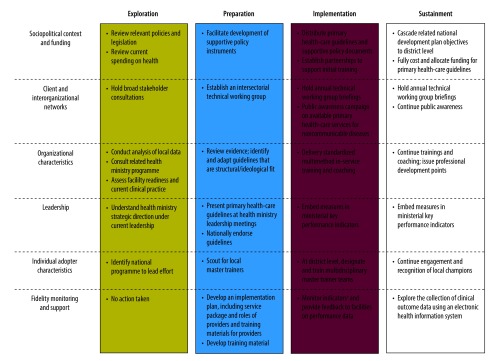
Despite the rising burden of noncommunicable diseases, access to quality decentralized noncommunicable disease services remain limited in many low- and middle-income countries. Here we describe the strategies we employed to drive the process from adaptation to national endorsement and implementation of the . The strategies included detailed multilevel assessment with broad stakeholder inputs and in-depth analysis of local data; leveraging academic partnerships; facilitating development of supporting policy instruments; and embedding noncommunicable disease guidelines within broader primary health-care guidelines in keeping with the health ministry strategic direction. At facility level, strategies included developing a multimethod training programme for health-care providers, leveraging on the experience of provision of human immunodeficiency virus care and engaging health-care implementers early in the process. Through the strategies employed, the country's first national primary health-care guidelines were endorsed in 2016 and a phased three-year implementation started in August 2017. In addition, provision of primary health-care delivery of noncommunicable disease services was included in the country's 11th national development plan (2017-2023). During the guideline development process, we learnt that strong interdisciplinary skills in communication, organization, coalition building and systems thinking, and technical grasp of best-practices in low- and middle-income countries were important. Furthermore, misaligned agendas of stakeholders, exaggerated by a siloed approach to guideline development, underestimation of the importance of having policy instruments in place and coordination of the processes initially being led outside the health ministry caused delays. Our experience is relevant to other countries interested in developing and implementing guidelines for evidence-based noncommunicable disease services.
尽管非传染性疾病的负担不断增加,但在许多中低收入国家,获得高质量的非传染性疾病分散服务仍然有限。在这里,我们将介绍我们采用的策略,以推动从适应到国家认可和实施的过程。这些策略包括详细的多层次评估,广泛征求利益相关者的意见,以及对当地数据的深入分析;利用学术伙伴关系;促进支持政策工具的制定;并根据卫生部的战略方向,将非传染性疾病指南嵌入更广泛的初级卫生保健指南中。在机构层面,策略包括为卫生保健提供者制定多方法培训方案,借鉴艾滋病毒护理提供的经验,并在早期让卫生保健执行者参与该过程。通过采用的策略,该国的第一批国家初级卫生保健指南于 2016 年获得认可,并于 2017 年 8 月开始分三个阶段实施。此外,初级卫生保健提供非传染性疾病服务的提供被纳入该国第 11 个国家发展计划(2017-2023 年)。在指南制定过程中,我们了解到,在中低收入国家,具有很强的跨学科沟通、组织、联盟建设和系统思维技能,以及对最佳实践的技术掌握,都是非常重要的。此外,由于采用孤立的方法制定指南,利益相关者的议程不一致,政策工具的重要性被低估,以及协调过程最初由卫生部以外的部门领导,这些都导致了延误。我们的经验与其他有兴趣制定和实施循证非传染性疾病服务指南的国家有关。