Gnjidic Danijela, Ong Hui Min Magdalene, Leung Celeste, Jansen Jesse, Reeve Emily
Charles Perkins Centre, University of Sydney, Sydney, NSW, Australia.
Sydney Pharmacy School, Sydney, NSW, Australia.
Ther Adv Drug Saf. 2019 Jan 17;10:2042098618816562. doi: 10.1177/2042098618816562. eCollection 2019.
Long-term benzodiazepine use in the older population is common and is associated with significant harm. The provision of a patient-educational booklet during hospitalization may encourage patients to discuss review and possible deprescribing of benzodiazepine therapy with their health professionals. The aim of this study was to assess the feasibility and effect of a patient empowerment intervention in hospital inpatients on patient initiation of a discussion about deprescribing benzodiazepines versus usual care.
A feasibility interventional study using a patient-empowerment education intervention was conducted at a Sydney teaching hospital. Patients aged ⩾ 65 years, prescribed a benzodiazepine, and able to provide consent were invited to participate in the study. Participants were randomly allocated to intervention or control group (1:1). Intervention participants received the patient-empowerment booklet and control received usual care. All participants received 1-month follow-up phone interviews to assess medication and attitudinal changes.
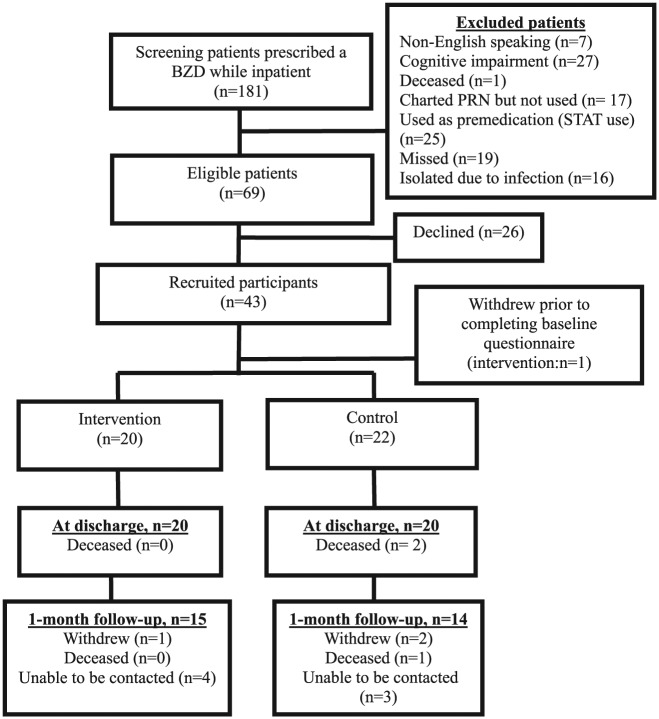
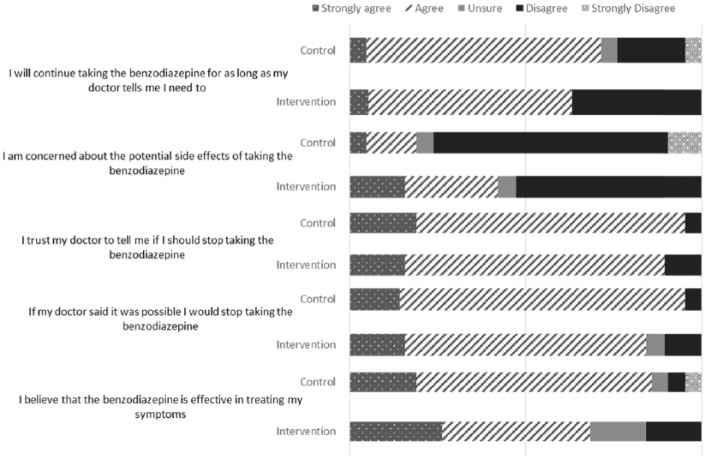
A total of 42 participants were recruited (20 intervention and 22 control). The average age was 71.5 (interquartile range: 69.0-80.3) and 54.8% were females. There was no difference in baseline characteristics between intervention and control groups ( > 0.05). At baseline, 65.0% of participants (53.0% intervention, 86.0% control) were not concerned about the potential benzodiazepine side effects. Twenty-nine participants (15 intervention and 14 control) completed 1-month follow up; 22 participants (11 intervention and 11 control) were discharged on the benzodiazepine. Among these, 13 (59.1%) had ceased benzodiazepine at 1-month follow up [46.2% ( = 6) intervention; 53.8% ( = 7) control]. In the intervention group, 33.3% ( = 5) of participants had initiated a discussion with their doctor or pharmacist about stopping the benzodiazepine compared with 35.7% ( = 5) in the control group.
Cessation of benzodiazepines 1 month following discharge was common. Future larger studies are required to confirm the effectiveness of providing a patient-empowerment booklet on reducing benzodiazepine use and other potentially inappropriate medications.
在老年人群中,长期使用苯二氮䓬类药物很常见,且会造成严重危害。住院期间提供一份患者教育手册可能会促使患者与医护人员讨论苯二氮䓬类药物治疗的复查及可能的减药问题。本研究的目的是评估针对住院患者的患者赋权干预措施在促使患者开始讨论苯二氮䓬类药物减药与常规护理相比的可行性及效果。
在悉尼一家教学医院进行了一项采用患者赋权教育干预措施的可行性干预研究。邀请年龄≥65岁、正在服用苯二氮䓬类药物且能够提供知情同意的患者参与研究。参与者被随机分配到干预组或对照组(1:1)。干预组参与者收到患者赋权手册,对照组接受常规护理。所有参与者均接受为期1个月的随访电话访谈,以评估用药及态度变化。
共招募了42名参与者(20名干预组和22名对照组)。平均年龄为71.5岁(四分位间距:69.0 - 80.3),54.8%为女性。干预组和对照组的基线特征无差异(P>0.05)。基线时,65.0%的参与者(干预组为53.0%,对照组为86.0%)不担心苯二氮䓬类药物的潜在副作用。29名参与者(15名干预组和14名对照组)完成了1个月的随访;22名参与者(11名干预组和11名对照组)出院时仍在服用苯二氮䓬类药物。其中,13名(59.1%)在1个月随访时已停用苯二氮䓬类药物[干预组为46.2%(n = 6);对照组为53.8%(n = 7)]。在干预组中,33.3%(n = 5)的参与者已与医生或药剂师开始讨论停用苯二氮䓬类药物,而对照组为35.7%(n = 5)。
出院后1个月停用苯二氮䓬类药物很常见。未来需要更大规模的研究来证实提供患者赋权手册在减少苯二氮䓬类药物及其他潜在不适当药物使用方面的有效性。