Kapurniotu Aphrodite, Gokce Ozgun, Bernhagen Jürgen
Division of Peptide Biochemistry, Technische Universität München, Freising, Germany.
System Neuroscience Laboratory, Institute for Stroke and Dementia Research, Klinikum der Universität München, Munich, Germany.
Front Med (Lausanne). 2019 Jan 23;6:3. doi: 10.3389/fmed.2019.00003. eCollection 2019.
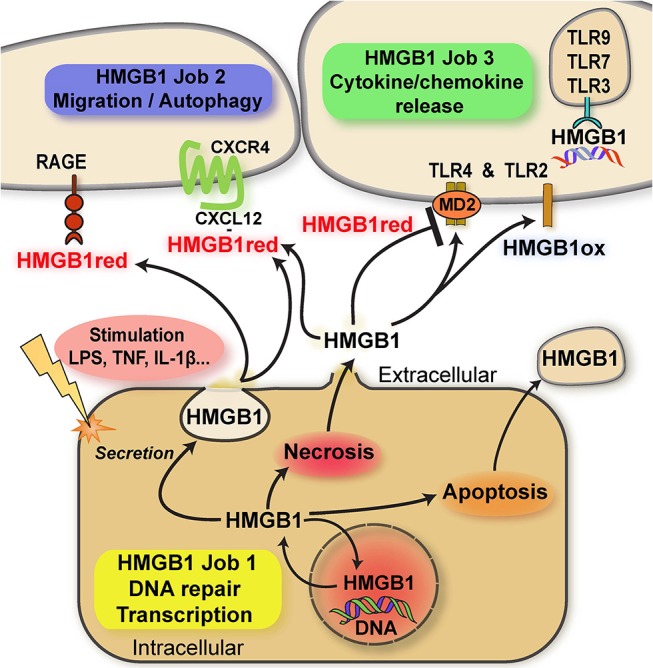
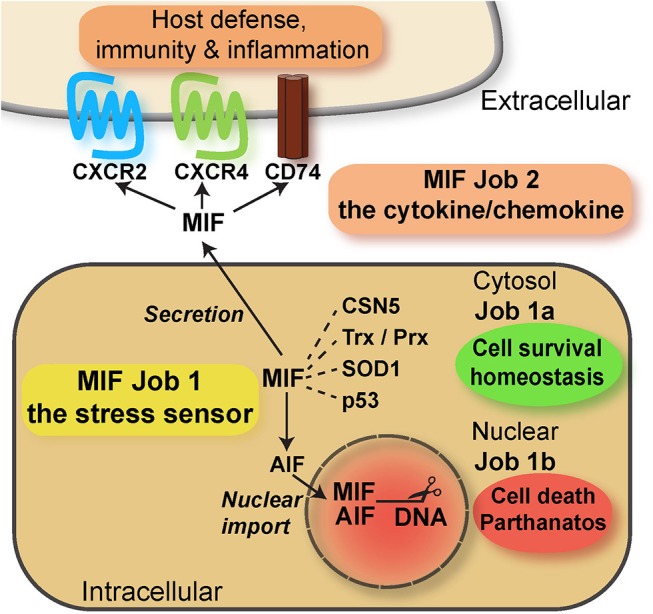
When the human genome was sequenced, it came as a surprise that it contains "only" 21,306 protein-coding genes. However, complexity and diversity are multiplied by alternative splicing, non-protein-coding transcripts, or post-translational modifications (PTMs) on proteome level. Here, we discuss how the multi-tasking potential of proteins can substantially enhance the complexity of the proteome further, while at the same time offering mechanisms for the fine-regulation of cell responses. Discoveries over the past two decades have led to the identification of "surprising" and previously unrecognized functionalities of long known cytokines, inflammatory mediators, and intracellular proteins that have established novel molecular networks in physiology, inflammation, and cardiovascular disease. In this mini-review, we focus on alarmins and atypical chemokines such as high-mobility group box protein-1 (HMGB-1) and macrophage migration-inhibitory factor (MIF)-type proteins that are prototypical examples of these classes, featuring a remarkable multitasking potential that allows for an elaborate fine-tuning of molecular networks in the extra- and intracellular space that may eventually give rise to novel "task"-based precision medicine intervention strategies.
人类基因组测序完成后,人们惊讶地发现它“仅”包含21306个蛋白质编码基因。然而,通过可变剪接、非蛋白质编码转录本或蛋白质组水平的翻译后修饰(PTM),复杂性和多样性得以成倍增加。在此,我们将探讨蛋白质的多任务潜力如何能进一步大幅提升蛋白质组的复杂性,同时为细胞反应的精细调节提供机制。过去二十年的研究发现,已鉴定出一些长期已知的细胞因子、炎症介质和细胞内蛋白质具有“惊人的”且此前未被认识到的功能,这些功能在生理学、炎症和心血管疾病中建立了新的分子网络。在本综述中,我们聚焦于警报素和非典型趋化因子,如高迁移率族蛋白B1(HMGB-1)和巨噬细胞迁移抑制因子(MIF)类型的蛋白质,它们是这些类别的典型代表,具有显著的多任务潜力,能够对细胞外和细胞内空间的分子网络进行精细调节,最终可能催生基于“任务”的新型精准医学干预策略。