Department of Basic and Clinical Neuroscience, Institute of Psychiatry Psychology and Neuroscience, King's College London, London, UK.
UCL Great Ormond Street Institute of Child Health, University College London, London, UK.
Epilepsia. 2019 Mar;60(3):e14-e19. doi: 10.1111/epi.14663. Epub 2019 Feb 7.
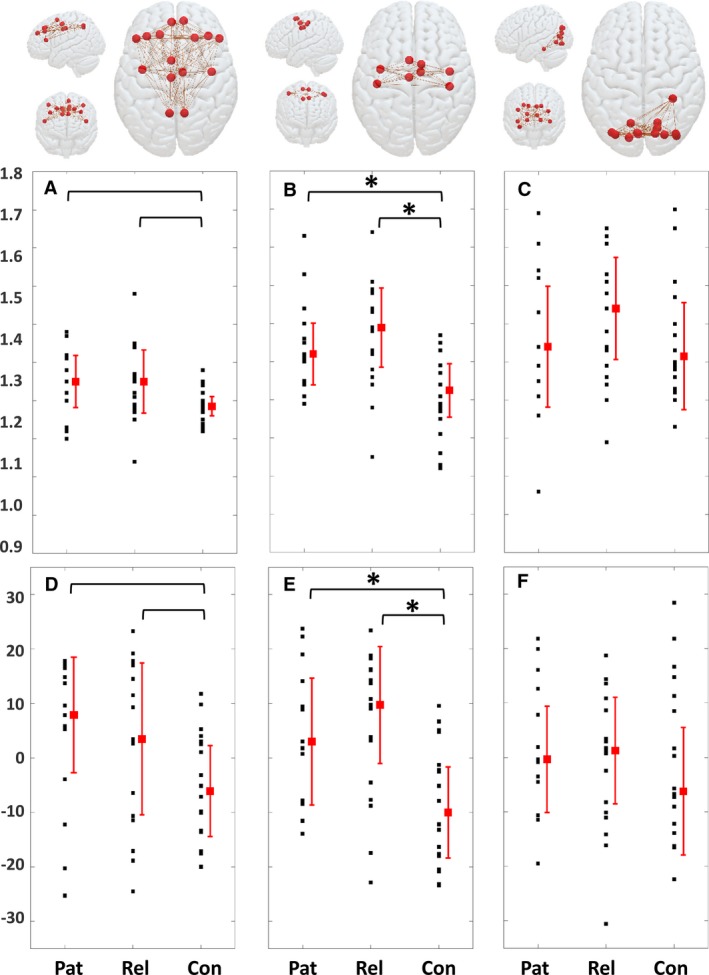
Recent evidence suggests that three specific brain networks show state-dependent levels of synchronization before, during, and after episodes of generalized spike-wave discharges (GSW) in patients with genetic generalized epilepsy (GGE). Here, we investigate whether synchronization in these networks differs between patients with GGE (n = 13), their unaffected first-degree relatives (n = 17), and healthy controls (n = 18). All subjects underwent two 10-minute simultaneous electroencephalographic-functional magnetic resonance imaging (fMRI) recordings without GSW. Whole-brain data were divided into 90 regions, and blood oxygen level-dependent (BOLD) phase synchrony in a 0.04-0.07-Hz band was estimated between all pairs of regions. Three networks were defined: (1) the network with highest synchrony during GSW events, (2) a sensorimotor network, and (3) an occipital network. Average synchrony (mean node degree) was inferred across each network over time. Notably, synchrony was significantly higher in the sensorimotor network in patients and in unaffected relatives, compared to controls. There was a trend toward higher synchrony in the GSW network in patients and in unaffected relatives. There was no difference between groups for the occipital network. Our findings provide evidence that elevated fMRI BOLD synchrony in a sensorimotor network is a state-independent endophenotype of GGE, present in patients in the absence of GSW, and present in unaffected relatives.
最近的证据表明,在遗传性全面性癫痫(GGE)患者出现全面性棘慢波放电(GSW)发作之前、期间和之后,三个特定的大脑网络表现出状态依赖性的同步水平。在这里,我们研究了这些网络中的同步是否在 GGE 患者(n=13)、未受影响的一级亲属(n=17)和健康对照者(n=18)之间存在差异。所有受试者均接受了两次 10 分钟的同步脑电图-功能磁共振成像(fMRI)记录,无 GSW。全脑数据被分为 90 个区域,并在 0.04-0.07 Hz 频段之间估计了所有区域之间的血氧水平依赖性(BOLD)相位同步。定义了三个网络:(1)在 GSW 事件期间同步性最高的网络,(2)感觉运动网络,(3)枕叶网络。在整个网络中,跨时间推断出平均同步性(平均节点度)。值得注意的是,与对照组相比,患者和未受影响的亲属的感觉运动网络中的同步性明显更高。患者和未受影响的亲属中的 GSW 网络中的同步性有升高的趋势。枕叶网络在组间没有差异。我们的研究结果提供了证据,表明感觉运动网络中 fMRI BOLD 同步性升高是 GGE 的一种状态独立的内表型,在无 GSW 的情况下出现在患者中,也出现在未受影响的亲属中。