Department of Anatomy, School of Osteopathic Medicine, Campbell University, Buies Creek, North Carolina, United States of America.
PLoS One. 2019 Feb 7;14(2):e0211692. doi: 10.1371/journal.pone.0211692. eCollection 2019.
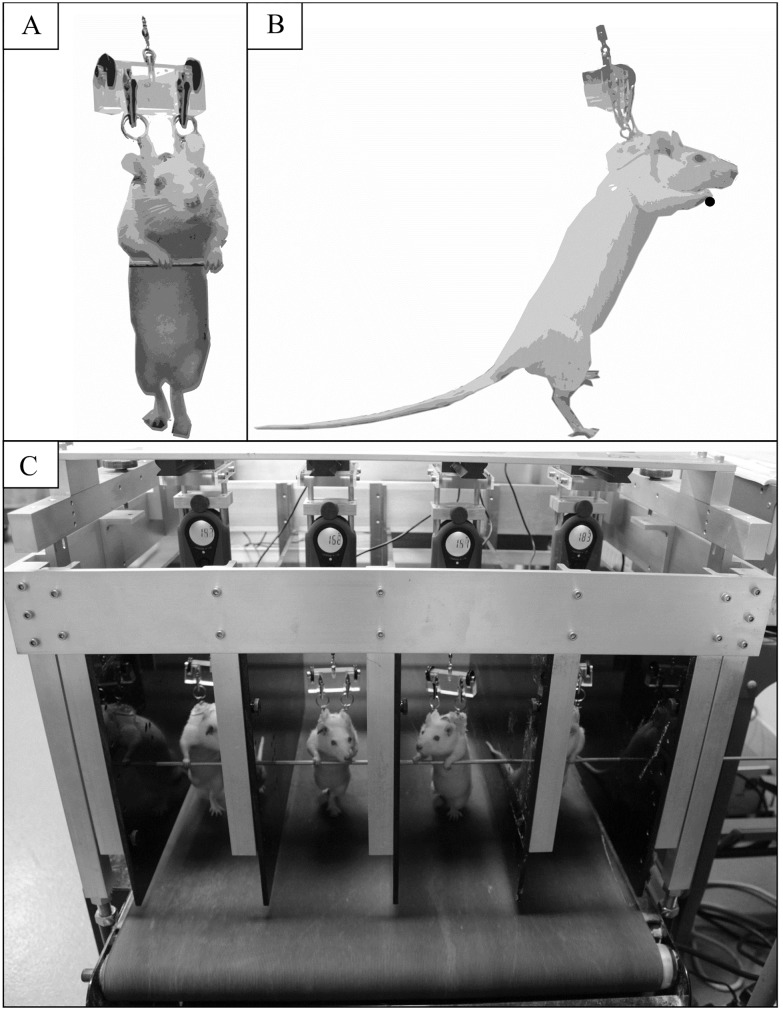
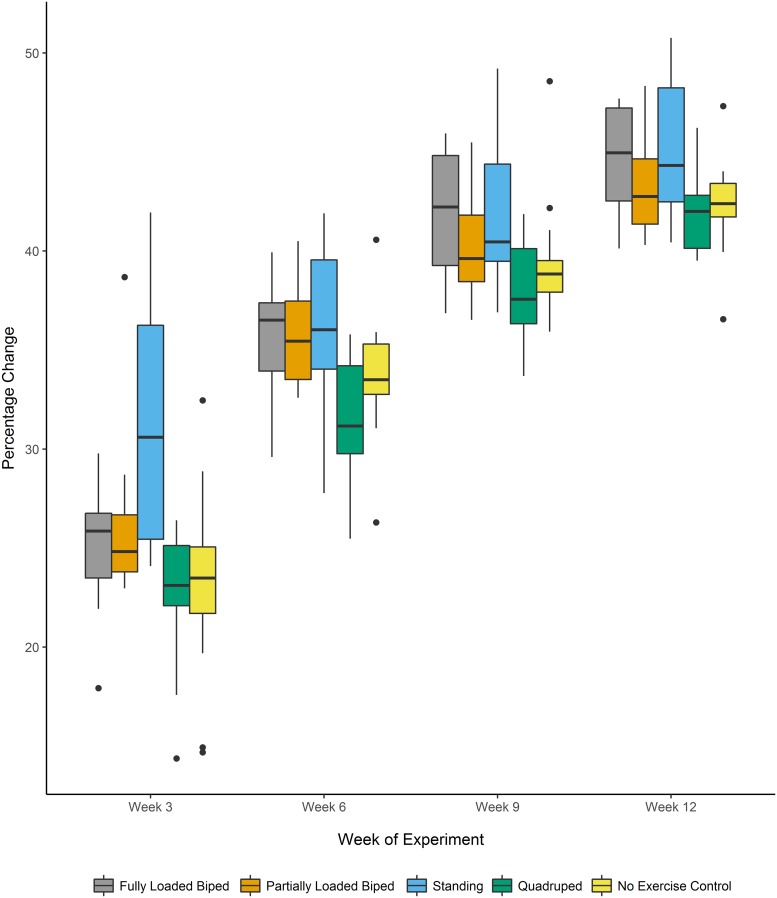
Longitudinal bone growth is accomplished through a process where proliferating chondrocytes produce cartilage in the growth plate, which ultimately ossifies. Environmental influences, like mechanical loading, can moderate the growth of this cartilage, which can alter bone length. However, little is known about how specific behaviors like bipedalism, which is characterized by a shift in body mass (mechanical load), to the lower limbs, may impact bone growth. This study uses an experimental approach to induce bipedal behaviors in a rodent model (Rattus norvegicus) over a 12-week period using a treadmill-mounted harness system to test how rat hindlimbs respond to the following loading conditions: 1) fully loaded bipedal walking, 2) partially loaded bipedal walking, 3) standing, 4) quadrupedal walking, and 5) no exercise control. These experimental conditions test whether mechanical loading from 1) locomotor or postural behaviors, and 2) a change in the magnitude of load can moderate longitudinal bone growth in the femur and tibia, relative to controls. The results demonstrate that fully loaded bipedal walking and bipedal standing groups showed significant differences in the percentage change in length for the tibia and femur. When comparing the change from baseline, which control for body mass, all bipedal groups showed significant differences in tibia length compared to control groups. However, there were no absolute differences in bone length, which suggests that mechanical loads from bipedal behaviors may instead be moderating changes in growth velocity. Implications for the relationship between bipedal behaviors and longitudinal bone growth are discussed.
骨骼的纵向生长是通过一个过程实现的,在此过程中,增殖的软骨细胞在生长板中产生软骨,最终软骨骨化。环境影响,如机械负荷,可以调节软骨的生长,从而改变骨的长度。然而,人们对特定行为(如以身体质量(机械负荷)转移到下肢为特征的两足行走)如何影响骨骼生长知之甚少。本研究使用实验方法在 12 周的时间内通过跑步机安装的吊带系统在啮齿动物模型(褐家鼠)中诱导两足行走行为,以测试大鼠后肢如何应对以下加载条件:1)完全负重两足行走,2)部分负重两足行走,3)站立,4)四足行走和 5)无运动对照。这些实验条件测试了机械负荷是否来自 1)运动或姿势行为,以及 2)负荷大小的变化是否可以调节股骨和胫骨的纵向骨骼生长,与对照相比。结果表明,完全负重的两足行走和两足站立组的胫骨和股骨长度的百分比变化有显著差异。当比较基线时,体重控制时,所有两足组的胫骨长度与对照组相比均有显著差异。然而,骨长度没有绝对差异,这表明两足行为的机械负荷可能调节生长速度的变化。讨论了两足行为与纵向骨骼生长之间关系的意义。