Miao Li-Feng, Wang Xiao-Yan, Ye Xiang-Hua, Cui Meng-Shen, He Xiao-Feng
Department of Galactophore, Affiliated Heping Hospital, Changzhi Medical College, Shanxi, Changzhi.
Department of Epidemiology and Health Statistics, Basic Medical College of Zhejiang University of Traditional Chinese Medicine.
Medicine (Baltimore). 2019 Feb;98(6):e14333. doi: 10.1097/MD.0000000000014333.
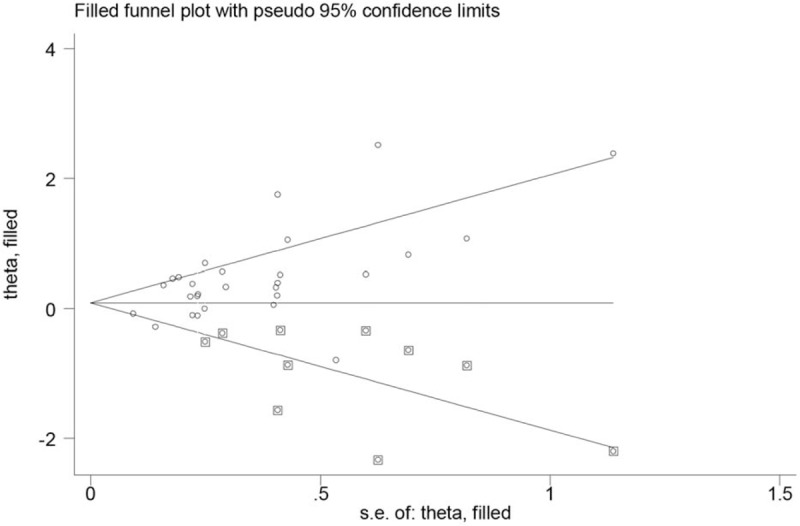
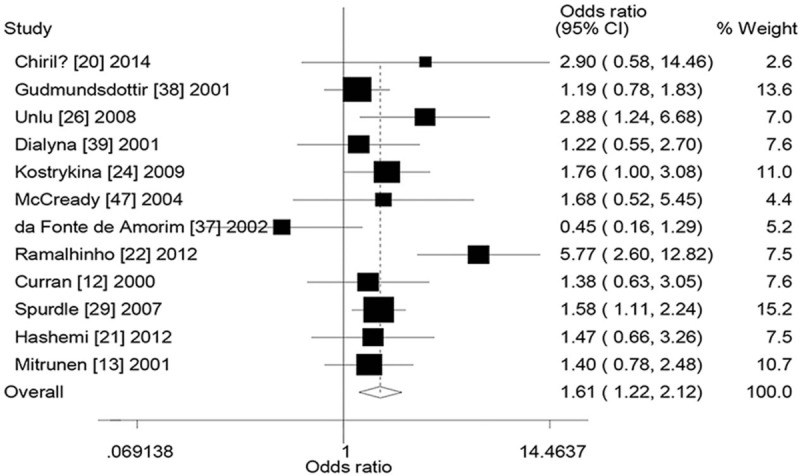
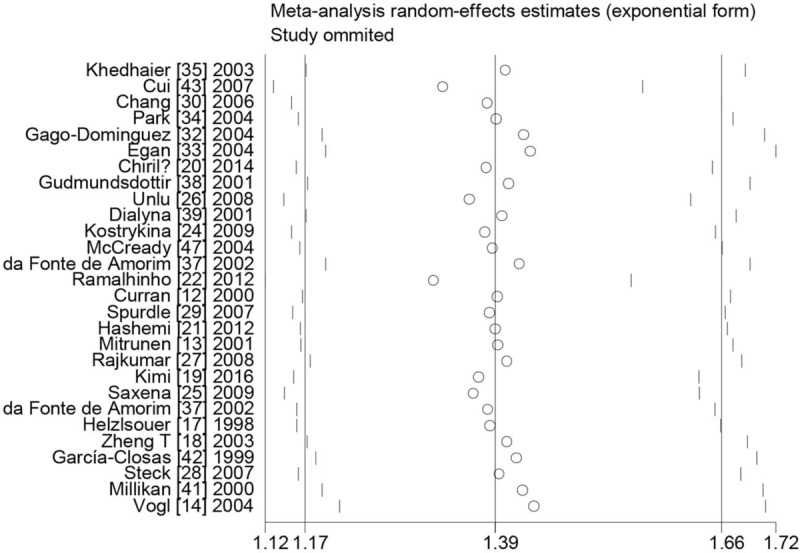
Many molecular epidemiology studies have reported an association between the combined effects of glutathione S-transferase M1 (GSTM1) and glutathione S-transferase T1 (GSTT1) polymorphisms on breast cancer risk. However, the results have been controversial.A meta-analysis was performed to clarify this issue.Meta-analysis of observational studies in epidemiology guidelines was used. Pooled the crude odds ratios (ORs) and 95% confidence intervals (CIs) were calculated using a random-effects model or fixed-effects model. Several subgroup analyses were conducted by ethnicity, source of control, matching, and menopausal status. In addition, we also performed sensitivity analysis and publication bias. Moreover, a false-positive report probability (FPRP) test was applied to assess positive results.A significantly increased breast cancer risk was observed in overall population (GSTM1 null/GSTT1 present [- +] vs GSTM1 present/GSTT1 present [+ +]: OR = 1.19, 95% CI: 1.03-1.36, GSTM1 null/GSTT1 null [- -] vs + +: OR = 1.63, 95% CI: 1.29-2.06, (- +) + GSTM1 present/GSTT1 null (+ -) vs + +: OR = 1.17, 95% CI: 1.05-1.31, (- +) + (+ -) + (- -) vs + +: OR = 1.27, 95% CI: 1.12-1.44, and - - vs (- +) + (+ -) + (+ +): OR = 1.39, 95% CI: 1.17-1.66) and several subgroup analyses, such as Caucasians, Indians, postmenopausal women, and so on. However, positive results were only considered noteworthy in overall population (- - vs + +: FPRP = 0.150 and (- +) + (+ -) + (- -) vs + +: FPRP = 0.162). Moreover, no significant association was observed when we used the trim and fill method to adjust the pooled data from all populations. Further, none of positive results of sensitivity analysis were considered noteworthy (FPRP >0.2).These positive findings should be interpreted with caution and indicate that an increased breast cancer risk may most likely result from false-positive results, rather than from true associations or biological factors on the combined effects of GSTM1 and GSTT1. Future studies should be based on sample sizes well-powered and attention needs to be paid to study design to further identify this issue.
许多分子流行病学研究报告了谷胱甘肽S-转移酶M1(GSTM1)和谷胱甘肽S-转移酶T1(GSTT1)基因多态性的联合作用与乳腺癌风险之间的关联。然而,结果一直存在争议。进行了一项荟萃分析以阐明这个问题。采用流行病学指南中的观察性研究荟萃分析方法。使用随机效应模型或固定效应模型计算合并的粗比值比(OR)和95%置信区间(CI)。通过种族、对照来源、匹配和绝经状态进行了几项亚组分析。此外,我们还进行了敏感性分析和发表偏倚分析。而且,应用了假阳性报告概率(FPRP)检验来评估阳性结果。在总体人群中观察到乳腺癌风险显著增加(GSTM1缺失/GSTT1存在[- +]与GSTM1存在/GSTT1存在[+ +]:OR = 1.19,95% CI:1.03 - 1.36;GSTM1缺失/GSTT1缺失[- -]与 + +:OR = 1.63,95% CI:1.29 - 2.06;(- +)+ GSTM1存在/GSTT1缺失(+ -)与 + +:OR = 1.17,95% CI:1.05 - 1.31;(- +)+(+ -)+(- -)与 + +:OR = 1.27,95% CI:1.12 - 1.44;以及 - - 与(- +)+(+ -)+(+ +):OR = 1.39,95% CI:1.17 - 1.66)以及一些亚组分析,如白种人组、印度人组、绝经后女性组等。然而,仅总体人群中的阳性结果被认为值得关注(- - 与 + +:FPRP = 0.150;(- +)+(+ -)+(- -)与 + +:FPRP = 0.162)。此外,当我们使用修剪和填充方法调整所有人群的合并数据时,未观察到显著关联。进一步地,敏感性分析的阳性结果均未被认为值得关注(FPRP > 0.2)。这些阳性发现应谨慎解释,表明乳腺癌风险增加很可能是由假阳性结果导致,而非GSTM1和GSTT1联合作用的真实关联或生物学因素所致。未来的研究应以充足的样本量为基础,并且需要关注研究设计以进一步明确这个问题。