Yi Dong-Min, Yang Tao-Tao, Chao Shuai-Heng, Li Ya-Xin, Zhou Ying-Lei, Zhang Hai-Hui, Lan Ling, Zhang Yu-Wei, Wang Xue-Mei, Zhang Yan-Rui, Li Jian, Ding Song-Ze
Department of Gastroenterology and Hepatology.
Department of Experimental Medicine.
Medicine (Baltimore). 2019 Feb;98(6):e14408. doi: 10.1097/MD.0000000000014408.
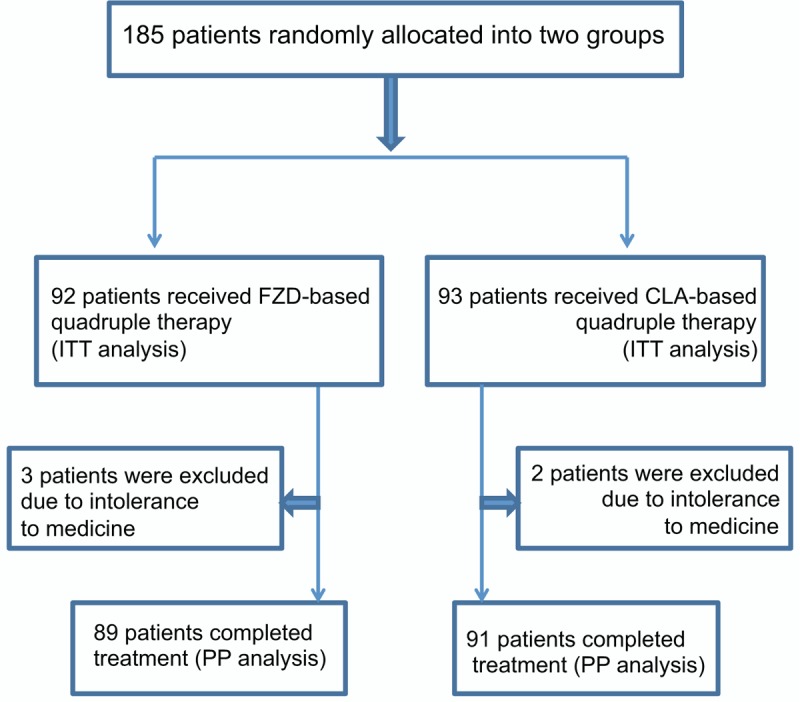
Helicobacter pylori (Hp) drug resistant rate to clarithromycin (CLA) has increased to 20% to 50%, which cause concerns regarding its effectiveness in eradicating Hp, we aim to evaluate the cost-effectiveness of CLA-based versus furazolidone (FZD)-based quadruple therapy, and assess factors that affect anti-Hp efficacy.One hundred eighty-five patients were enrolled in this single-center, prospective, randomized, open-label study. In FZD group, 92 patients were treated with FZD plus esomeprazole, bismuth potassium citrate, and amoxicillin for 14 days. In CLA group, 93 patients were treated with the same regimen except FZD was replaced by CLA. Patients were tested 4 weeks post-treatment to confirm eradication.Of the 185 enrolled patients, 180 completed the study. On intention-to-treat analysis, Hp eradication rates in FZD and CLA groups were 90.22% and 86.02% (P = .378); in per-protocol analysis, their eradication rates were 93.26% and 87.91%, respectively (P = .220). Overall incidence of total side effects in FZD and CLA groups was 19.57% and 13.98%, and their severe side effects were 3.26% and 2.15%, respectively (P > .05). Cost-effectiveness ratios of FZD and CLA groups were 0.75 and 1.02, and incremental cost-effectiveness ratio of FZD group over CLA group was -3.62. Eradication failures were not associated with factors including gender, age, body mass index, smoking, alcohol consumption, educational level, and urban-rural distribution in this observation (P > .05).Despite increasing drug resistance to CLA, Hp eradication rates in FZD and CLA groups have no significant difference at present; as FZD-based quadruple therapy is more cost-effective, we recommend this regimen be a first-line choice for Hp eradication.
幽门螺杆菌(Hp)对克拉霉素(CLA)的耐药率已升至20%至50%,这引发了对其根除Hp有效性的担忧。我们旨在评估基于CLA的四联疗法与基于呋喃唑酮(FZD)的四联疗法的成本效益,并评估影响抗Hp疗效的因素。185例患者纳入了这项单中心、前瞻性、随机、开放标签研究。FZD组92例患者接受FZD联合埃索美拉唑、枸橼酸铋钾和阿莫西林治疗14天。CLA组93例患者接受相同方案治疗,只是将FZD替换为CLA。治疗4周后对患者进行检测以确认根除情况。185例纳入患者中,180例完成研究。意向性分析中,FZD组和CLA组的Hp根除率分别为90.22%和86.02%(P = 0.378);符合方案分析中,其根除率分别为93.26%和87.91%(P = 0.220)。FZD组和CLA组总的副作用发生率分别为19.57%和13.98%,严重副作用分别为3.26%和2.15%(P>0.05)。FZD组和CLA组的成本效益比分别为0.75和1.02,FZD组相对于CLA组的增量成本效益比为-3.62。在本观察中,根除失败与性别、年龄、体重指数、吸烟、饮酒、教育程度和城乡分布等因素无关(P>0.05)。尽管对CLA的耐药性增加,但目前FZD组和CLA组的Hp根除率无显著差异;由于基于FZD的四联疗法更具成本效益,我们推荐该方案作为根除Hp的一线选择。