Centre on Population Approaches for Non-Communicable Disease Prevention, Nuffield Department of Population Health, University of Oxford, Old Road Campus, Headington, Oxford, OX3 7LF, UK.
Int J Behav Nutr Phys Act. 2019 Feb 7;16(1):18. doi: 10.1186/s12966-019-0778-5.
Health-related claims (HRCs) are statements found on food packets that convey the nutritional quality of a food (nutrition claims) and/or its impact on a health outcome (health claims). The EU stated that HRCs should be regulated such that they can only appear on foods that meet a specified nutrient profile (NP). A NP model has been proposed, but not agreed by the European Commission.
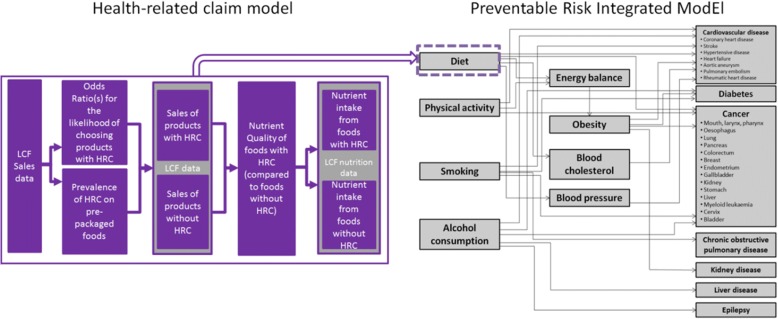
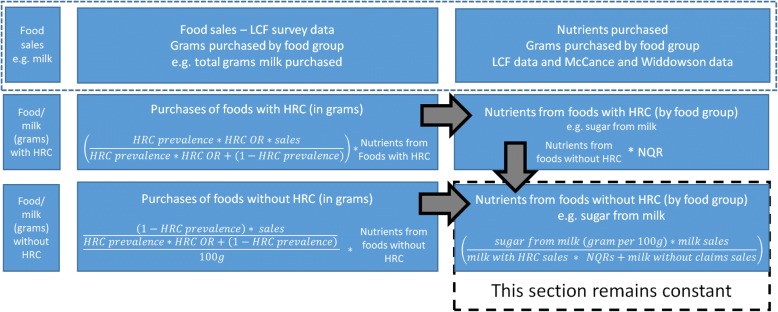
To model the impact of HRCs on health impacts in the UK, we built a front-end model to a pre-established non-communicable-disease (NCD) scenario model, the Preventable Risk Integrated ModEl (PRIME) by combining data from a meta-analysis examining the impact of HRCs on dietary choices and a survey of pre-packaged foods examining the prevalence of HRCs and the nutritional quality of foods that carry them. These data are used to model the impact of regulating HRCs on the nutritional quality of the diet and PRIME is used to model the health outcomes associated with these changes. Two scenarios are modelled: regulating HRCs with a NP model (the FSANZ NPSC and a draft EU model) so that only foods that pass the model are eligible to carry HRCs, and reformulating HRC-carrying foods that fail the model.
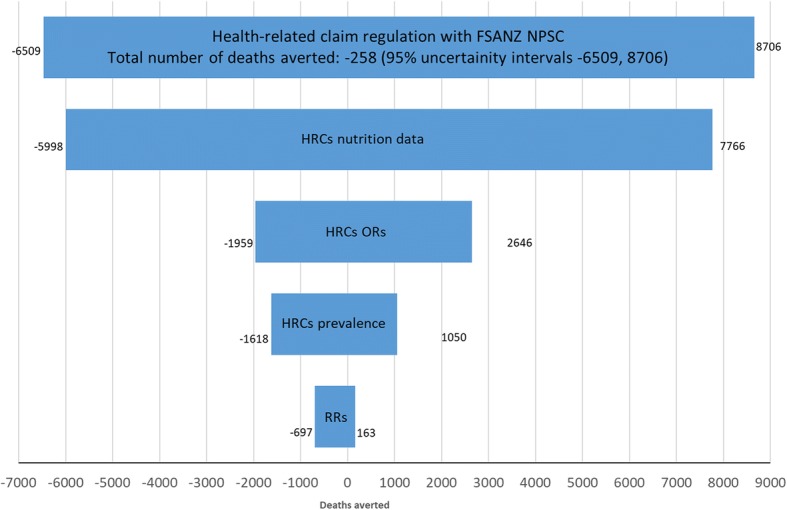
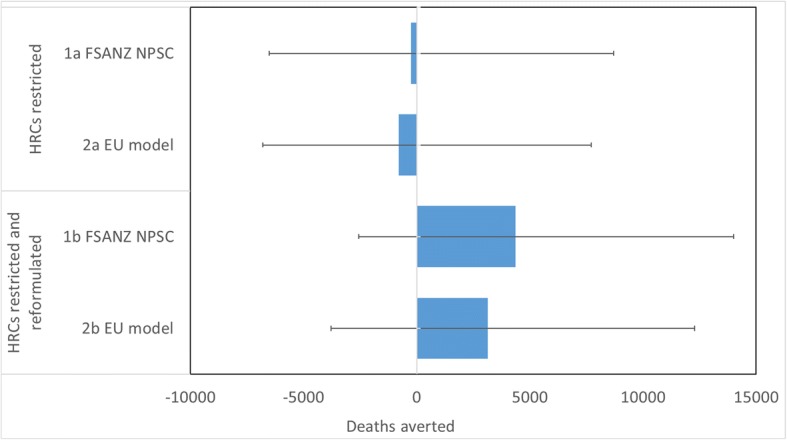
Regulating the use of HRCs with a NP model (the FSANZ NPSC) would have unclear impacts on population health and could potentially lead to less healthy diets. This is because HRCs are currently more likely to be found on products with a better nutritional profile and restricting their use could shift consumers to less healthy diets. Two hundred fifty-eight additional deaths (95% Uncertainty Intervals [UI] -6509, 8706) were predicted if foods did not change in their nutrient composition. If all foods that currently carry HRCs were reformulated to meet the NP model criteria then there would be a positive impact of using the model: (4374 deaths averted (95%UI -2569, 14,009)). The largest contributor to the uncertainty is the underpowered estimates of nutritional quality of foods with and without claims.
Regulating HRCs could result in negative health impacts, however the wide uncertainty intervals from this analysis demonstrate that a larger health impact assessment is necessary.
健康声称(HRCs)是食品包装上的声明,传达食品的营养质量(营养声称)和/或其对健康结果的影响(健康声称)。欧盟表示,HRCs 应受到监管,以便仅出现在符合特定营养成分谱(NP)的食品上。已经提出了 NP 模型,但尚未得到欧盟委员会的同意。
为了模拟 HRCs 对英国健康影响的影响,我们通过结合一项元分析研究 HRCs 对饮食选择的影响的数据和一项关于预包装食品中 HRCs 流行率和携带 HRCs 的食品营养质量的调查数据,构建了一个前端模型到预先建立的非传染性疾病(NCD)情景模型,即预防风险综合模型(PRIME)。这些数据用于模拟监管 HRCs 对饮食营养质量的影响,而 PRIME 则用于模拟与这些变化相关的健康结果。模拟了两种情况:使用 NP 模型(FSANZ NPSC 和欧盟草案模型)监管 HRCs,只有通过模型的食品才有资格携带 HRCs,以及对不符合模型的携带 HRCs 的食品进行重新配方。
使用 NP 模型(FSANZ NPSC)监管 HRCs 的使用可能对人口健康产生不确定的影响,并且可能导致饮食不健康。这是因为 HRCs 目前更可能出现在营养状况较好的产品上,限制其使用可能会使消费者转向更不健康的饮食。如果食品的营养成分不变,则预测会增加 258 例死亡(95%不确定区间[UI] -6509,8706)。如果目前所有携带 HRCs 的食品都进行重新配方以符合 NP 模型标准,那么使用该模型将产生积极影响:(避免 4374 例死亡(95%UI -2569,14009))。不确定性最大的是有和没有声称的食品的营养质量的估计值不足。
监管 HRCs 可能会对健康产生负面影响,但是该分析的广泛不确定性区间表明需要进行更大规模的健康影响评估。