Zhuo Hongwu, Li Jian
Fuzhou Second Hospital Affiliated to Xiamen University, No.47, Shang Teng Street, Cang Shan District, Fuzhou, 350007, China.
J Orthop Surg Res. 2019 Feb 7;14(1):40. doi: 10.1186/s13018-019-1075-3.
To compare the clinical outcomes of one-stage and two-stage procedures for the management of patients with rotator cuff tear and concomitant shoulder stiffness.
From December 2013 to June 2016, we recruited 42 consecutive patients with rotator cuff tear and concomitant shoulder stiffness. Twenty-two patients underwent a one-stage procedure, including arthroscopic capsule release and concomitant rotator cuff repair, within 2 weeks of the diagnosis. For the remaining twenty patients, conservative treatment for the recovery of range of motion (ROM) was initially performed before arthroscopic rotator cuff repair. The ROM, visual analogue scale (VAS), American Shoulder and Elbow Surgeons (ASES) score, Constant-Murley score, and satisfaction rate were assessed preoperatively; 3, 6, 12, and 24 months after surgery; and at final follow-up.
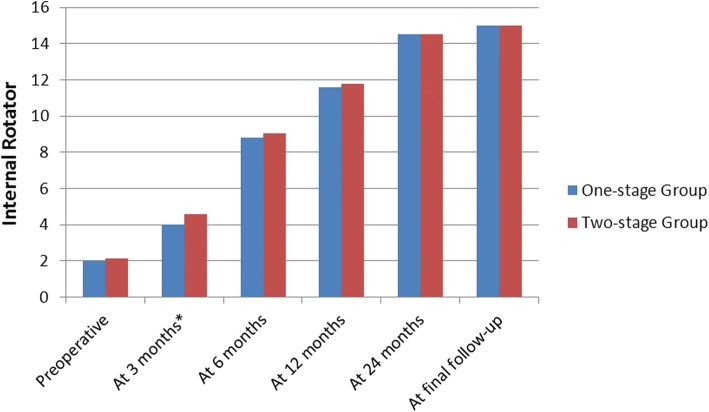
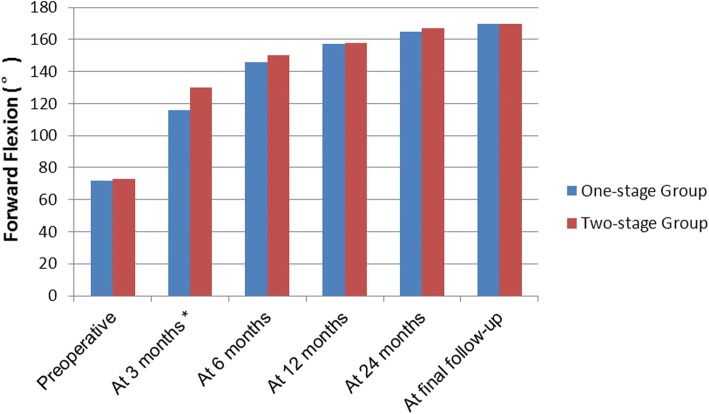
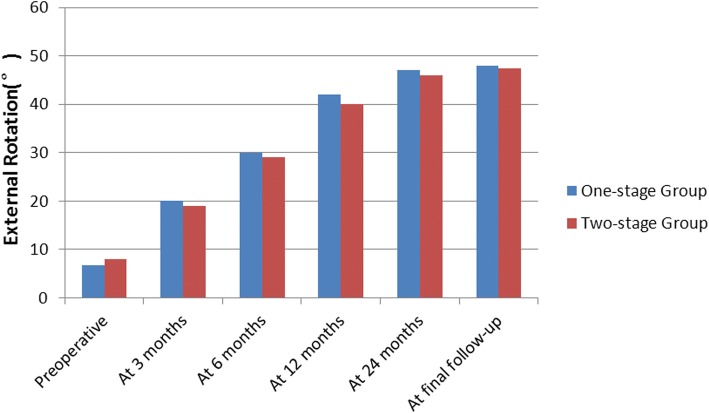
The mean follow-up period was 26.3 months (range, 24-33 months). No significant difference was noted in preoperative demographic data (age, sex, dominant/non-dominant, diabetes mellitus, thyroid disease, and duration of symptoms) between the two groups (P = 0.165, P = 0.580, P = 0.662, P = 0.716, P = 0.231, and P = 0.152, respectively). After treatment, all patients exhibited significant improvement in ROM and functional scores (P = 0.001 and P = 0.001, respectively). At 3 months postoperatively, the two-stage group exhibited significantly improved forward flexion and internal rotation compared with the one-stage group (P = 0.001 and P = 0.038, respectively). No significant difference in ROM was noted between the two groups at 6, 12, 24 months postoperatively and the final follow-up. In addition, no significant differences in VAS, ASES, Constant-Murley score and satisfaction rate were noted between the two groups at final follow-up (P = 0.319, P = 0.529, P = 0.711, and P = 0.085, respectively).
In the treatment of rotator cuff tear with concomitant stiffness, although the recovery of ROM took longer in patients who underwent the one-stage procedure, satisfactory results at final follow-up can be achieved using either the one-stage procedure or two-stage procedure.
Case-control study.
比较一期手术和二期手术治疗肩袖撕裂合并肩关节僵硬患者的临床疗效。
2013年12月至2016年6月,我们连续招募了42例肩袖撕裂合并肩关节僵硬的患者。22例患者在诊断后2周内接受了一期手术,包括关节镜下关节囊松解术和同期肩袖修复术。对于其余20例患者,在关节镜下肩袖修复术前首先进行保守治疗以恢复活动范围(ROM)。在术前、术后3、6、12和24个月以及末次随访时评估ROM、视觉模拟评分(VAS)、美国肩肘外科医师学会(ASES)评分、Constant-Murley评分和满意率。
平均随访期为26.3个月(范围24 - 33个月)。两组术前人口统计学数据(年龄、性别、优势/非优势侧、糖尿病、甲状腺疾病和症状持续时间)无显著差异(分别为P = 0.165、P = 0.580、P = 0.662、P = 0.716、P = 0.231和P = 0.152)。治疗后,所有患者的ROM和功能评分均有显著改善(分别为P = 0.001和P = 0.001)。术后3个月,二期手术组的前屈和内旋改善程度明显优于一期手术组(分别为P = 0.001和P = 0.038)。术后6、12、24个月及末次随访时,两组ROM无显著差异。此外,末次随访时两组的VAS、ASES、Constant-Murley评分和满意率无显著差异(分别为P = 0.319、P = 0.529、P = 0.711和P = 0.085)。
在治疗肩袖撕裂合并僵硬时,虽然一期手术患者的ROM恢复时间较长,但一期手术或二期手术在末次随访时均可取得满意结果。
病例对照研究。