Clark Anne
University of Michigan, Department of Sociology and Population Studies Center, Institute for Social Research, Michigan, USA.
Demogr Res. 2018 Jan-Jun;38:169-196. doi: 10.4054/DemRes.2018.38.7. Epub 2018 Jan 12.
This study assesses whether frequency of residential mobility plays a role in the reproduction of socioeconomic inequality during the transition to adulthood based on two criteria: (1) selection - is there socioeconomic sorting into residential trajectories? - and (2) lack of moderation - is this sorting irreducible to other life events that prompt moves (e.g., changes in employment status)?
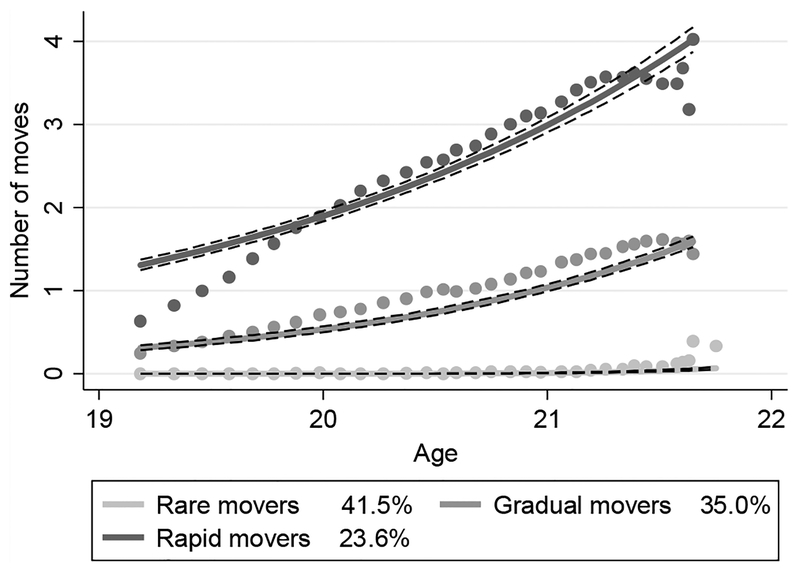
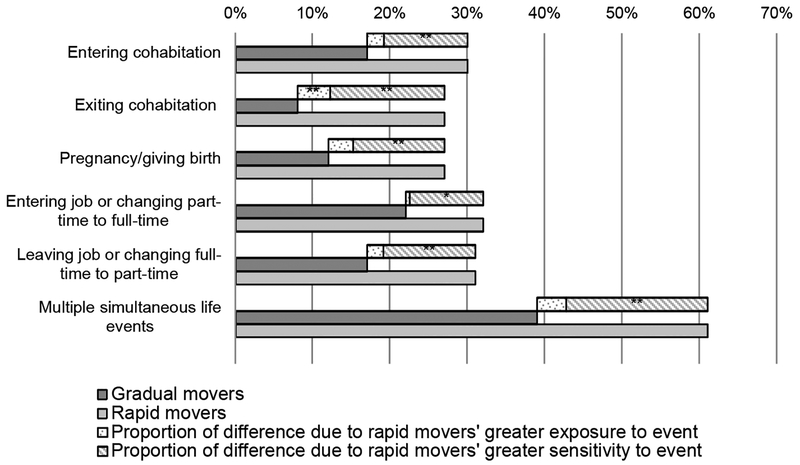
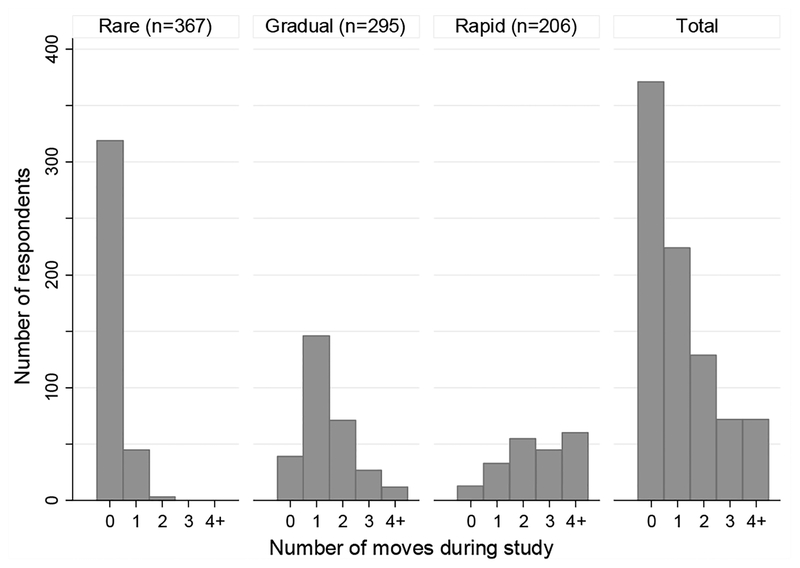
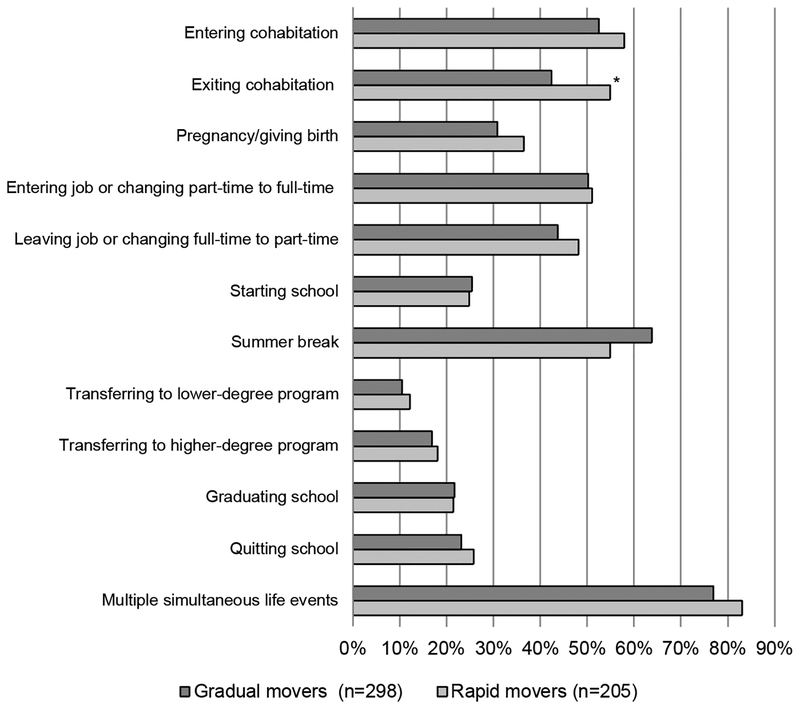
I use two and a half years of monthly address data from the Relationship Dynamics and Social Life data set, a sample of 18- and 19-year-old young women in a Michigan county. As an improvement upon previous measures of residential mobility, I use group-based trajectory analysis to categorize young women into residential trajectory groups. I then conduct a series of nested logistic regressions to predict membership in residential trajectory groups and a decomposition analysis to determine whether rapid movers are exposed to more life events (e.g., entering/exiting employment) or are simply more sensitive to moving in the face of life events compared to gradual movers.
Rapid moving is associated with low socioeconomic status. Rapid movers experience similar family formation, employment, and academic changes as gradual movers but are more likely to move when faced with these life events.
High residential mobility is a phenomenon among early home-leavers as part of an accelerated and underfunded transition to adulthood rather than a reflection of the upward socioeconomic mobility of college students.
High residential mobility is not simply a neutral or normative aspect of the transition to adulthood but rather part of the process of reproducing socioeconomic stratification.
本研究基于两个标准评估居住流动性频率在向成年期过渡过程中社会经济不平等的再现中是否起作用:(1)选择——社会经济因素是否会影响居住轨迹的选择?以及(2)缺乏调节作用——这种选择是否不能归因于促使搬家的其他生活事件(例如就业状况的变化)?
我使用了来自“关系动态与社会生活”数据集的两年半的月度住址数据,该数据集是密歇根州一个县18岁和19岁年轻女性的样本。作为对先前居住流动性测量方法的改进,我使用基于群体的轨迹分析将年轻女性分类到居住轨迹组中。然后,我进行了一系列嵌套逻辑回归,以预测居住轨迹组的成员身份,并进行分解分析,以确定与缓慢迁移者相比,快速迁移者是否经历了更多的生活事件(例如进入/退出就业),或者只是在面对生活事件时对搬家更敏感。
快速迁移与低社会经济地位相关。快速迁移者与缓慢迁移者经历了类似的家庭组建、就业和学业变化,但在面对这些生活事件时更有可能搬家。
高居住流动性是早期离开家庭者中的一种现象,是向成年期加速过渡且资金不足的一部分,而不是大学生社会经济向上流动的反映。
高居住流动性不仅仅是向成年期过渡的一个中性或规范性方面,而是社会经济分层再现过程的一部分。