Ali Ammar Mohammed Ahmed, El-Nour Mawahib ElAmin Mohamed, Yagi Sakina Mohamed
Department of Biology and Biotechnology, Faculty of Science and Technology, AL Neelain University, Sudan.
Botany Department, Faculty of Science, University of Khartoum, Sudan.
J Genet Eng Biotechnol. 2018 Dec;16(2):677-682. doi: 10.1016/j.jgeb.2018.03.003. Epub 2018 Mar 21.
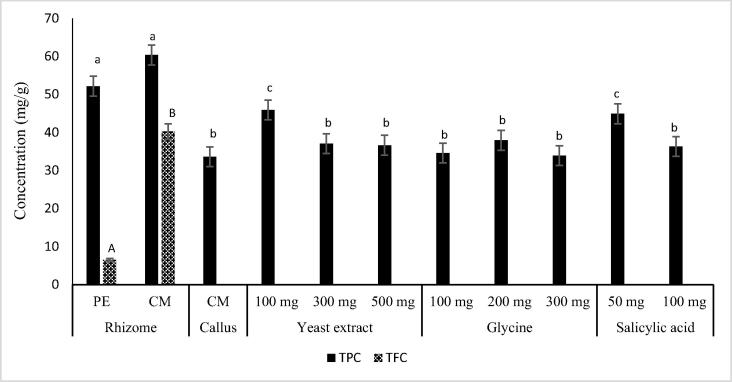
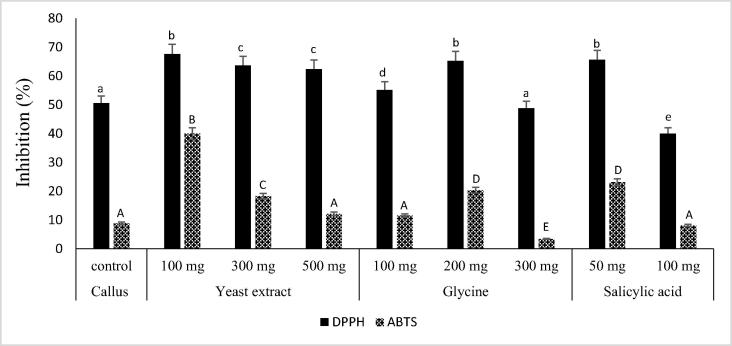
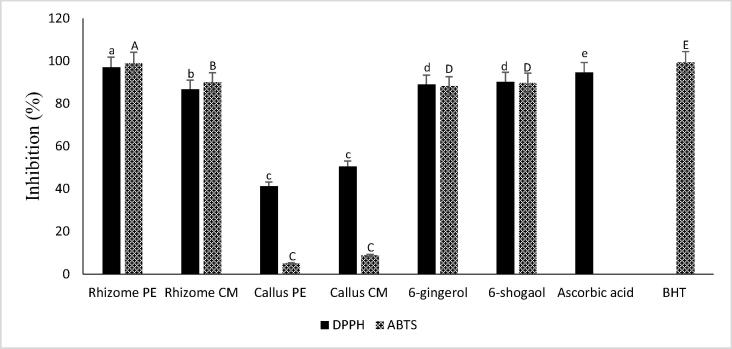
The present study was aimed at determining total phenolic and flavonoid contents and studying the antioxidant activity of ginger ( Rosc.) rhizome and callus, 6-gingerol and 6-shogaol and callus treated with elicitors. Petroleum ether (PE) and chloroform: methanol (1:1, v/v) (CM) extracts were prepared by maceration. Highest total phenolic content was obtained from the CM extract (60.34 ± 0.43 mg gallic acid/g) of rhizome while callus showed lower content detected in the CM extract (33.6 ± 0.07 mg gallic acid/g). Flavonoids were only detected in rhizome (CM extract 40.25 ± 0.21 mg quercetin/g). Both rhizome extracts exhibited good antioxidant activity with higher activity recorded in PE extract (IC value 8.29 ± 1.73 μg/mL). Callus extracts revealed lower antioxidant activity (IC value 1265.49 ± 59.9 μg/mL obtained from CM extract). 6-gingerol and 6-shogaol displayed high antioxidant activity in both assays with IC 4.85 + 0.58 and 5.35 ± 0.33 μg/mL for the former and IC 7.61 ± 0.81 and IC 7.05 ± 0.23 μg/mL for the latter. Treatment of callus with elicitors showed significant (p < 0.05) effects in enhancing phenolic content and related antioxidant activity. The highest significant increase in phenolic content (37% and 34%) and antioxidant activity in DPPH assay (34% and 30%) was observed in callus treated with 100 mg/L yeast extract and 50 mg/L salicylic acid respectively. Therefore, studying the effect of the elicitation of ginger cultured tissues in phenolic accumulation would be of immense importance for pharmacological, cosmetic and agronomic industries.
本研究旨在测定生姜(Rosc.)根茎和愈伤组织、6-姜酚和6-姜烯酚以及用诱导子处理的愈伤组织中的总酚和黄酮含量,并研究其抗氧化活性。通过浸渍法制备石油醚(PE)提取物和氯仿:甲醇(1:1,v/v)(CM)提取物。根茎的CM提取物总酚含量最高(60.34±0.43mg没食子酸/g),而愈伤组织的CM提取物中总酚含量较低(33.6±0.07mg没食子酸/g)。黄酮类物质仅在根茎中检测到(CM提取物中为40.25±0.21mg槲皮素/g)。两种根茎提取物均表现出良好的抗氧化活性,PE提取物的活性更高(IC值为8.29±1.73μg/mL)。愈伤组织提取物的抗氧化活性较低(CM提取物的IC值为1265.49±59.9μg/mL)。在两种测定中,6-姜酚和6-姜烯酚均表现出较高的抗氧化活性,前者的IC值分别为4.85+0.58和5.35±0.33μg/mL,后者的IC值分别为7.61±0.81和7.05±0.23μg/mL。用诱导子处理愈伤组织对提高酚类含量和相关抗氧化活性具有显著(p<0.05)作用。在用100mg/L酵母提取物和50mg/L水杨酸处理的愈伤组织中,分别观察到酚类含量的最高显著增加(37%和34%)和DPPH测定中抗氧化活性的最高显著增加(34%和30%)。因此,研究诱导生姜培养组织对酚类积累的影响对制药、化妆品和农业产业具有极其重要的意义。