Department of Health Sciences, University of Eastern Piedmont, Novara, Italy.
European Institute for Research in Cystic Fibrosis, San Raffaele Scientific Institute, Milan, Italy.
Cell Death Dis. 2019 Feb 8;10(2):114. doi: 10.1038/s41419-019-1392-9.
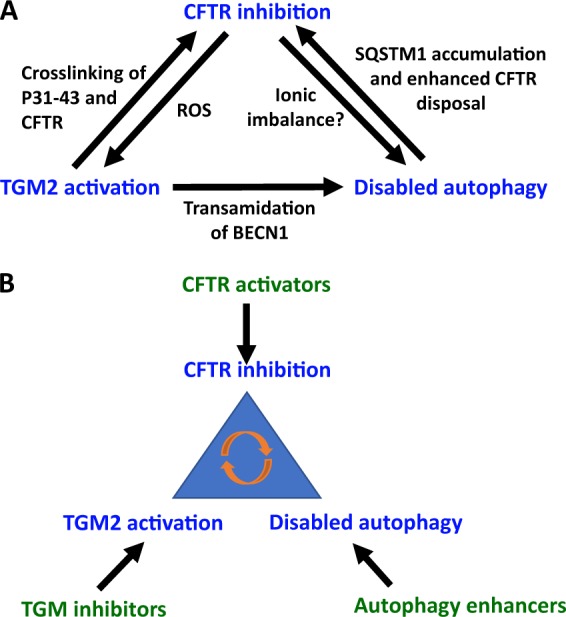
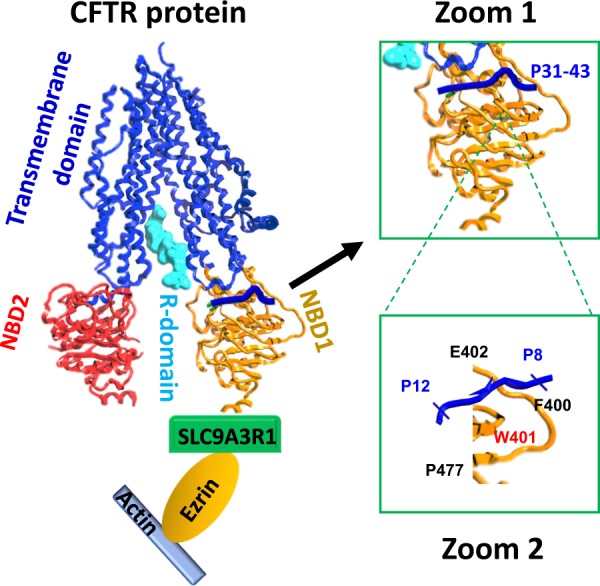
Cystic fibrosis (CF) is a disease caused by loss-of-function mutations affecting the CF transmembrane conductance regulator (CFTR), a chloride channel. Recent evidence indicates that CFTR is inhibited by a gluten/gliadin-derived peptide (P31-43), causing an acquired state of CFTR inhibition within the gut that contributes to the pathogenesis of celiac disease (CD). Of note, CFTR inhibition does not only cause intra- and extracellular ion imbalances but also affects proteostasis by activating transglutaminase-2 (TGM2) and by disabling autophagy. These three phenomena (CFTR inhibition, TGM2 activation, and autophagy impairment) engage in multiple self-amplifying circuitries, thus forming an "infernal trio". The trio hinders enterocytes from returning to homeostasis and instead locks them in an irreversible pro-inflammatory state that ultimately facilitates T lymphocyte-mediated immune responses against another gluten/gliadin-derived peptide (P57-68), which,upon deamidation by activated TGM2, becomes fully antigenic. Hence, the pathogenic protein gliadin exemplifies a food constituent the exceptional immunogenicity of which arises from a combination of antigenicity (conferred by deaminated P57-68) and adjuvanticity (conferred by P31-43). CF can be treated by agents targeting the "infernal trio" including CFTR potentiators, TGM2 inhibitors, and autophagy enhancers. We speculate that such agents may also be used for CD therapy and indeed could constitute close-to-etiological treatments of this enteropathy.
囊性纤维化(CF)是一种由影响氯离子通道 CF 跨膜电导调节因子(CFTR)的功能丧失性突变引起的疾病。最近的证据表明,CFTR 被来源于谷蛋白/麦醇溶蛋白的肽(P31-43)抑制,导致肠道内 CFTR 抑制的获得性状态,这有助于乳糜泻(CD)的发病机制。值得注意的是,CFTR 抑制不仅导致细胞内外离子失衡,还通过激活转谷氨酰胺酶-2(TGM2)和使自噬失活来影响蛋白质稳态。这三种现象(CFTR 抑制、TGM2 激活和自噬受损)参与多个自我放大的循环,从而形成一个“地狱三重奏”。该三重奏阻碍肠细胞恢复到体内平衡,而是将其锁定在不可逆的促炎状态,最终促进 T 淋巴细胞介导的针对另一种来源于谷蛋白/麦醇溶蛋白的肽(P57-68)的免疫反应,在活化的 TGM2 作用下,该肽发生脱酰胺作用,成为完全抗原。因此,致病蛋白麦醇溶蛋白是一种食物成分,其异常免疫原性源于抗原性(由脱酰胺的 P57-68 赋予)和佐剂性(由 P31-43 赋予)的结合。可以通过靶向“地狱三重奏”的药物来治疗 CF,包括 CFTR 增强剂、TGM2 抑制剂和自噬增强剂。我们推测,这些药物也可用于 CD 治疗,并且实际上可能构成这种肠病的接近病因的治疗方法。