Institute of Cognitive Neuroscience, University College London, London, United Kingdom.
Institute of Cognitive Neuroscience, University College London, London, United Kingdom.
Cognition. 2019 May;186:32-41. doi: 10.1016/j.cognition.2019.01.018. Epub 2019 Feb 7.
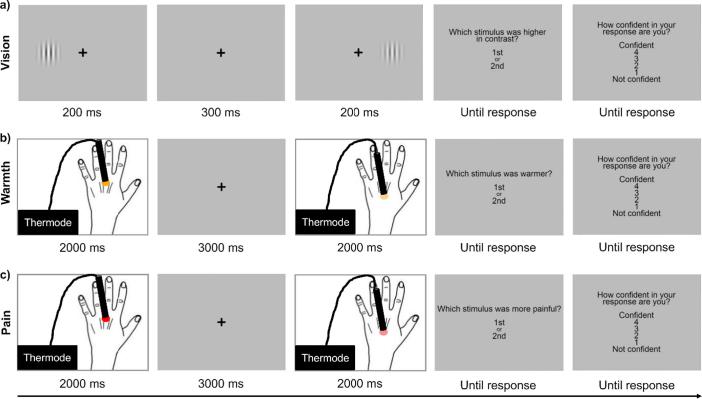
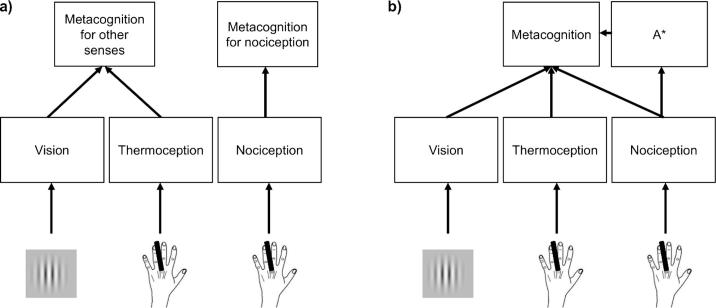
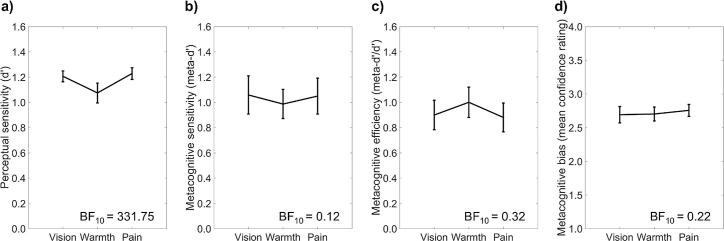
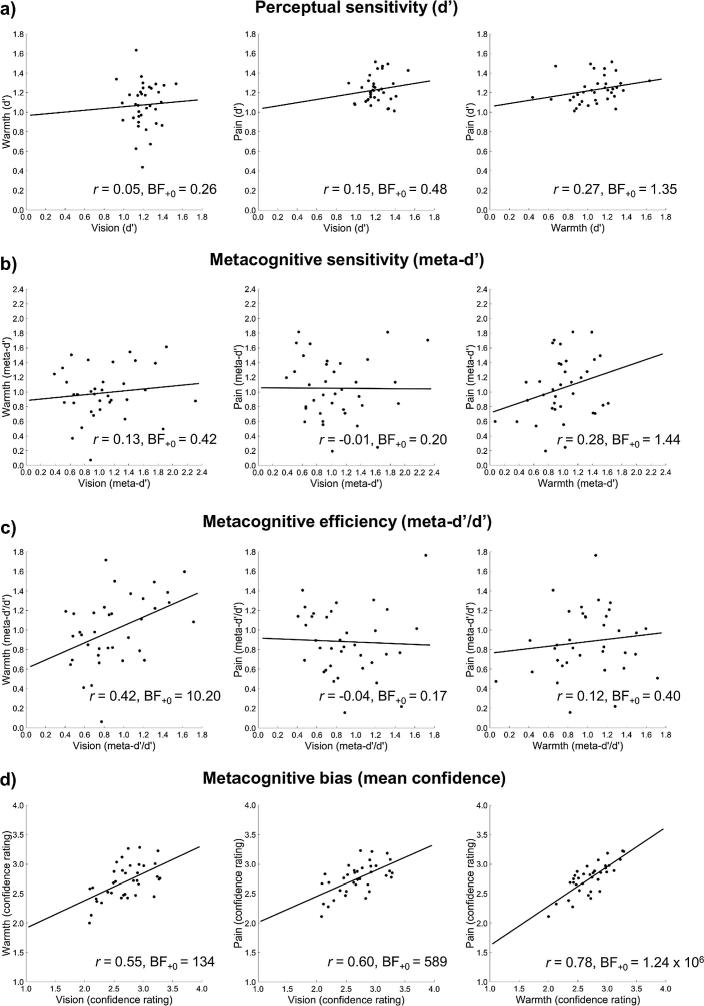
The distinctive experience of pain, beyond mere processing of nociceptive inputs, is much debated in psychology and neuroscience. One aspect of perceptual experience is captured by metacognition-the ability to monitor and evaluate one's own mental processes. We investigated confidence in judgements about nociceptive pain (i.e. pain that arises from the activation of nociceptors by a noxious stimulus) to determine whether metacognitive processes contribute to the distinctiveness of the pain experience. Our participants made intensity judgements about noxious heat, innocuous warmth, and visual contrast (first-order, perceptual decisions) and rated their confidence in those judgements (second-order, metacognitive decisions). First-order task performance between modalities was balanced using adaptive staircase procedures. For each modality, we quantified metacognitive efficiency (meta-d'/d')-the degree to which participants' confidence reports were informed by the same evidence that contributed to their perceptual judgements-and metacognitive bias (mean confidence)-the participant's tendency to report higher or lower confidence overall. We found no overall differences in metacognitive efficiency or mean confidence between modalities. Mean confidence ratings were highly correlated between all three tasks, reflecting stable inter-individual variability in metacognitive bias. However, metacognitive efficiency for pain varied independently of metacognitive efficiency for warmth and visual perception. That is, those participants who had higher metacognitive efficiency in the visual task also tended to have higher metacognitive efficiency in the warmth task, but not necessarily in the pain task. We thus suggest that some distinctive and idiosyncratic aspects of the pain experience may stem from additional variability at a metacognitive level. We further speculate that this additional variability may arise from the affective or arousal aspects of pain.
疼痛的独特体验,不仅仅是对伤害性输入的处理,在心理学和神经科学中备受争议。感知体验的一个方面是元认知——监测和评估自己心理过程的能力。我们研究了对伤害性疼痛判断的信心(即由有害刺激激活伤害感受器引起的疼痛),以确定元认知过程是否有助于疼痛体验的独特性。我们的参与者对有害热、无害温暖和视觉对比(一阶、感知决策)做出强度判断,并对这些判断的信心进行评级(二阶、元认知决策)。使用自适应阶梯程序平衡模态之间的一阶任务表现。对于每种模态,我们量化了元认知效率(meta-d'/d')——参与者的信心报告与促成其感知判断的相同证据的程度——以及元认知偏差(平均信心)——参与者总体上报告更高或更低信心的倾向。我们没有发现模态之间的元认知效率或平均信心有总体差异。所有三个任务的平均信心评级高度相关,反映了元认知偏差的个体间稳定的可变性。然而,疼痛的元认知效率与温暖和视觉感知的元认知效率独立变化。也就是说,那些在视觉任务中元认知效率较高的参与者也倾向于在温暖任务中元认知效率较高,但不一定在疼痛任务中。因此,我们认为疼痛体验的某些独特和特殊的方面可能源于元认知层面的额外可变性。我们进一步推测,这种额外的可变性可能源于疼痛的情感或唤醒方面。