Computational and Biological Learning Unit, Department of Engineering, University of Cambridge, Cambridge CB2 1PZ, UK.
Institute of Neuroscience, UCLouvain, 1200 Woluwe-Saint-Lambert, Belgium.
Proc Natl Acad Sci U S A. 2023 Jan 24;120(4):e2212252120. doi: 10.1073/pnas.2212252120. Epub 2023 Jan 20.
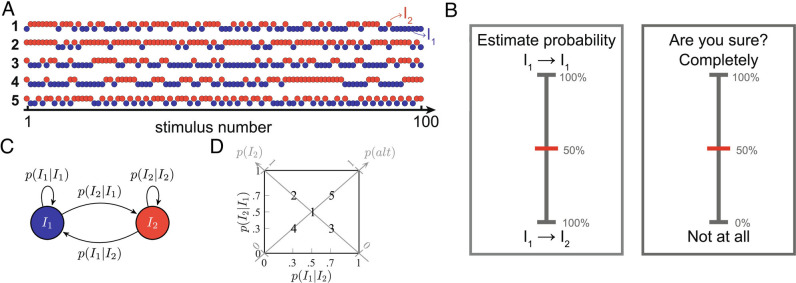
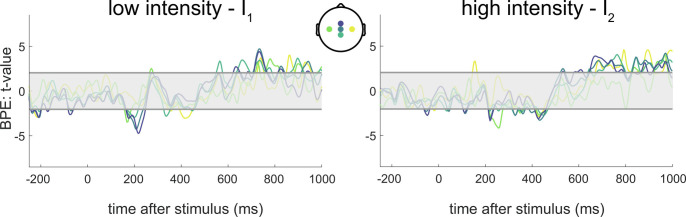
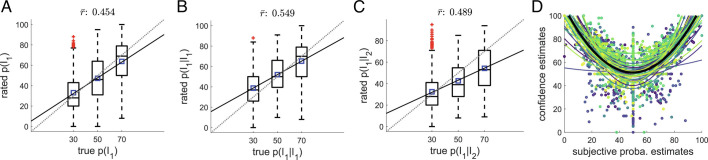
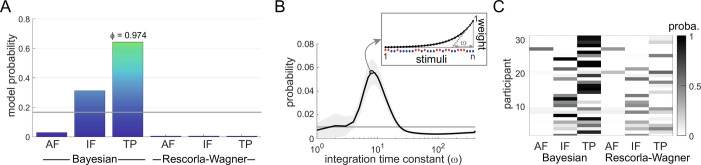
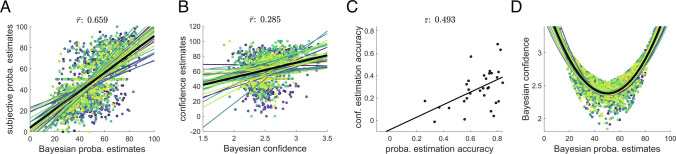
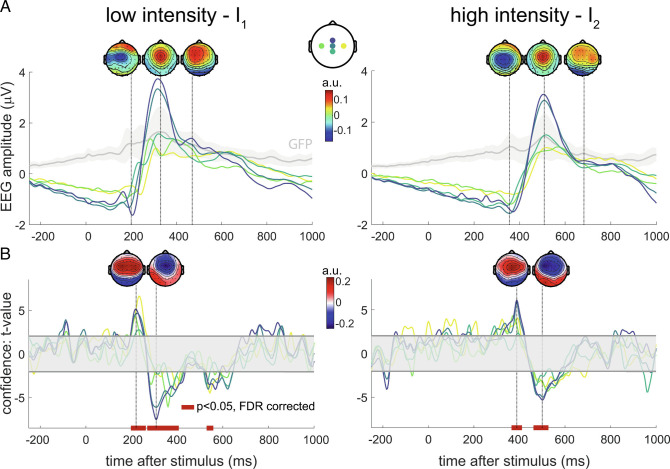
Pain typically evolves over time, and the brain needs to learn this temporal evolution to predict how pain is likely to change in the future and orient behavior. This process is termed temporal statistical learning (TSL). Recently, it has been shown that TSL for pain sequences can be achieved using optimal Bayesian inference, which is encoded in somatosensory processing regions. Here, we investigate whether the confidence of these probabilistic predictions modulates the EEG response to noxious stimuli, using a TSL task. Confidence measures the uncertainty about the probabilistic prediction, irrespective of its actual outcome. Bayesian models dictate that the confidence about probabilistic predictions should be integrated with incoming inputs and weight learning, such that it modulates the early components of the EEG responses to noxious stimuli, and this should be captured by a negative correlation: when confidence is higher, the early neural responses are smaller as the brain relies more on expectations/predictions and less on sensory inputs (and vice versa). We show that participants were able to predict the sequence transition probabilities using Bayesian inference, with some forgetting. Then, we find that the confidence of these probabilistic predictions was negatively associated with the amplitude of the N2 and P2 components of the vertex potential: the more confident were participants about their predictions, the smaller the vertex potential. These results confirm key predictions of a Bayesian learning model and clarify the functional significance of the early EEG responses to nociceptive stimuli, as being implicated in confidence-weighted statistical learning.
疼痛通常会随时间演变,大脑需要学习这种时间演变,以便预测疼痛在未来可能会如何变化,并调整行为。这个过程被称为时间统计学习(TSL)。最近的研究表明,使用最优贝叶斯推断可以实现对疼痛序列的 TSL,而这种推断编码在体感处理区域中。在这里,我们使用 TSL 任务研究了这些概率预测的置信度是否会调节对有害刺激的 EEG 反应。置信度衡量了对概率预测的不确定性,而不考虑其实际结果。贝叶斯模型规定,应该将概率预测的置信度与传入的输入和学习权重进行整合,从而调节对有害刺激的 EEG 早期反应,这应该通过负相关来捕获:当置信度较高时,由于大脑更多地依赖于期望/预测,而较少地依赖于感觉输入,因此早期神经反应会更小(反之亦然)。我们表明,参与者能够使用贝叶斯推断来预测序列转换概率,但存在一定的遗忘。然后,我们发现这些概率预测的置信度与顶点电位的 N2 和 P2 成分的幅度呈负相关:参与者对其预测的置信度越高,顶点电位越小。这些结果证实了贝叶斯学习模型的关键预测,并阐明了对伤害性刺激的早期 EEG 反应的功能意义,因为它们涉及置信度加权的统计学习。