Hibi Toshifumi, Motoya Satoshi, Ashida Toshifumi, Sai Souken, Sameshima Yukinori, Nakamura Shiro, Maemoto Atsuo, Nii Masahiro, Sullivan Barbara A, Gasser Robert A, Suzuki Yasuo
Center for Advanced IBD Research and Treatment, Kitasato University Kitasato Institute Hospital, Kitasato University, Tokyo, Japan.
IBD Center, Sapporo-Kosei General Hospital, Sapporo, Japan.
Intest Res. 2019 Jul;17(3):375-386. doi: 10.5217/ir.2018.00141. Epub 2019 Feb 12.
BACKGROUND/AIMS: Inhibition of α4β7 integrin has been shown to be effective for induction and maintenance therapy in patients with ulcerative colitis (UC). We investigated the effects of varying doses of the α4β7 inhibitor abrilumab in Japanese patients with moderate-to-severe UC despite conventional treatments.
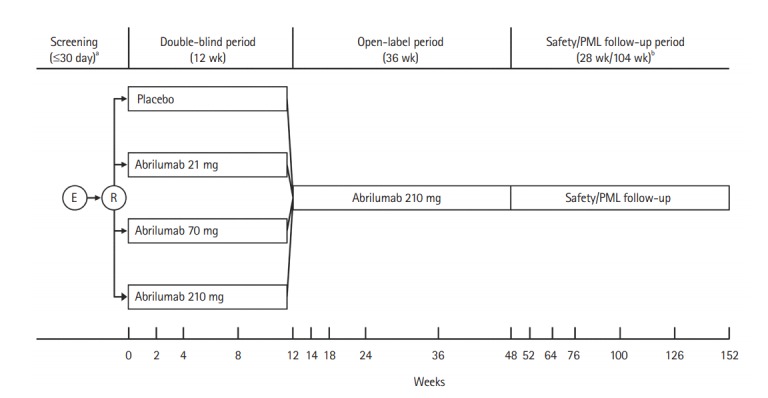
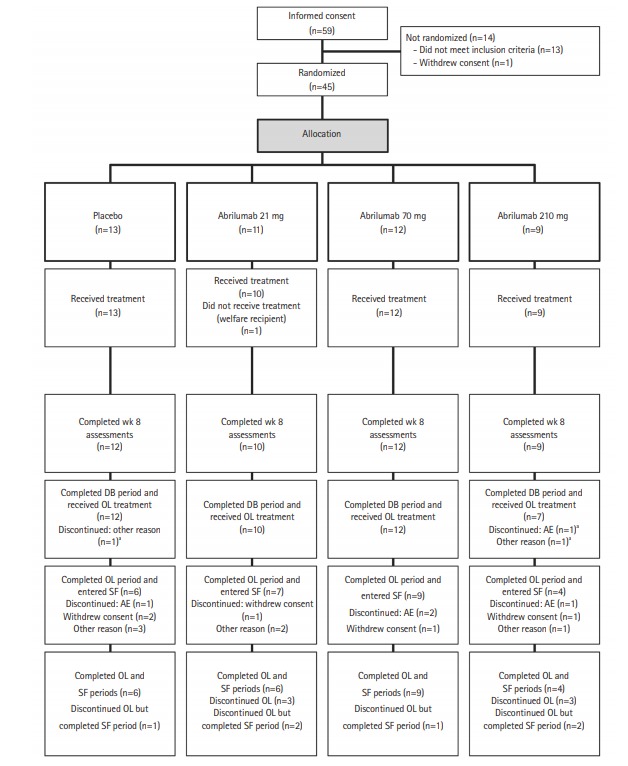
In this randomized, double-blind, placebocontrolled study, 45 UC patients were randomized to abrilumab 21 mg (n=11), 70 mg (n=12), 210 mg (n=9), or placebo (n=13) via subcutaneous (SC) injection for 12 weeks. The double-blind period was followed by a 36-week open-label period, in which all patients received abrilumab 210 mg SC every 12 weeks, and a 28-week safety follow-up period. The primary efficacy variable was clinical remission at week 8 (total Mayo score ≤2 points with no individual subscore >1 point).
Clinical remission at week 8 was 4 out of 31 (12.9%) overall in the abrilumab groups versus 0 out of 13 in the placebo group (abrilumab 21 mg, 1/10 [10.0%]; 70 mg, 2/12 [16.7%]; 210 mg, 1/9 [11.1%]). In both the double-blind and open-label periods, fewer patients in the abrilumab groups experienced ≥1 adverse event compared with those in the placebo group. There were no cases of progressive multifocal leukoencephalopathy and no deaths.
Abrilumab 70 mg and 210 mg yielded numerically better results in terms of clinical remission rate at Week 8 than placebo, with the 210 mg dose showing more consistent treatment effects. Abrilumab was well tolerated in Japanese patients with UC.
背景/目的:已证明抑制α4β7整合素对溃疡性结肠炎(UC)患者的诱导缓解和维持治疗有效。我们研究了不同剂量的α4β7抑制剂阿柏西普单抗对尽管接受了传统治疗但仍患有中度至重度UC的日本患者的影响。
在这项随机、双盲、安慰剂对照研究中,45例UC患者通过皮下注射随机分为阿柏西普单抗21mg组(n = 11)、70mg组(n = 12)、210mg组(n = 9)或安慰剂组(n = 13),治疗12周。双盲期后是36周的开放标签期,在此期间所有患者每12周接受一次210mg皮下注射阿柏西普单抗,随后是28周的安全性随访期。主要疗效变量是第8周时的临床缓解(梅奥总评分≤2分且无单项评分>1分)。
阿柏西普单抗组第8周时的临床缓解率在31例患者中为4例(12.9%),而安慰剂组13例患者中无1例缓解(阿柏西普单抗21mg组,1/10 [10.0%];70mg组,2/12 [16.7%];210mg组,1/9 [11.1%])。在双盲期和开放标签期,与安慰剂组相比,阿柏西普单抗组经历≥1次不良事件的患者更少。未发生进行性多灶性白质脑病病例,也无死亡病例。
阿柏西普单抗70mg和210mg在第8周的临床缓解率方面比安慰剂在数值上有更好的结果,210mg剂量显示出更一致的治疗效果。阿柏西普单抗在日本UC患者中耐受性良好。