Department of Gynecologic Oncology, IRCCS National Cancer Institute, Milan, Italy.
J Gynecol Oncol. 2019 Mar;30(2):e27. doi: 10.3802/jgo.2019.30.e27. Epub 2018 Nov 27.
Nerve-sparing radical hysterectomy has been implemented in order to reduce pelvic floor dysfunctions in women undergoing radical surgery for cervical cancer. Here, we aimed to investigate if the adoption of laparoscopic surgery impacts on patients' outcomes.
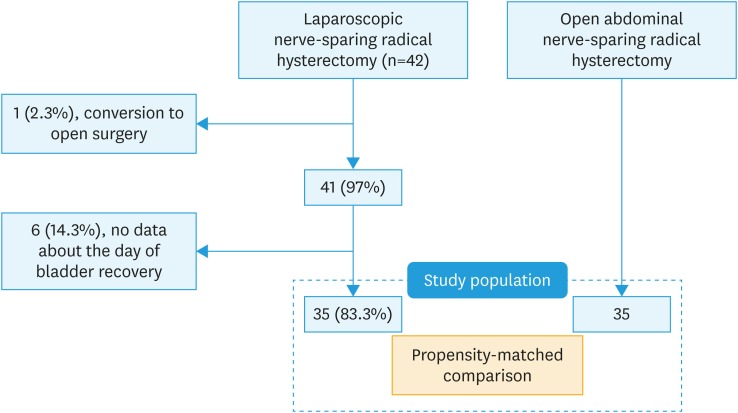
Data of consecutive patients affected by cervical cancer who had laparoscopic nerve-sparing radical hysterectomy were matched 1:1 with an historical cohort of patients undergoing open procedure. A propensity-score matched algorithm was applied.
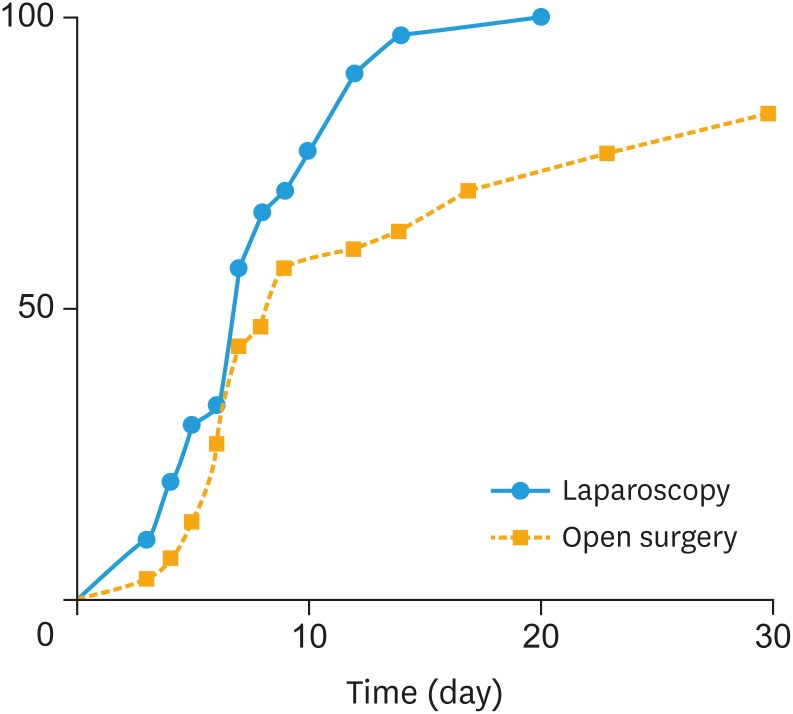
Thirty-five patients' pairs (70 patients: 35 undergoing laparoscopic vs. 35 undergoing open abdominal nerve-sparing radical hysterectomy) were included. Demographic and baseline oncologic characteristics were balanced between groups. Patients undergoing laparoscopic surgery had similar operative time than patients undergoing open abdominal procedures (249 [±91.5] vs. 223 [±65.0] minutes; p=0.066). Laparoscopic approach correlated with lower blood loss (30.5 [±11.0] vs. 190 [90.4] mL; p<0.001) and shorter hospital stay (3.2 [±1.2] vs. 5.4 [2.0] days; p=0.023). Patients undergoing laparoscopy experienced a lower 30-day pelvic floor dysfunction rate than patients having open surgery. Moreover, they experienced shorter recovery of bladder function than patients having open procedures (median, 7 vs. 9 days; p=0.004, log-rank test).
Laparoscopic approach resulted in a faster recovery of bladder function in comparison to open surgery for patients undergoing nerve-sparing radical hysterectomy.
为了减少宫颈癌根治性手术患者盆底功能障碍,已经实施了保留神经的根治性子宫切除术。在这里,我们旨在研究腹腔镜手术的应用是否会影响患者的结局。
对接受腹腔镜保留神经的根治性子宫切除术的连续宫颈癌患者的数据进行了匹配,1:1 与接受开放手术的历史队列患者进行匹配。应用倾向评分匹配算法。
纳入了 35 对患者(70 例患者:35 例接受腹腔镜手术与 35 例接受开放腹部保留神经的根治性子宫切除术)。两组患者的人口统计学和基线肿瘤特征均平衡。与接受开放腹部手术的患者相比,接受腹腔镜手术的患者手术时间相似(249 [±91.5] 分钟与 223 [±65.0] 分钟;p=0.066)。腹腔镜方法与较低的出血量(30.5 [±11.0] 毫升与 190 [90.4] 毫升;p<0.001)和较短的住院时间(3.2 [±1.2] 天与 5.4 [2.0] 天;p=0.023)相关。与接受开放手术的患者相比,接受腹腔镜手术的患者在 30 天内发生盆底功能障碍的发生率较低。此外,与接受开放手术的患者相比,接受腹腔镜手术的患者膀胱功能恢复更快(中位数为 7 天与 9 天;p=0.004,对数秩检验)。
与开放手术相比,对于接受保留神经的根治性子宫切除术的患者,腹腔镜方法可更快地恢复膀胱功能。