Max-Eder Research Group for Pediatric Sarcoma Biology, Institute of Pathology of the LMU Munich, Munich, Germany.
Institute of Pathology of the LMU Munich, Munich, Germany.
Cell Death Dis. 2019 Feb 11;10(2):116. doi: 10.1038/s41419-019-1372-0.
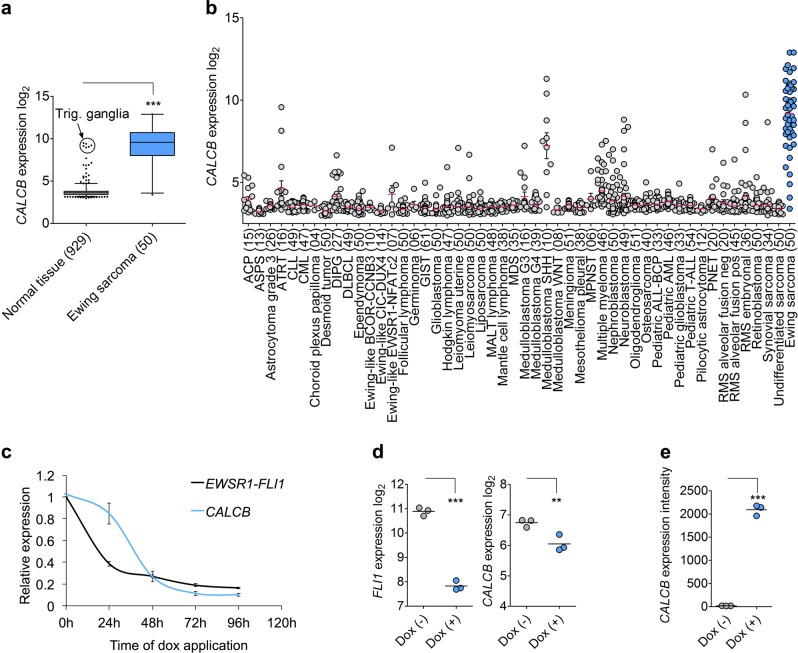
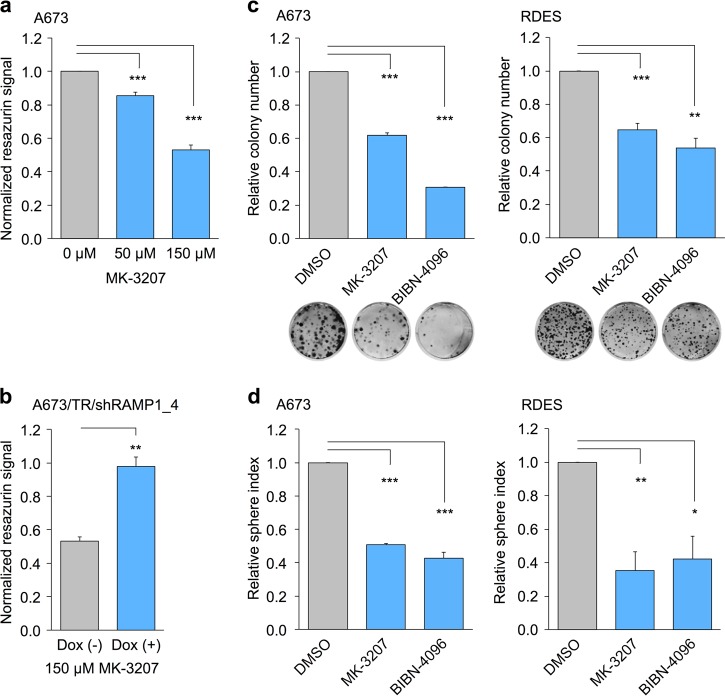
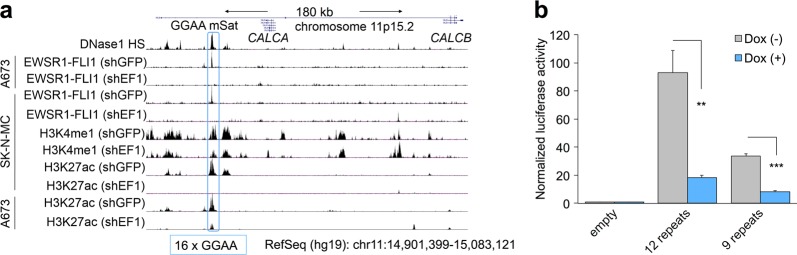
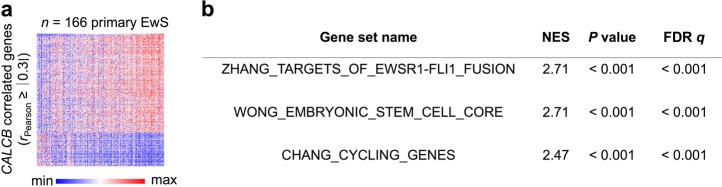
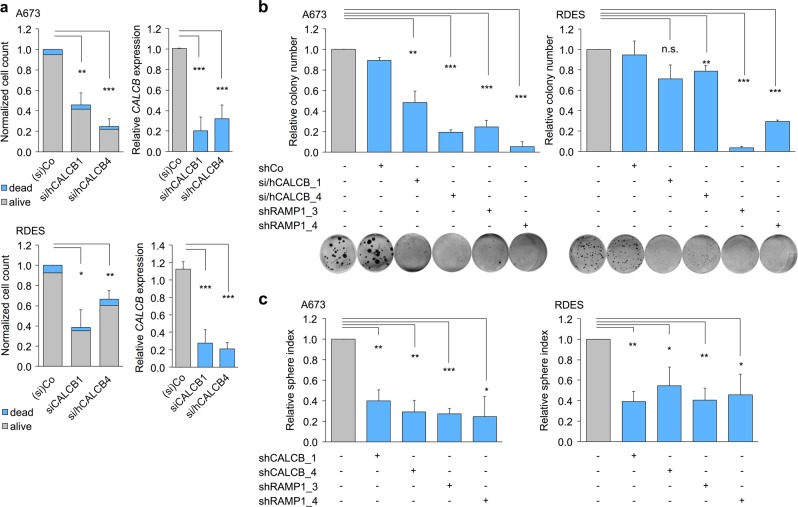
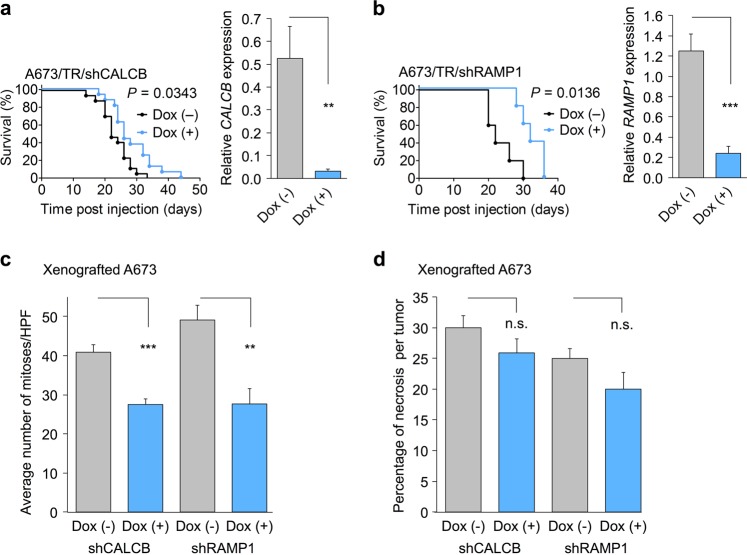
Ewing sarcoma (EwS) is an aggressive cancer characterized by chromosomal translocations generating fusions of the EWSR1 gene with ETS transcription factors (in 85% FLI1). EWSR1-FLI1 induces gene expression via binding to enhancer-like GGAA-microsatellites, whose activity correlates with the number of consecutive GGAA-repeats. Herein we investigate the role of the secretory neuropeptide CALCB (calcitonin-related polypeptide β) in EwS, which signals via the CGRP (calcitonin gene-related peptide) receptor complex, containing RAMP1 (receptor activity modifying protein 1) as crucial part for receptor specificity. Analysis of 2678 gene expression microarrays comprising 50 tumor entities and 71 normal tissue types revealed that CALCB is specifically and highly overexpressed in EwS. Time-course knockdown experiments showed that CALCB expression is tightly linked to that of EWSR1-FLI1. Consistently, gene set enrichment analyses of genes whose expression in primary EwS is correlated to that of CALCB indicated that it is co-expressed with other EWSR1-FLI1 target genes and associated with signatures involved in stemness and proliferation. Chromatin immunoprecipitation followed by sequencing (ChIP-seq) data for FLI1 and histone marks from EwS cell lines demonstrated that EWSR1-FLI1 binds to a GGAA-microsatellite close to CALCB, which exhibits characteristics of an active enhancer. Reporter assays confirmed the strong EWSR1-FLI1- and length-dependent enhancer activity of this GGAA-microsatellite. Mass spectrometric analyses of EwS cell culture supernatants demonstrated that CALCB is secreted by EwS cells. While short-term RNA interference-mediated CALCB knockdown had no effect on proliferation and clonogenic growth of EwS cells in vitro, its long-term knockdown decreased EwS growth in vitro and in vivo. Similarly, knockdown of RAMP1 reduced clonogenic/spheroidal growth and tumorigenicity, and small-molecule inhibitors directed against the RAMP1-comprising CGRP receptor reduced growth of EwS. Collectively, our findings suggest that CALCB is a direct EWSR1-FLI1 target and that targeting the CALCB/RAMP1 axis may offer a new therapeutic strategy for inhibition of EwS growth.
尤文肉瘤(EwS)是一种侵袭性癌症,其特征在于染色体易位,导致 EWSR1 基因与 ETS 转录因子融合(在 85%的 FLI1 中)。EWSR1-FLI1 通过与增强子样 GGAA-微卫星结合来诱导基因表达,其活性与连续 GGAA-重复的数量相关。在此,我们研究了分泌神经肽 CALCB(降钙素相关多肽β)在 EwS 中的作用,该神经肽通过包含 RAMP1(受体活性修饰蛋白 1)作为受体特异性关键部分的 CGRP(降钙素基因相关肽)受体复合物发出信号。对包含 50 种肿瘤实体和 71 种正常组织类型的 2678 个基因表达微阵列的分析表明,CALCB 在 EwS 中特异性且高度过表达。时间过程敲低实验表明,CALCB 表达与 EWSR1-FLI1 的表达紧密相关。一致地,对原发性 EwS 中与 CALCB 表达相关的基因的基因集富集分析表明,它与其他 EWSR1-FLI1 靶基因共同表达,并与涉及干性和增殖的特征相关。来自 EwS 细胞系的 EWSR1-FLI1 和组蛋白标记的染色质免疫沉淀测序(ChIP-seq)数据表明,EWSR1-FLI1 结合到 CALCB 附近的一个 GGAA-微卫星,该微卫星具有活性增强子的特征。报告基因分析证实了该 GGAA-微卫星的强 EWSR1-FLI1 和长度依赖性增强子活性。EwS 细胞培养上清液的质谱分析表明,CALCB 由 EwS 细胞分泌。虽然短期 RNA 干扰介导的 CALCB 敲低对 EwS 细胞的体外增殖和克隆形成生长没有影响,但长期敲低会降低 EwS 的体外和体内生长。同样,RAMP1 的敲低减少了克隆形成/球体生长和致瘤性,并且针对包含 RAMP1 的 CGRP 受体的小分子抑制剂减少了 EwS 的生长。总的来说,我们的发现表明 CALCB 是 EWSR1-FLI1 的直接靶标,靶向 CALCB/RAMP1 轴可能为抑制 EwS 生长提供新的治疗策略。