Department of Electronics and Computer Engineering, Hanyang University, 222 Wangsimini-ro, Seongdong-gu, Seoul 04763, Korea.
Department of Psychiatry, Hanyang University Medical Center, 222-1 Wangsimni-ro, Seongdong-gu, Seoul 04763, Korea.
Sensors (Basel). 2019 Feb 8;19(3):688. doi: 10.3390/s19030688.
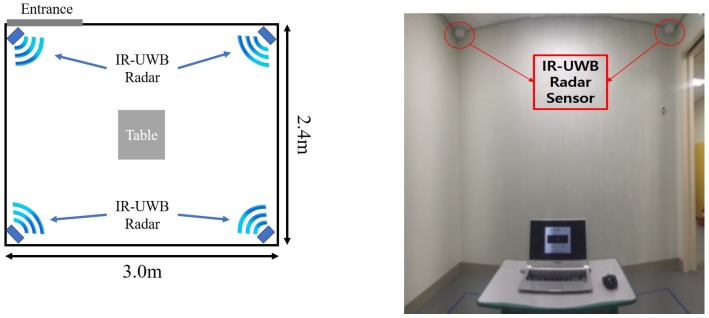
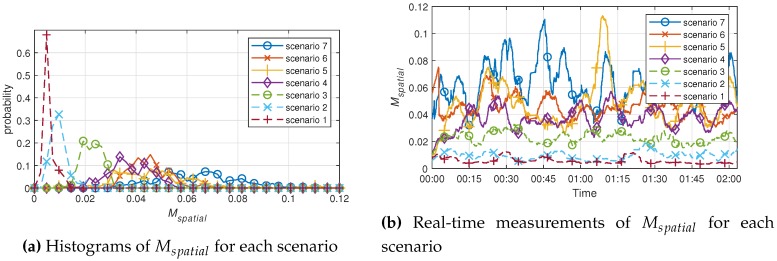
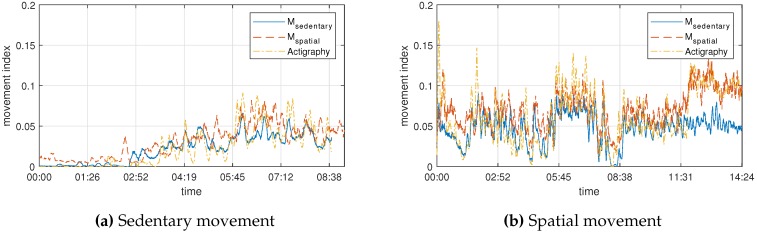
Movement disorders, such as Parkinson's disease, dystonia, tic disorder, and attention-deficit/hyperactivity disorder (ADHD) are clinical syndromes with either an excess of movement or a paucity of voluntary and involuntary movements. As the assessment of most movement disorders depends on subjective rating scales and clinical observations, the objective quantification of activity remains a challenging area. The purpose of our study was to verify whether an impulse radio ultra-wideband (IR-UWB) radar sensor technique is useful for an objective measurement of activity. Thus, we proposed an activity measurement algorithm and quantitative activity indicators for clinical assistance, based on IR-UWB radar sensors. The received signals of the sensor are sufficiently sensitive to measure heart rate, and multiple sensors can be used together to track the positions of people. To measure activity using these two features, we divided movement into two categories. For verification, we divided these into several scenarios, depending on the amount of activity, and compared with an actigraphy sensor to confirm the clinical feasibility of the proposed indicators. The experimental environment is similar to the environment of the comprehensive attention test (CAT), but with the inclusion of the IR-UWB radar. The experiment was carried out, according to a predefined scenario. Experiments demonstrate that the proposed indicators can measure movement quantitatively, and can be used as a quantified index to clinically record and compare patient activity. Therefore, this study suggests the possibility of clinical application of radar sensors for standardized diagnosis.
运动障碍,如帕金森病、肌张力障碍、抽动障碍和注意缺陷多动障碍(ADHD),是一种运动过多或自主和非自主运动过少的临床综合征。由于大多数运动障碍的评估依赖于主观评分量表和临床观察,因此活动的客观量化仍然是一个具有挑战性的领域。我们的研究目的是验证脉冲无线电超宽带(IR-UWB)雷达传感器技术是否可用于对活动进行客观测量。因此,我们提出了一种基于 IR-UWB 雷达传感器的活动测量算法和定量活动指标,用于临床辅助。传感器的接收信号对测量心率非常敏感,并且可以使用多个传感器一起跟踪人员的位置。为了使用这两个特征来测量活动,我们将运动分为两类。为了验证,我们根据活动量将这些分为几种情况,并与动作传感器进行比较,以确认所提出指标的临床可行性。实验环境类似于综合注意力测试(CAT)的环境,但包含了 IR-UWB 雷达。根据预定义的方案进行了实验。实验表明,所提出的指标可以定量测量运动,并且可以用作临床记录和比较患者活动的量化指标。因此,本研究表明雷达传感器用于标准化诊断的临床应用的可能性。