Department of Health Sciences, Respiratory Unit, ASST Santi Paolo e Carlo, Università degli Studi di Milano, San Paolo Hospital, Via Di Rudinì n. 8, 20142, Milan, Italy.
ASST Lodi, UOC Pneumologia, Lodi, Italy.
BMC Pulm Med. 2019 Feb 11;19(1):36. doi: 10.1186/s12890-019-0795-9.
Bronchoscopy plays a key role to diagnose the etiology, to localize the site, and to identify the sources of the bleeding in patients with hemoptysis, but the ideal timing of an endoscopic examination is still unclear.
We performed a secondary analysis of an observational and multicenter study, aimed at evaluating the epidemiology of hemoptysis in Italy and the diagnostic yield of the most frequently prescribed examinations. The aim of the study was to evaluate whether an early bronchoscopy (i.e., performed during active bleeding/≤48 h after hemoptysis stopped) helps localize bleeding (i.e., site, lobe, lung) and increase diagnostic yield in comparison with a delayed examination.
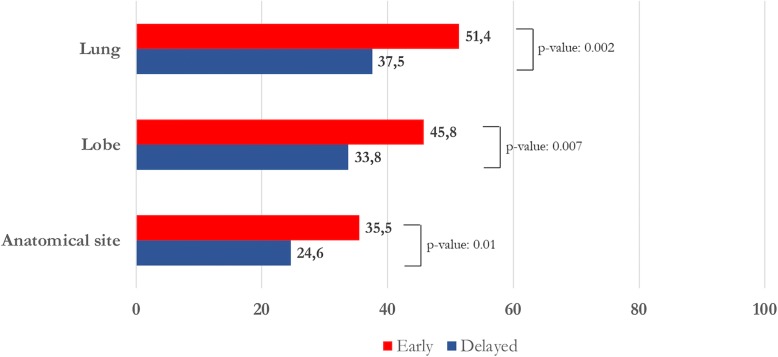
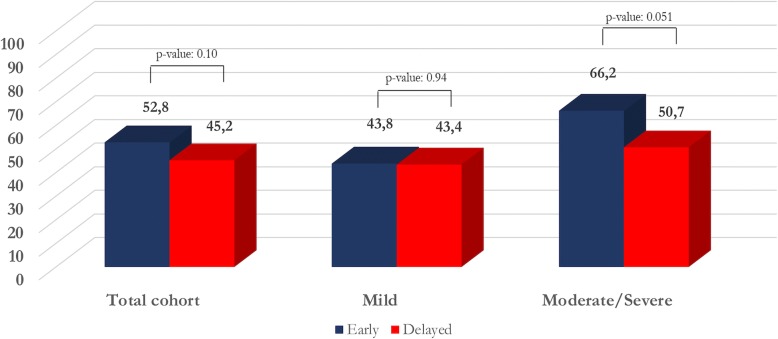
Four hundred eighty-six consecutive adult patients (69.2% males; median [IQR] age: 67 [53-76] years) with hemoptysis requiring an etiological diagnosis and undergoing bronchoscopy were recruited. Bleeding focus could be located more frequently in case of moderate-severe bleedings than in cases of mild hemoptysis (site: 70/154, 45.4%, VS. 73/330, 22.1%; p-value < 0.0001; lobe: 95/155, 61.3%, VS. 95/331, 28.7%; p-value < 0.0001; lung: 101/155, 65.1%, VS. 111/331, 33.5%; p-value < 0.0001). Early bronchoscopy showed a higher detection rate of bleeding source in comparison with delayed examination (site: 76/214, 35.5%, VS. 67/272, 24.6%; p-value = 0.01; lobe: 98/214, 45.8%, VS. 92/272, 33.8%; p-value = 0.007; lung: 110/214, 51.4%, VS. 102/272, 37.5%; p-value = 0.002). Early bronchoscopy did not provide any advantages in terms of increased diagnostic yield, in the total cohort (113/214, 52.8%, VS. 123/272, 45.2%; p-value = 0.10) and in the severity subtypes (mild: 56/128, 43.8%, VS. 88/203, 43.4%; p-value = 0.94; moderate-severe: 57/86, 66.2%, VS. 35/69, 50.7%; p-value = 0.051).
Early bronchoscopy helps detect bleeding sources, particularly in cases of moderate-severe hemoptysis, without increasing diagnostic accuracy.
ClinicalTrials.gov (identifier: NCT02045394 ).
支气管镜检查在诊断病因、定位部位和识别咯血患者出血来源方面发挥着关键作用,但内镜检查的理想时机仍不清楚。
我们对一项观察性和多中心研究进行了二次分析,旨在评估意大利咯血的流行病学和最常开的检查的诊断收益。该研究的目的是评估早期支气管镜检查(即在出血期间/停止出血后 48 小时内进行)是否有助于定位出血(即部位、叶、肺)并与延迟检查相比提高诊断收益。
共招募了 486 例因病因诊断需要行支气管镜检查的连续成年咯血患者(69.2%为男性;中位[IQR]年龄:67[53-76]岁)。与轻度咯血相比,中重度咯血更容易定位出血部位(部位:70/154,45.4%,VS. 73/330,22.1%;p 值<0.0001;叶:95/155,61.3%,VS. 95/331,28.7%;p 值<0.0001;肺:101/155,65.1%,VS. 111/331,33.5%;p 值<0.0001)。与延迟检查相比,早期支气管镜检查显示出血源的检测率更高(部位:76/214,35.5%,VS. 67/272,24.6%;p 值=0.01;叶:98/214,45.8%,VS. 92/272,33.8%;p 值=0.007;肺:110/214,51.4%,VS. 102/272,37.5%;p 值=0.002)。早期支气管镜检查在总队列(113/214,52.8%,VS. 123/272,45.2%;p 值=0.10)和严重程度亚组(轻度:56/128,43.8%,VS. 88/203,43.4%;p 值=0.94;中重度:57/86,66.2%,VS. 35/69,50.7%;p 值=0.051)中均未提高诊断收益。
早期支气管镜检查有助于检测出血源,特别是在中重度咯血的情况下,而不会提高诊断准确性。
ClinicalTrials.gov(标识符:NCT02045394)。