Ro Seung-Hyun, Jang Yura, Bae Jiyoung, Kim Isaac M, Schaecher Cameron, Shomo Zachery D
Department of Biochemistry, University of Nebraska-Lincoln, Lincoln, NE, United States.
Department of Neurology, Johns Hopkins University School of Medicine, Baltimore, MD, United States.
Front Physiol. 2019 Jan 28;10:22. doi: 10.3389/fphys.2019.00022. eCollection 2019.
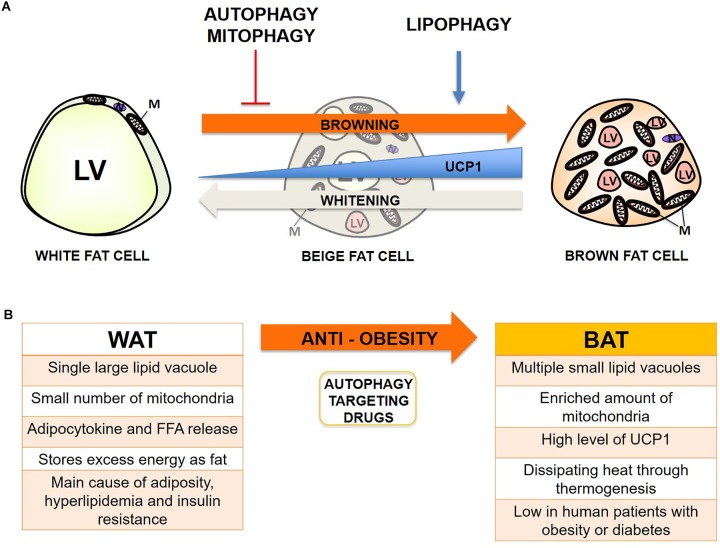
Autophagy, lipophagy, and mitophagy are considered to be the major recycling processes for protein aggregates, excess fat, and damaged mitochondria in adipose tissues in response to nutrient status-associated stress, oxidative stress, and genotoxic stress in the human body. Obesity with increased body weight is often associated with white adipose tissue (WAT) hypertrophy and hyperplasia and/or beige/brown adipose tissue atrophy and aplasia, which significantly contribute to the imbalance in lipid metabolism, adipocytokine secretion, free fatty acid release, and mitochondria function. In recent studies, hyperactive autophagy in WAT was observed in obese and diabetic patients, and inhibition of adipose autophagy through targeted deletion of autophagy genes in mice improved anti-obesity phenotypes. In addition, active mitochondria clearance through activation of autophagy was required for beige/brown fat whitening - that is, conversion to white fat. However, inhibition of autophagy seemed detrimental in hypermetabolic conditions such as hepatic steatosis, atherosclerosis, thermal injury, sepsis, and cachexia through an increase in free fatty acid and glycerol release from WAT. The emerging concept of white fat browning-conversion to beige/brown fat-has been controversial in its anti-obesity effect through facilitation of weight loss and improving metabolic health. Thus, proper regulation of autophagy activity fit to an individual metabolic profile is necessary to ensure balance in adipose tissue metabolism and function, and to further prevent metabolic disorders such as obesity and diabetes. In this review, we summarize the effect of autophagy in adipose tissue browning in the context of obesity prevention and its potential as a promising target for the development of anti-obesity drugs.
自噬、脂肪自噬和线粒体自噬被认为是脂肪组织中蛋白质聚集体、多余脂肪和受损线粒体的主要回收过程,以应对人体中与营养状况相关的应激、氧化应激和基因毒性应激。体重增加的肥胖通常与白色脂肪组织(WAT)肥大和增生和/或米色/棕色脂肪组织萎缩和发育不全有关,这显著导致脂质代谢、脂肪细胞因子分泌、游离脂肪酸释放和线粒体功能的失衡。在最近的研究中,在肥胖和糖尿病患者的WAT中观察到自噬过度活跃,通过在小鼠中靶向缺失自噬基因来抑制脂肪自噬改善了抗肥胖表型。此外,通过激活自噬进行活跃的线粒体清除是米色/棕色脂肪变白(即转化为白色脂肪)所必需的。然而,在诸如肝脂肪变性、动脉粥样硬化、热损伤、脓毒症和恶病质等高代谢条件下,抑制自噬似乎是有害的,因为这会增加WAT中游离脂肪酸和甘油的释放。白色脂肪褐变(转化为米色/棕色脂肪)这一新兴概念在通过促进体重减轻和改善代谢健康来发挥抗肥胖作用方面一直存在争议。因此,适当调节自噬活性以适应个体代谢状况对于确保脂肪组织代谢和功能的平衡以及进一步预防肥胖和糖尿病等代谢紊乱是必要的。在这篇综述中,我们总结了自噬在肥胖预防背景下对脂肪组织褐变的影响及其作为抗肥胖药物开发的有前景靶点的潜力。