Keefe Bruce D, Suray Pierre-Arthur, Watt Simon J
School of Psychology, Bangor University, Penrallt Rd., Bangor, Gwynedd, LL57 2AS, UK.
Exp Brain Res. 2019 Apr;237(4):1063-1075. doi: 10.1007/s00221-019-05489-z. Epub 2019 Feb 12.
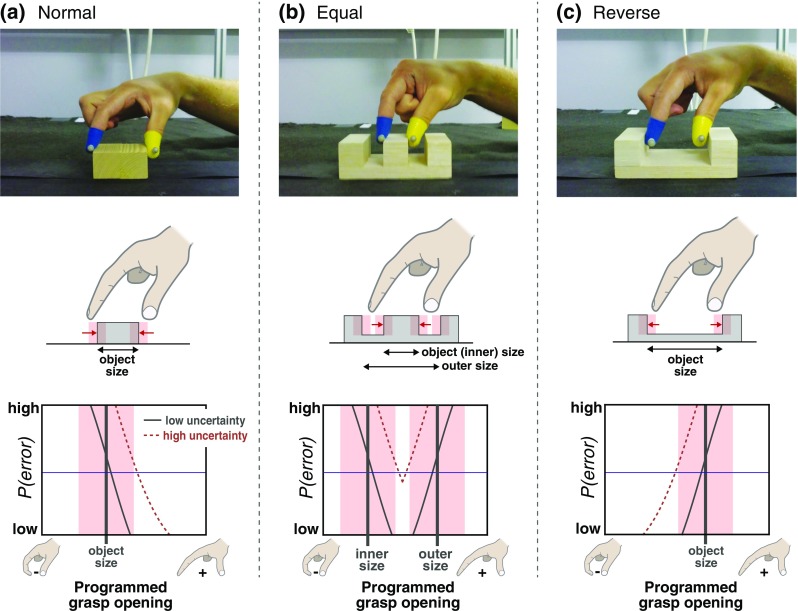
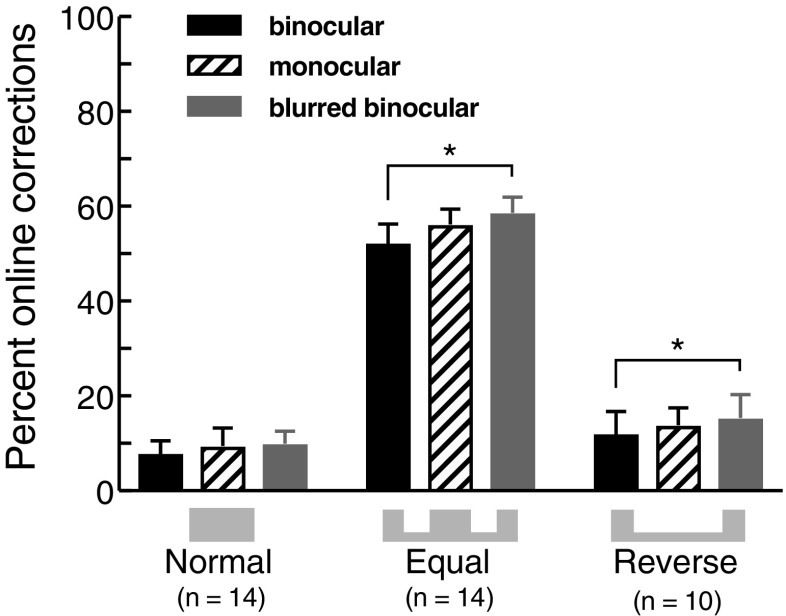
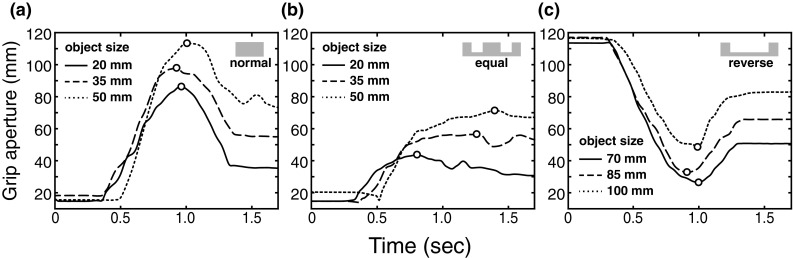
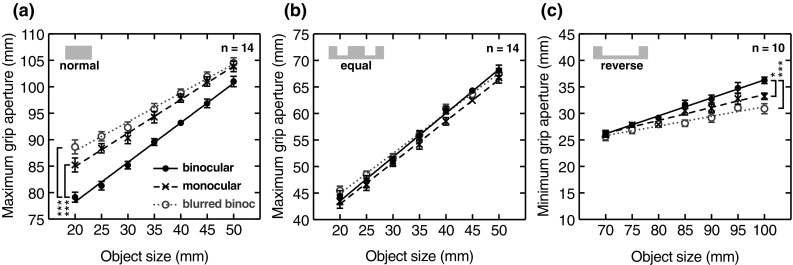
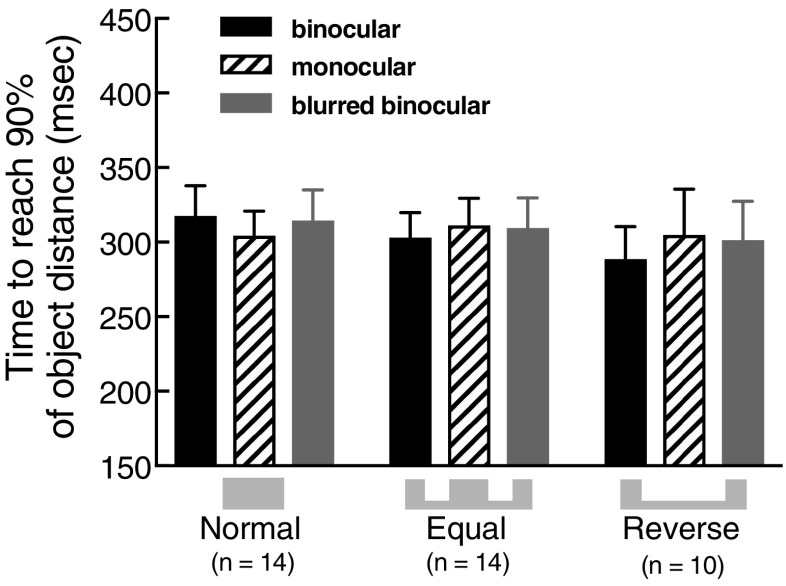
Ideal grasping movements should maintain an appropriate probability of success, while controlling movement-related costs, in the presence of varying visual (and motor) uncertainty. It is often assumed that the probability of errors is managed by adjusting a margin for error in hand opening (e.g., opening the hand wider with increased visual uncertainty). This idea is intuitive, but non-trivial. It implies not only that the brain can estimate the amount of uncertainty, but also that it can compute how different possible alterations to the movement will affect the probability of errors-which we term the 'probability landscape'. Previous work suggests the amount of uncertainty is factored into grasping movements. Our aim was to determine whether grasping movements are also sensitive to the probability landscape. Subjects completed three different grasping tasks, with naturally different probability landscapes, such that appropriate margin-for-error responses to increased uncertainty were qualitatively different (opening the hand wider, the same amount, or less wide). We increased visual uncertainty by blurring vision, and by covering one eye. Movements were performed without visual feedback to isolate uncertainty in the brain's initial estimate of object properties. Changes to hand opening in response to increased visual uncertainty closely resembled those predicted by the margin-for-error account, suggesting that grasping is sensitive to the probability landscape associated with different tasks. Our findings therefore support the intuitive idea that grasping movements employ a true margin-for-error mechanism, which exerts active control over the probability of errors across changing circumstances.
理想的抓握动作应在存在不同视觉(和运动)不确定性的情况下,保持适当的成功概率,同时控制与运动相关的成本。人们通常认为,错误概率是通过调整手部张开的误差余量来管理的(例如,随着视觉不确定性增加而更宽地张开手部)。这个想法很直观,但并非微不足道。这不仅意味着大脑能够估计不确定性的程度,还意味着它能够计算运动的不同可能改变将如何影响错误概率——我们将其称为“概率图景”。先前的研究表明,不确定性的程度已被纳入抓握动作中。我们的目的是确定抓握动作是否也对概率图景敏感。受试者完成了三项不同的抓握任务,其自然具有不同的概率图景,以至于对增加的不确定性做出的适当误差余量反应在性质上是不同的(更宽地、同等程度地或更窄地张开手部)。我们通过模糊视觉和遮住一只眼睛来增加视觉不确定性。在没有视觉反馈的情况下进行动作,以分离大脑对物体属性的初始估计中的不确定性。对增加的视觉不确定性做出的手部张开变化与误差余量理论所预测的变化非常相似,这表明抓握对与不同任务相关的概率图景敏感。因此我们的数据支持了这样一个直观的观点,即抓握动作采用了一种真正的误差余量机制,该机制在不断变化的情况下对错误概率施加主动控制。