Department of Chemistry, The Scripps Research Institute, La Jolla, CA, USA.
Department of Pharmacy, University of Wisconsin - Madison, Madison, WI, USA.
Sci Rep. 2019 Feb 12;9(1):1841. doi: 10.1038/s41598-019-38549-z.
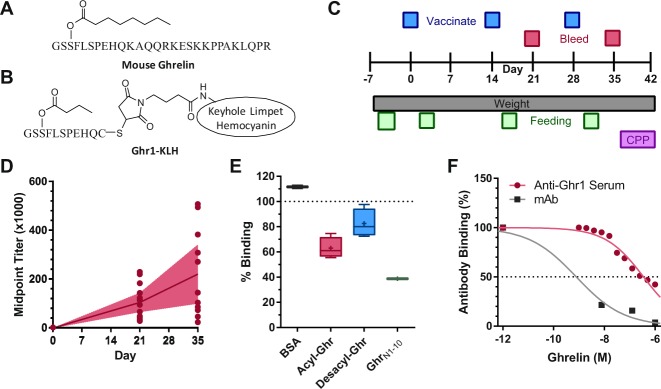
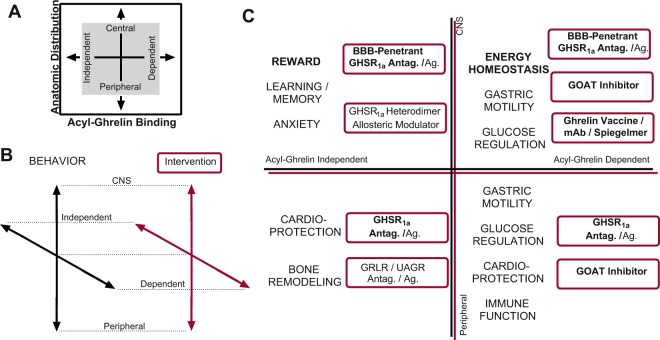
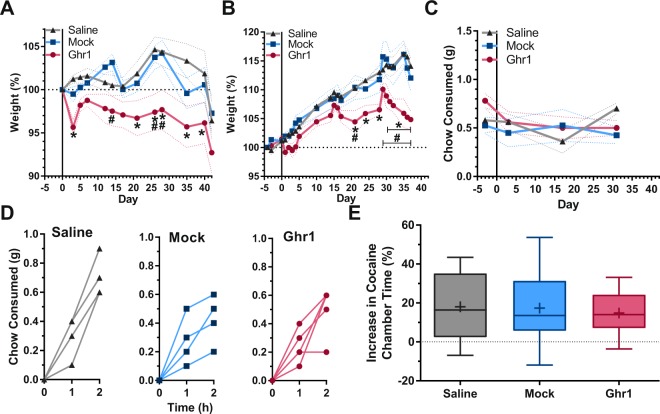
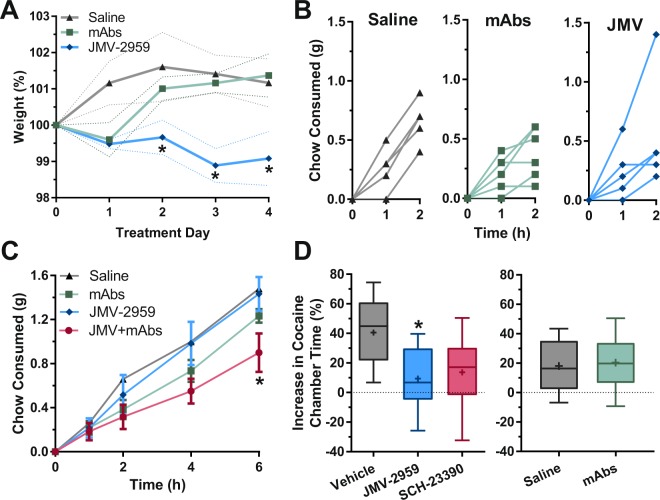
The peptide hormone acyl-ghrelin and its receptor, GHSR, represent intriguing therapeutic targets due to their actions in metabolic homeostasis and reward activity. However, this pleotropic activity makes it difficult to intervene in this system without inducing unwanted effects. Thus, it is desirable to identify passive and active regulatory mechanisms that allow differentiation between functional domains. Anatomical restriction by the blood brain barrier represents one major passive regulatory mechanism. However, it is likely that the ghrelin system is subject to additional passive mechanisms that promote independent regulation of orexigenic behavior and reward processing. By applying acyl-ghrelin sequestering antibodies, it was determined that peripheral sequestration of acyl-ghrelin is sufficient to blunt weight gain, but not cocaine rewarding effects. However, both weight gain and reward-associated behaviors were shown to be blocked by direct antagonism of GHSR. Overall, these data indicate that GHSR effects on reward are independent from peripheral acyl-ghrelin binding, whereas centrally-mediated alteration of energy storage requires peripheral acyl-ghrelin binding. This demonstration of variable ligand-dependence amongst functionally-distinct GHSR populations is used to generate a regulatory model for functional manipulation of specific effects when attempting to therapeutically target the ghrelin system.
肽激素酰基-ghrelin 及其受体 GHSR 因其在代谢稳态和奖赏活动中的作用而成为有趣的治疗靶点。然而,这种多效性活性使得在不引起不良反应的情况下干预该系统变得困难。因此,有必要识别允许区分功能域的被动和主动调节机制。血脑屏障的解剖限制是一种主要的被动调节机制。然而,ghrelin 系统可能受到其他被动机制的影响,这些机制促进摄食行为和奖赏处理的独立调节。通过应用酰基-ghrelin 隔离抗体,确定外周酰基-ghrelin 的隔离足以阻止体重增加,但不会阻止可卡因的奖赏作用。然而,体重增加和与奖赏相关的行为都被证明可以被 GHSR 的直接拮抗剂阻断。总的来说,这些数据表明,GHSR 对奖赏的影响与外周酰基-ghrelin 的结合无关,而中枢介导的能量储存的改变需要外周酰基-ghrelin 的结合。这种在功能上不同的 GHSR 群体之间的可变配体依赖性的证明被用来生成一个调节模型,用于在试图治疗性靶向 ghrelin 系统时对特定效应进行功能操作。