UCLA, Neuroscience Interdepartmental Graduate Program, University of California, Los Angeles, USA.
Department of Psychiatry and Biobehavioral Sciences, David Geffen School of Medicine, University of California, Los Angeles, USA.
Drugs. 2024 Nov;84(11):1395-1417. doi: 10.1007/s40265-024-02098-1. Epub 2024 Oct 10.
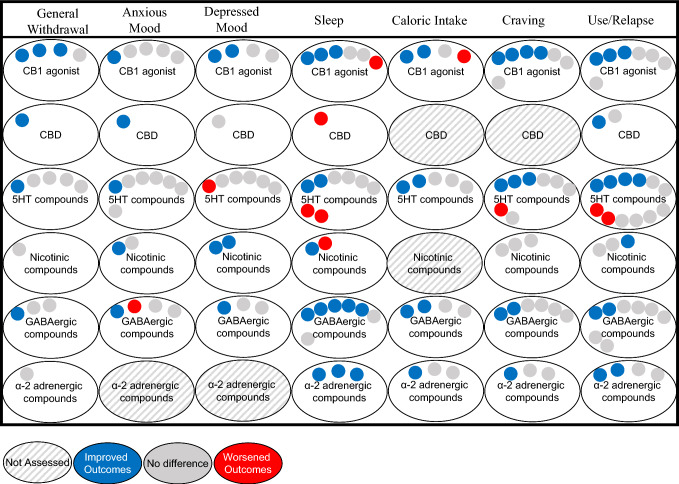
With rapid expansion of cannabis legalization worldwide, rates of cannabis use and cannabis use disorder (CUD) are increasing; the need for safe and effective medications to treat CUD is urgent. This narrative review evaluates evidence for promising pharmacotherapies to treat CUD from randomized, placebo-controlled trials. Pharmacotherapies for CUD are categorized based on compound targets (e.g., cannabinoid receptor 1 [CB1] agonists such as nabilone, serotonergic compounds such as bupropion, GABAergic compounds such as zolpidem) and outcomes are organized by predetermined withdrawal symptoms, cannabis craving, and cannabis relapse/use. Most promising pharmacotherapies for CUD are drugs that act on the endocannabinoid system and specifically at the CB1 receptor. Priority populations such as females, certain racial/ethnic groups, and age groups experience a different course of CUD progression, symptoms, and drug effects that are important to consider when evaluating outcomes related to CUD. Possible explanations for these disparities are explored, along with the clinical trials that explore these demographics in treating CUD with pharmacotherapies.
随着全球大麻合法化的迅速扩张,大麻使用和大麻使用障碍(CUD)的发生率正在上升;急需安全有效的药物来治疗 CUD。本综述评价了来自随机、安慰剂对照试验的有前途的治疗 CUD 的药物治疗的证据。根据化合物靶点(例如大麻素受体 1 [CB1] 激动剂,如纳布啡,血清素化合物,如安非他酮,GABA 能化合物,如唑吡坦)对 CUD 的药物治疗进行分类,根据预先确定的戒断症状、大麻渴望和大麻复发/使用来组织结果。最有前途的治疗 CUD 的药物治疗是作用于内源性大麻素系统并特别作用于 CB1 受体的药物。优先人群,如女性、某些种族/族裔群体和年龄组,经历不同的 CUD 进展、症状和药物作用过程,在评估与 CUD 相关的结果时,这些都需要考虑。探讨了这些差异的可能解释,以及探索这些人群用药物治疗 CUD 的临床试验。