Department of Epidemiology, Johns Hopkins Bloomberg School of Public Health, Baltimore, Maryland, United States of America.
Center for Drug Safety and Effectiveness, Johns Hopkins University, Baltimore, Maryland, United States of America.
PLoS One. 2019 Feb 13;14(2):e0211820. doi: 10.1371/journal.pone.0211820. eCollection 2019.
Clinical guidelines recommend that metformin be continued after insulin is initiated among patients with type 2 diabetes, yet little is known regarding how often metformin or other non-insulin diabetes medications are continued in this setting.
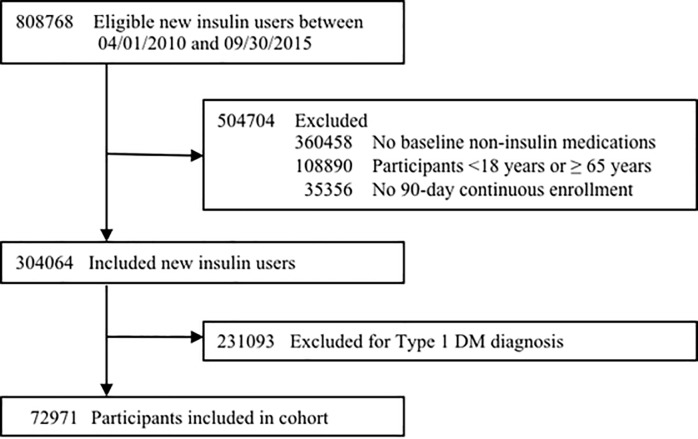
We conducted a retrospective cohort study to characterize rates and use patterns of six classes of non-insulin diabetes medications: biguanides (metformin), sulfonylureas, thiazolidinediones (TZDs), glucagon-like peptide 1 receptor agonists (GLP1 receptor agonists), dipeptidyl peptidase 4 inhibitors (DPP4 inhibitors), and sodium-glucose co-transporter inhibitors (SGLT2 inhibitors), among patients with type 2 diabetes initiating insulin. We used the 2010-2015 MarketScan Commercial Claims and Encounters data examining 72,971 patients with type 2 diabetes aged 18-65 years old who initiated insulin and had filled a prescription for a non-insulin diabetes medication in the 90 days prior to insulin initiation. Our primary outcome was the proportion of patients refilling the various non-insulin diabetes medications during the first 90 days after insulin initiation. We also used time-to-event analysis to characterize the time to discontinuation of specific medication classes.
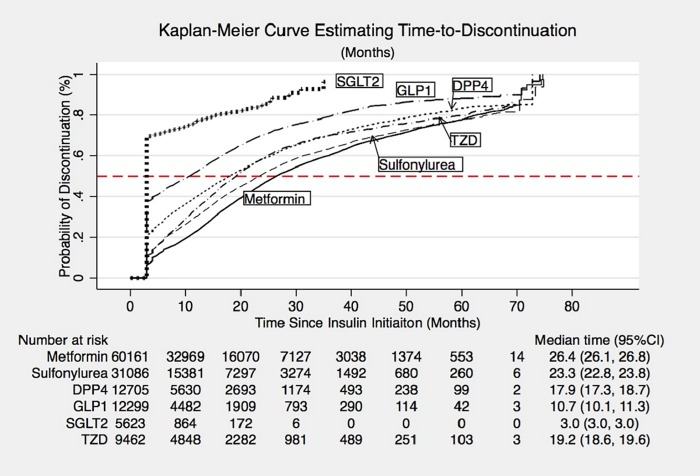
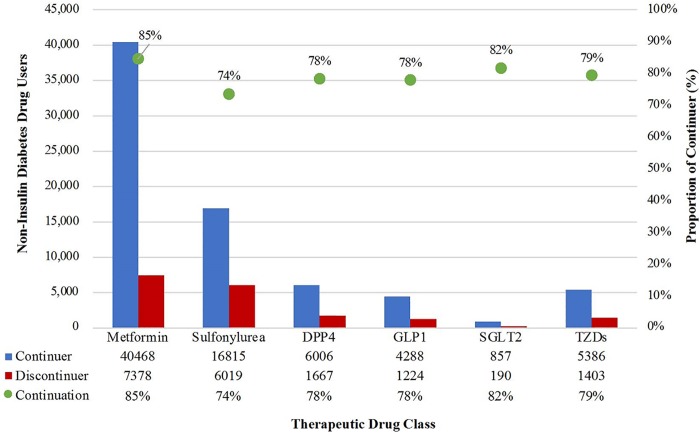
Metformin was the most common non-insulin medication used prior to insulin initiation (N = 53,017, 72.7%), followed by sulfonylureas (N = 25,439, 34.9%) and DPP4 inhibitors (N = 8,540, 11.7%). More than four out of five patients (N = 65,902, 84.7%) refilled prescriptions for any non-insulin diabetes medications within 90 days after insulin initiation. Within that period, metformin remained the most common medication with the highest continuation rate of 84.6%, followed by SGLT2 inhibitors (81.9%) and TZDs (79.3%). Sulfonylureas were the least likely medications to be continued (73.6% continuation) though they remained the second most common medication class used after insulin initiation. The median time to discontinuation varied by therapeutic class from the longest time to discontinuation of 26.4 months among metformin users to the shortest (3.0 months) among SGLT2 inhibitor users.
While metformin was commonly continued among commercially insured adults starting insulin, rates of continuation of other non-insulin diabetes medications were also high. Further studies are needed to determine the comparative effectiveness and safety of continuing insulin secretagogues and newer diabetes medications after insulin initiation.
临床指南建议,2 型糖尿病患者在开始使用胰岛素后继续使用二甲双胍,但对于在此情况下,二甲双胍或其他非胰岛素类糖尿病药物的继续使用频率知之甚少。
我们进行了一项回顾性队列研究,以评估在开始使用胰岛素的 2 型糖尿病患者中,六大类非胰岛素类糖尿病药物(双胍类药物[二甲双胍]、磺酰脲类、噻唑烷二酮类[TZDs]、胰高血糖素样肽 1 受体激动剂[GLP1 受体激动剂]、二肽基肽酶 4 抑制剂[DPP4 抑制剂]和钠-葡萄糖共转运蛋白抑制剂[SGLT2 抑制剂])的使用频率和使用模式。我们使用了 2010-2015 年 MarketScan 商业索赔和就诊数据,对 72971 名年龄在 18-65 岁之间的 2 型糖尿病患者进行了研究,这些患者在开始使用胰岛素前的 90 天内已经开具了非胰岛素类糖尿病药物的处方。我们的主要结局是在开始使用胰岛素后的 90 天内,患者重新开处方使用各种非胰岛素类糖尿病药物的比例。我们还使用生存时间分析来描述特定药物类别的停药时间。
在开始使用胰岛素之前,最常用的非胰岛素药物是二甲双胍(N=53017,72.7%),其次是磺酰脲类(N=25439,34.9%)和 DPP4 抑制剂(N=8540,11.7%)。超过五分之四的患者(N=65902,84.7%)在开始使用胰岛素后的 90 天内重新开了非胰岛素类糖尿病药物的处方。在此期间,二甲双胍仍然是最常用的药物,其续用率最高,为 84.6%,其次是 SGLT2 抑制剂(81.9%)和 TZDs(79.3%)。磺酰脲类药物是最不可能续用的药物(续用率为 73.6%),尽管它们仍然是继胰岛素之后第二常用的药物类别。每种治疗类别的停药中位时间不同,从二甲双胍使用者最长的 26.4 个月到 SGLT2 抑制剂使用者最短的 3.0 个月。
虽然在开始使用胰岛素的商业保险成年人中,二甲双胍通常会继续使用,但其他非胰岛素类糖尿病药物的续用率也很高。需要进一步研究来确定在开始使用胰岛素后继续使用胰岛素促分泌剂和新型糖尿病药物的相对有效性和安全性。