HealthCore, Inc., 123 Justison St, Suite 200, Wilmington, DE, 19801, USA.
AIM Specialty Health, Chicago, IL, USA.
Cardiovasc Diabetol. 2017 Jul 31;16(1):93. doi: 10.1186/s12933-017-0575-x.
Newer oral antidiabetic drug classes are expanding treatment options for type 2 diabetes mellitus (T2DM); however, concerns remain. The objective was to assess relative risk of heart failure hospitalization of sodium-glucose co-transporter-2 (SGLT2) and dipeptidyl peptidase-4 (DPP4) inhibitors in T2DM patients.
This retrospective observational study used a national commercially insured claims database. Adults (>18 years) with T2DM newly starting SGLT2 or DPP4 medication between April 2013 and December 2014 were included. Depending on their index fill, patients were grouped into either SGLT2 or DPP4 medication class cohorts. The primary outcome was hospitalization for heart failure and the risk was assessed using Cox regression models. Propensity score matching (1:2 ratio) was used to adjust for potential confounders. Analyses were also stratified by the presence of baseline diabetes complication and age (<65 vs 65+).
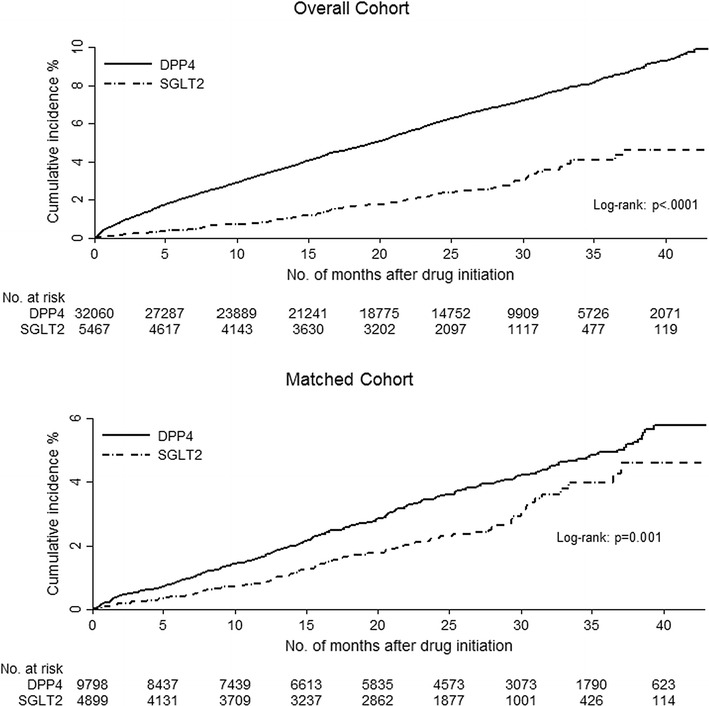
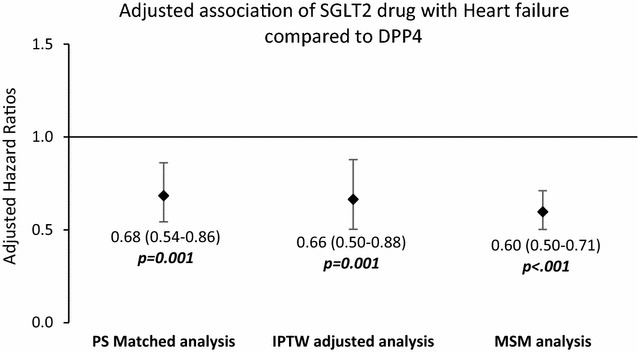
The matched cohort included 4899 SGLT2 and 9798 DPP4 users. The risk of heart failure hospitalization was lower among SGLT2 users in comparison with matched DPP4 users (2.0% SGLT2 vs 3.1% DPP4; adjusted hazard ratio [aHR] 0.68; 95% confidence interval [CI] 0.54-0.86; p = .001). However, the stratified analyses revealed no risk difference among the majority of the analyzed patients, i.e., those aged <65, which comprised 85% of the matched cohort (aHR = 0.78; 95% CI 0.57-1.05; p = .09), and those without prior complication, which comprised 69% of matched cohort (aHR = 0.83; 95% CI 0.54-1.27; p = 0.40).
In this real-life analysis, the rate of hospitalizations for heart failure was significantly lower for patients initiating an SGLT2 compared with a DPP4 medication, specifically among older patients and those with diabetes complication.
新型口服降糖药种类繁多,为 2 型糖尿病(T2DM)的治疗提供了更多选择;然而,人们仍存在一些担忧。本研究旨在评估钠-葡萄糖协同转运蛋白 2(SGLT2)和二肽基肽酶 4(DPP4)抑制剂在 T2DM 患者中心衰住院的相对风险。
这是一项回顾性观察性研究,使用了全国商业保险索赔数据库。纳入 2013 年 4 月至 2014 年 12 月期间新开始服用 SGLT2 或 DPP4 药物的 T2DM 成年患者(>18 岁)。根据他们的索引填充情况,患者被分为 SGLT2 或 DPP4 药物类别队列。主要结局为心力衰竭住院,使用 Cox 回归模型评估风险。采用倾向评分匹配(1:2 比例)调整潜在混杂因素。还按基线糖尿病并发症和年龄(<65 岁与≥65 岁)进行分层分析。
匹配队列包括 4899 例 SGLT2 使用者和 9798 例 DPP4 使用者。与匹配的 DPP4 使用者相比,SGLT2 使用者心力衰竭住院的风险较低(2.0% SGLT2 与 3.1% DPP4;调整后的危险比[aHR]0.68;95%置信区间[CI]0.54-0.86;p=0.001)。然而,分层分析显示,在大多数分析患者中,即年龄<65 岁的患者(占匹配队列的 85%)和无既往并发症的患者(占匹配队列的 69%)中,风险无差异,(aHR=0.78;95%CI 0.57-1.05;p=0.09)和(aHR=0.83;95%CI 0.54-1.27;p=0.40)。
在这项真实世界的分析中,与起始 DPP4 药物治疗相比,起始 SGLT2 药物治疗的患者心力衰竭住院率显著降低,特别是在老年患者和有糖尿病并发症的患者中。